
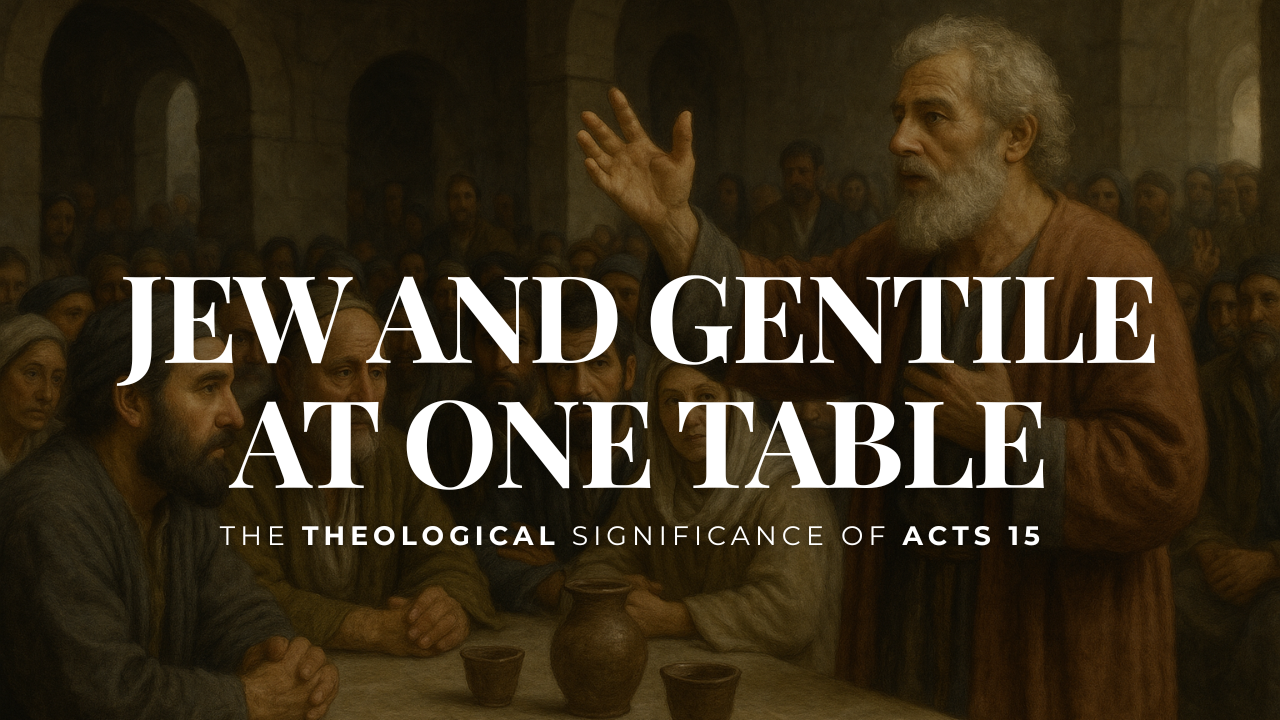
Abstract
This article revisits the Apostolic Decree of Acts 15:20, in which the Jerusalem Council directed Gentile believers to abstain from pollutions of idols, fornication, things strangled, and blood. These four prohibitions are examined within their Jewish cultural and theological context, engaging Second Temple Judaism, Levitical purity codes, and later rabbinic Noahide traditions. The analysis explores whether these requirements were intended as conditions for salvation, as pragmatic accommodations for fellowship between Jewish and Gentile believers, or as ethical imperatives for all Christians. By placing the decree within its historical setting, this study argues that these stipulations represent a pastoral strategy to maintain unity without undermining the gospel of grace. All Scripture references are drawn from the King James Version unless otherwise noted.
Acts 15 and the Question of Gentile Inclusion
The fifteenth chapter of Acts records one of the most critical junctures in the history of the early church. As Gentiles began to respond to the gospel in increasing numbers, the fledgling movement faced a theological and cultural crisis: must Gentile converts submit to circumcision and keep the law of Moses in order to be fully included in the covenant community of God’s people? Certain Jewish believers, particularly those from the sect of the Pharisees, insisted upon this requirement, declaring, “That it was needful to circumcise them, and to command them to keep the law of Moses” (Acts 15.5). This position reflected centuries of Jewish self-understanding rooted in covenantal fidelity expressed through Torah observance, circumcision, and ritual purity. As N.T. Wright observes, “The question of Gentile inclusion was not about adding a few outsiders to an otherwise unchanged Israel; it was about whether the God of Israel was now doing something radically new in Christ.”[1]
The Jerusalem Council’s resolution to this debate was both decisive and nuanced. The apostles and elders, under the guidance of the Holy Spirit, opted not to impose the Mosaic law upon Gentile believers but instead required them to abstain from four practices: “That they abstain from pollutions of idols, and from fornication, and from things strangled, and from blood” (Acts 15:20). These prohibitions, reaffirmed in Acts 15:29 and Acts 21:25, have long been the subject of exegetical and theological reflection. Were they to be understood as conditions of salvation? Were they a means of facilitating table fellowship between Jewish and Gentile believers? Or did they represent universal moral imperatives that remain binding on all Christians?
To answer these questions, it is necessary to examine the Jewish roots of these prohibitions. The four commands bear a striking resemblance to the laws found in Leviticus 17–18, often referred to as the Holiness Code, and to the Noahide laws later codified in rabbinic tradition.[2] They reflect concerns central to Jewish identity in the Second Temple period: monotheism, sexual purity, and dietary distinctiveness.[3] For a Jewish-Christian audience, these prohibitions would have resonated deeply as markers of covenant faithfulness and social integrity. Craig Keener notes, “The decree reflects Jewish ethical priorities in a way that would enable Jewish believers to maintain fellowship with Gentile Christians without compromising their own halakhic sensitivities.”[4]
This article argues that the Apostolic Decree was not intended as a new legalistic standard for Gentile believers but as a pastoral accommodation designed to preserve the unity of the body of Christ in a highly polarized cultural setting. By reframing the prohibitions through a Jewish-Christian lens, we can appreciate their significance as an early example of contextual theology—balancing doctrinal truth with cultural sensitivity. This approach also provides a model for the contemporary church as it navigates questions of unity and diversity in a global context.
The Jewish Roots of the Four Prohibitions
The four prohibitions articulated in Acts 15:20—abstaining from pollutions of idols, fornication, things strangled, and blood—are far from arbitrary. Their selection reflects a careful engagement with Jewish law and tradition, particularly with regard to maintaining communal purity and covenant fidelity. At first glance, these instructions appear closely aligned with the stipulations outlined in Leviticus 17–18, often referred to as the Holiness Code. In Leviticus 17:10–14, God commands that no Israelite or stranger within Israel’s gates shall eat blood, for “the life of the flesh is in the blood” (v. 11). Similarly, Leviticus 17:15 prohibits eating animals that die naturally or are torn by beasts, practices that Gentiles in the ancient world often ignored. By echoing these laws, the Apostolic Decree establishes a baseline for Gentile behavior that avoids offenses most likely to hinder fellowship with Torah-observant Jewish believers.[5]
Furthermore, many scholars observe that these prohibitions resonate with what later rabbinic literature identified as the Noahide laws—seven universal commandments given to all humanity through Noah. Though these laws were codified after the time of Acts, the concept of Gentiles observing minimal moral and cultic standards was already present in Second Temple Jewish thought.[6] As Ben Witherington III notes, “These four prohibitions may be viewed as a halakhic compromise derived from Jewish notions of what Gentiles must observe to reside in the midst of Jews without defiling the community.”[7] By abstaining from idolatry and sexual immorality, Gentile believers affirmed their allegiance to the God of Israel, rejecting the pagan cultic practices so pervasive in Greco-Roman society. The dietary restrictions, meanwhile, mitigated concerns about ritual impurity that could arise from shared meals between Jewish and Gentile Christians.
The prohibition against “pollutions of idols” underscores the foundational Jewish commitment to monotheism. In a polytheistic culture where temple banquets and meat sacrificed to idols were common, abstention from such practices was essential. Paul later addresses the complexities of this issue in 1 Corinthians 8–10, affirming Gentile freedom while warning against actions that might cause others to stumble.[8] The second prohibition, “fornication” (Greek: πορνεία), likely refers not only to general sexual immorality but also to specific illicit unions forbidden in Leviticus 18, such as incestuous relationships, adultery, and cultic prostitution.[9] These prohibitions, deeply embedded in the moral fabric of Jewish law, would have served as non-negotiable markers of covenantal ethics for the early church.
The final two prohibitions—abstaining from things strangled and from blood—are dietary in nature and directly tied to Levitical commands concerning the sacredness of blood. Ancient methods of slaughter among Gentiles often left blood in the meat, which was abhorrent to Jewish sensibilities.[10] To Jewish believers, consuming such meat symbolized a disregard for the sanctity of life and the covenantal distinctions between Israel and the nations. Craig Keener observes, “These dietary restrictions were not intended as universal moral laws but as concessions to maintain fellowship between Jewish and Gentile believers in a context where eating together carried profound covenantal significance.”[11] Thus, these prohibitions, drawn from Jewish law, functioned as a means of enabling cross-cultural unity without imposing full Torah observance on Gentile Christians.
Salvation by Grace, Fellowship by Accommodation
The Jerusalem Council’s decision in Acts 15 reflects a deliberate distinction between salvation as the work of divine grace and fellowship as a lived reality within the multicultural body of Christ. Peter’s testimony before the assembly is unequivocal: “But we believe that through the grace of the Lord Jesus Christ we shall be saved, even as they” (Acts 15:11). This assertion places salvation firmly on the basis of God’s grace through faith, apart from works of the law.[12] The council, therefore, did not impose the four prohibitions as prerequisites for entering the covenant community of God’s people. Rather, these guidelines functioned as practical measures to preserve table fellowship and unity between Jewish and Gentile believers in an ecclesia still deeply shaped by Jewish categories of purity and holiness. As F.F. Bruce explains, “The decree was not intended as a legalistic requirement for salvation, but as a necessary concession to Jewish sensitivities, in the interest of peace and fellowship.”[13]
The central issue at stake was not only doctrinal but also social and relational. In the first-century context, meals were not merely acts of nourishment but symbolic expressions of fellowship and belonging. To share a table implied mutual acceptance and solidarity. Yet for Jewish believers committed to the dietary laws of the Torah, sitting at the same table with Gentiles who consumed food sacrificed to idols or meat improperly slaughtered was unthinkable. The four prohibitions provided a minimal standard of conduct that enabled such fellowship without demanding full Torah observance from Gentile converts. As Darrell Bock observes, “The decree allowed the Gentiles to avoid practices most offensive to Jews, thus fostering unity without compromising the gospel’s freedom from the law.”[14] This pastoral strategy preserved the integrity of the Jewish believers’ conscience while affirming the Gentiles’ inclusion in Christ apart from the works of the law.
It is important to note that Paul, though a defender of Gentile liberty, upheld the spirit of this decree in his own ministry. In 1 Corinthians 8–10, he navigates the complexities of eating food sacrificed to idols. While affirming that “an idol is nothing in the world” (1 Cor. 8:4), he nevertheless warns against participating in idolatrous feasts and causing weaker brothers to stumble. Similarly, in Romans 14, Paul advocates for deference to the consciences of others regarding dietary practices, encapsulating the principle of mutual accommodation.[15] These passages reveal Paul’s pastoral sensitivity to the cultural and ethical concerns addressed in Acts 15, even as he maintains the primacy of salvation by grace through faith in Jesus Christ. As N.T. Wright comments, “Paul’s theology of freedom was never an excuse for cultural insensitivity; rather, it was the foundation for a radical ethic of love and mutual submission.”[16]
Thus, the four prohibitions of Acts 15 function as a paradigm of contextual theology, illustrating how the early church negotiated the tension between doctrinal truth and cultural diversity. The council did not compromise the gospel by imposing legalistic requirements but upheld its universality by providing a practical framework for unity in the midst of deep cultural divisions. This model remains instructive for the contemporary church, which likewise faces the challenge of embodying the gospel across diverse cultures without surrendering its core convictions. As Craig Keener notes, “The council’s wisdom lay in its ability to affirm Gentile freedom while calling for a restraint motivated by love—a balance still needed today.”[17]
Full Acceptance as Brothers?
The Apostolic Decree of Acts 15 raises an important question regarding the nature of Gentile inclusion within the covenant community: did these four prohibitions mark Gentile believers as second-class citizens in the body of Christ, or did they affirm their full status as brothers and sisters in the Lord? Some interpreters have argued that the decree represents a kind of compromise, where Gentiles were admitted into the ecclesia but under restrictions that maintained a hierarchy privileging Jewish Christians.[18] However, such a reading is not supported by the broader witness of Acts or the Pauline corpus. The council’s decision came on the heels of Peter’s testimony that God “put no difference between us and them, purifying their hearts by faith” (Acts 15:9). This declaration, grounded in the gift of the Holy Spirit to Cornelius’ household (Acts 10:44–48), signals that Gentile believers were not merely guests in God’s household but full participants in the new covenant inaugurated by Christ.
James’ speech in Acts 15:13–21 provides further evidence of the Gentiles’ full acceptance. Citing Amos 9:11–12, James envisions the restoration of David’s fallen tent so that “the residue of men might seek after the Lord, and all the Gentiles, upon whom my name is called” (Acts 15:17). This prophetic fulfillment underscores the universality of God’s salvific plan and the equal standing of Jew and Gentile within the messianic community. As Richard Bauckham observes, “James interprets the Gentile mission not as an addendum to God’s covenant with Israel but as its eschatological expansion.”[19] The four prohibitions, then, were not barriers to full inclusion but practical measures to ensure peaceful coexistence within a church composed of culturally diverse members.
It is crucial to recognize the pastoral dynamics at work in the Apostolic Decree. While Gentile believers were justified by faith alone, their behavior could not be divorced from the communal realities of life within a predominantly Jewish-Christian assembly. The prohibitions against idolatry, fornication, and consuming blood or strangled meat were designed to prevent scandal and offense among Jewish Christians still zealous for the law. As Ben Witherington notes, “The decree’s aim was not to restrict Gentile liberty per se but to exercise love that considered the consciences of Jewish brethren.”[20] Far from suggesting partial acceptance, these instructions reflect Paul’s later exhortation in 1 Corinthians 10:23–24: “All things are lawful for me, but all things are not expedient: all things are lawful for me, but all things edify not. Let no man seek his own, but every man another’s wealth.”
Thus, the Apostolic Decree embodies the principle articulated in Ephesians 2:14–16, where Christ “is our peace, who hath made both one, and hath broken down the middle wall of partition between us.” The unity of Jew and Gentile in Christ required mutual deference and the laying aside of culturally offensive practices. In this light, the four prohibitions should be understood not as signs of Gentile inferiority but as acts of self-giving love for the sake of ecclesial harmony. As Craig Keener rightly concludes, “The decree served as a bridge, not a barrier, affirming the equal status of Gentile believers while enabling practical fellowship with Jewish Christians.”[21]
Are These Standards Binding Today?
The question of whether the four prohibitions outlined in Acts 15 retain binding authority for the contemporary church has generated substantial theological debate. Some branches of Eastern Orthodoxy have historically viewed the Apostolic Decree as permanently normative for Gentile believers, rooted in continuity with the moral and ritual expectations of the early church.[22] In contrast, many in the Western tradition—including Augustine and later the Reformers—understood these restrictions as temporary measures designed to preserve fellowship between Jewish and Gentile Christians in a unique historical moment following Pentecost.[23] These differing perspectives reveal a deeper tension: whether the decree is a timeless ethical mandate or a contextual concession aimed at ecclesial unity.
The content of the decree itself supports a distinction between enduring moral imperatives and culturally-bound ritual concerns. Prohibitions against idolatry and sexual immorality reflect moral standards grounded in God’s unchanging character and are consistently reaffirmed in Paul’s epistles as incompatible with the life of the Spirit (cf. 1 Cor. 6:9–10; Gal. 5:19–21). In contrast, the dietary restrictions—avoiding blood and things strangled—appear to reflect sensitivity to Jewish concerns, rather than a permanent rule. Jesus declared all foods clean (Mark 7:19), and Paul taught that nothing is unclean in itself, though believers should abstain from practices that cause others to stumble (Rom. 14:14–15).
The Jerusalem Council’s decision was therefore not a universal legal code, but a model of gospel-centered accommodation. As F.F. Bruce explains, the decree was pastoral, not juridical—a wise effort to avoid offense and preserve fellowship in a multi-ethnic church.[24] It exemplified the principle that liberty in Christ must be exercised in love, especially where conscience and cultural background intersect.
Today, while the specific ritual restrictions of Acts 15 are no longer binding in most Christian contexts, the underlying ethic remains essential. The early church demonstrated how to balance doctrinal truth with relational unity. The Apostolic Decree is not merely a first-century artifact—it is a reminder that Christian maturity involves surrendering personal rights for the sake of the body of Christ.
Theological Implications for the Church
The Apostolic Decree of Acts 15 offers profound insights into the nature of the church as a multicultural and covenantal community. At its core, the decree underscores that salvation is grounded in divine grace, not in ethnic identity or ritual observance. As Peter affirmed before the council, “But we believe that through the grace of the Lord Jesus Christ we shall be saved, even as they” (Acts 15:11). This declaration remains foundational for Christian theology: neither circumcision nor uncircumcision, neither Torah observance nor cultural assimilation, can justify humanity before God.[25] The early church’s recognition of Gentile inclusion apart from the law exemplifies the radical scope of the gospel. It also reinforces the Pauline vision articulated in Galatians 3:28: “There is neither Jew nor Greek…for ye are all one in Christ Jesus.” This theological unity is not a call to cultural uniformity but to shared participation in the life of Christ.
The decree also serves as a paradigm for negotiating cultural and ethical diversity within the body of Christ. By instructing Gentile believers to abstain from practices offensive to Jewish Christians, the apostles modeled a pastoral sensitivity that prioritized unity without compromising doctrinal integrity. As Ben Witherington notes, “The early church recognized that gospel liberty is not a license for cultural insensitivity but a call to mutual deference and love.”[26] This ethic challenges contemporary churches—especially in globalized and pluralistic contexts—to discern how to embody the gospel in ways that honor cultural particularities while maintaining fidelity to biblical truth. The principle of voluntarily limiting one’s freedom for the sake of others, as Paul later elaborates in 1 Corinthians 9:19–23, remains an indispensable component of Christian discipleship.
Furthermore, the Apostolic Decree highlights the necessity of Spirit-led discernment in addressing new theological and cultural challenges. The council’s conclusion, introduced with the phrase “For it seemed good to the Holy Ghost, and to us” (Acts 15:28), reflects an ecclesiology grounded in the Spirit’s active guidance of the community.[27] This dynamic interplay between Scripture, tradition, and the Spirit provides a model for how the church can navigate contested issues today. As Craig Keener observes, “The Jerusalem Council stands as a prototype of how the Spirit directs the church to maintain gospel fidelity in changing cultural landscapes.”[28] Such an approach resists rigid legalism on the one hand and uncritical accommodation on the other, charting a path of faithful contextualization.
Finally, the decree challenges the church to embrace its vocation as a reconciled and reconciling community. The early church’s struggle to integrate Gentiles into a covenantal framework shaped by Jewish categories mirrors contemporary struggles to reconcile diverse peoples, traditions, and social identities within the body of Christ. The breaking down of “the middle wall of partition” (Eph. 2:14) demands an ongoing commitment to unity rooted in the cross of Christ. As Richard Bauckham aptly states, “The inclusion of the Gentiles is not a peripheral theme but lies at the heart of God’s eschatological purposes.”[29] The Apostolic Decree thus continues to speak prophetically, reminding the church that its witness depends not merely on doctrinal orthodoxy but on the visible love and unity of its members across lines of difference.
Conclusion
The Apostolic Decree recorded in Acts 15 represents a decisive moment in the church’s history, where the early leaders, under the guidance of the Holy Spirit, discerned a path forward that upheld both the radical grace of the gospel and the practical need for unity in a culturally diverse community. The four prohibitions—abstaining from pollutions of idols, fornication, things strangled, and blood—emerged not as salvific requirements but as wise pastoral accommodations. They addressed the cultural tensions between Jewish and Gentile believers, allowing for shared fellowship without compromising the freedom Christ had secured for all.
Examined through a Jewish lens, these prohibitions reveal their deep roots in Torah and Second Temple Jewish thought. They reflect concerns about idolatry, sexual immorality, and ritual purity that were central to Jewish identity. Yet, they also point forward to the inclusive vision of the new covenant community where Jew and Gentile alike are “fellowcitizens with the saints, and of the household of God” (Eph. 2:19). The decision of the Jerusalem Council thus models for the church a Spirit-led process of theological discernment, one that balances doctrinal fidelity with cultural sensitivity and practical wisdom.
For the contemporary church, the Apostolic Decree continues to offer a paradigm for navigating questions of unity and diversity. While the specific cultural context of the first-century Jewish-Gentile divide may differ from today’s challenges, the underlying principles remain relevant. The church is called to embody a unity that respects cultural differences without surrendering the universality of the gospel. As the global body of Christ grows increasingly diverse, Acts 15 reminds us that love often requires the voluntary limitation of liberty for the sake of others and that true fellowship demands humility and mutual accommodation.
In an age where the church often struggles with fragmentation and division, the example of the Jerusalem Council challenges us to pursue peace, to listen attentively to the Spirit, and to prioritize the visible unity of God’s people. The breaking down of the wall of partition in Christ is not merely a theological truth to be affirmed but a lived reality to be enacted in every generation.
Bibliography
Bruce, F. F. The Book of Acts. New International Commentary on the New Testament. Grand Rapids: Eerdmans, 1988.
Bauckham, Richard. Jesus and the Eyewitnesses: The Gospels as Eyewitness Testimony. Grand Rapids: Eerdmans, 2006.
Bock, Darrell L. Acts. Baker Exegetical Commentary on the New Testament. Grand Rapids: Baker Academic, 2007.
Dunn, James D. G. The Theology of Paul the Apostle. Grand Rapids: Eerdmans, 1998.
France, R. T. The Gospel of Mark: A Commentary on the Greek Text. New International Greek Testament Commentary. Grand Rapids: Eerdmans, 2002.
Hays, Richard B. The Moral Vision of the New Testament: Community, Cross, New Creation. San Francisco: HarperSanFrancisco, 1996.
Keener, Craig S. Acts: An Exegetical Commentary. 4 vols. Grand Rapids: Baker Academic, 2012–2015.
Luther, Martin. Lectures on Galatians (1535). In Luther’s Works, Vol. 26. Edited by Jaroslav Pelikan. St. Louis: Concordia, 1963.
Marshall, I. Howard. Acts: An Introduction and Commentary. Tyndale New Testament Commentaries. Downers Grove: IVP Academic, 2008.
Meyendorff, John. Byzantine Theology: Historical Trends and Doctrinal Themes. New York: Fordham University Press, 1974.
Witherington, Ben III. The Acts of the Apostles: A Socio-Rhetorical Commentary. Grand Rapids: Eerdmans, 1998.
Wright, N. T. Paul and the Faithfulness of God. Christian Origins and the Question of God, Vol. 4. Minneapolis: Fortress Press, 2013.
[1] N.T. Wright, Paul and the Faithfulness of God (Minneapolis: Fortress Press, 2013), 1123
[2] Joseph A. Fitzmyer, Acts of the Apostles: A New Translation with Introduction and Commentary, Anchor Bible 31 (New York: Doubleday, 1998), 558–560
[3] Richard Bauckham, “James and the Gentiles (Acts 15.13–21),” History, Literature, and Society in the Book of Acts, ed. Ben Witherington III (Cambridge: Cambridge University Press, 1996), 168–186
[4] Craig S. Keener, Acts: An Exegetical Commentary, vol. 3 (Grand Rapids: Baker Academic, 2014), 2247
[5] Joseph A. Fitzmyer, The Acts of the Apostles: A New Translation with Introduction and Commentary, Anchor Bible 31 (New York: Doubleday, 1998), 558–560
[6] Richard Bauckham, “James and the Gentiles (Acts 15.13–21),” in History, Literature, and Society in the Book of Acts, ed. Ben Witherington III (Cambridge: Cambridge University Press, 1996), 168–186
[7] Ben Witherington III, The Acts of the Apostles: A Socio-Rhetorical Commentary (Grand Rapids: Eerdmans, 1998), 464
[8] N. T. Wright, Paul and the Faithfulness of God (Minneapolis: Fortress Press, 2013), 1127–1129
[9] F. F. Bruce, The Book of Acts, New International Commentary on the New Testament (Grand Rapids: Eerdmans, 1988), 303–305
[10] Darrell L. Bock, Acts, Baker Exegetical Commentary on the New Testament (Grand Rapids: Baker Academic, 2007), 507–508
[11] Craig S. Keener, Acts: An Exegetical Commentary, vol. 3 (Grand Rapids: Baker Academic, 2014), 2249
[12] Joseph A. Fitzmyer, The Acts of the Apostles: A New Translation with Introduction and Commentary, Anchor Bible 31 (New York: Doubleday, 1998), 561
[13] F. F. Bruce, The Book of Acts, New International Commentary on the New Testament (Grand Rapids: Eerdmans, 1988), 306
[14] Darrell L. Bock, Acts, Baker Exegetical Commentary on the New Testament (Grand Rapids: Baker Academic, 2007), 509
[15] Ben Witherington III, Conflict and Community in Corinth: A Socio-Rhetorical Commentary on 1 and 2 Corinthians (Grand Rapids: Eerdmans, 1995), 192–194
[16] N. T. Wright, Paul and the Faithfulness of God (Minneapolis: Fortress Press, 2013), 1130
[17] Craig S. Keener, Acts: An Exegetical Commentary, vol. 3 (Grand Rapids: Baker Academic, 2014), 2251
[18] James D. G. Dunn, The Acts of the Apostles (Valley Forge: Trinity Press International, 1996), 207
[19] Richard Bauckham, “James and the Gentiles (Acts 15.13–21),” in History, Literature, and Society in the Book of Acts, ed. Ben Witherington III (Cambridge: Cambridge University Press, 1996), 177
[20] Ben Witherington III, The Acts of the Apostles: A Socio-Rhetorical Commentary (Grand Rapids: Eerdmans, 1998), 466
[21] Craig S. Keener, Acts: An Exegetical Commentary, vol. 3 (Grand Rapids: Baker Academic, 2014), 2253
[22] John Meyendorff, Byzantine Theology: Historical Trends and Doctrinal Themes (New York: Fordham University Press, 1974), 196–198
[23] Martin Luther, Lectures on Galatians (1535), in Luther’s Works, Vol. 26, ed. Jaroslav Pelikan (St. Louis: Concordia, 1963), 120–121
[24] F. F. Bruce, The Book of Acts, New International Commentary on the New Testament (Grand Rapids: Eerdmans, 1988), 308
[25] James D. G. Dunn, The Theology of Paul the Apostle (Grand Rapids: Eerdmans, 1998), 340–342
[26] Ben Witherington III, The Acts of the Apostles: A Socio-Rhetorical Commentary (Grand Rapids: Eerdmans, 1998), 468
[27] Darrell L. Bock, Acts, Baker Exegetical Commentary on the New Testament (Grand Rapids: Baker Academic, 2007), 514
[28] Craig S. Keener, Acts: An Exegetical Commentary, vol. 3 (Grand Rapids: Baker Academic, 2014), 2257
[29] Richard Bauckham, “James and the Gentiles (Acts 15.13–21),” in History, Literature, and Society in the Book of Acts, ed. Ben Witherington III (Cambridge: Cambridge University Press, 1996), 183

Leave a Reply