
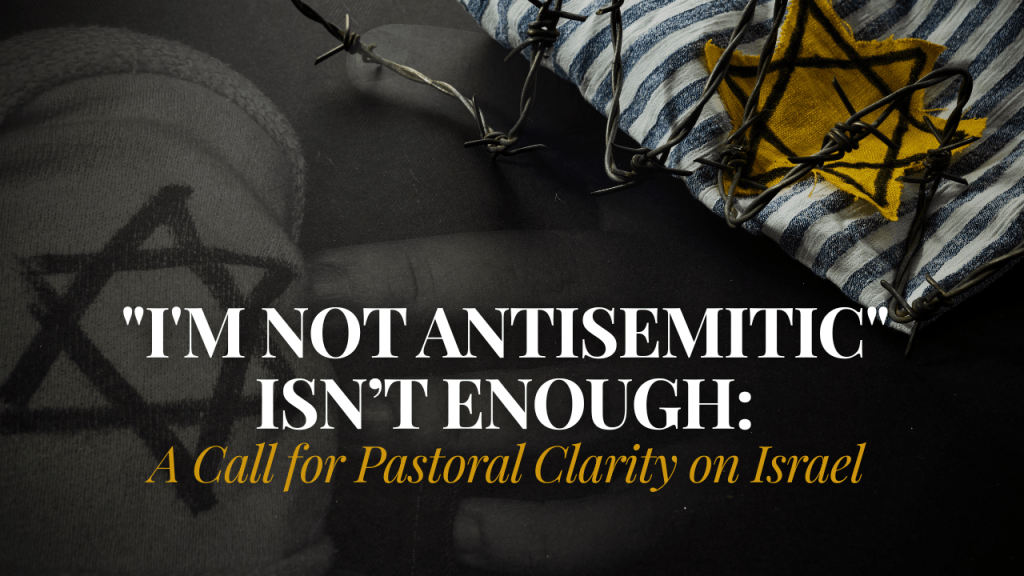
With antisemitism on the rise and confusion about what the Bible teaches, staying silent on Israel isn’t being neutral—it’s stepping back from our calling. This article urges pastors to speak clearly from Scripture, stand on God’s covenant promises, and lead their people with both truth and love.
A Conversation in the Hallway
The Sunday service had ended. As members of the congregation slowly made their way toward the doors, returning to the familiar rhythm of their weekly routines, the pastor stood faithfully in his place, offering warm handshakes and brief words of encouragement. It was a sacred moment of pastoral connection—a time when smiles and blessings are exchanged before the realities of Monday take over.
Yet on this particular Sunday, one exchange stood apart. A faithful church member approached the pastor, leaning in to speak in a low, almost hesitant voice.
“Pastor, I truly appreciated the sermon today. But I have to be honest—while I’m not antisemitic, I do have a problem with rallying support for Israel. With everything I see in the news and on social media, I just can’t bring myself to support them.”
Her words were not spoken with hostility, but with sincerity. She was not challenging Scripture outright, nor questioning her faith. She was wrestling—like many in the Church today—with how to reconcile biblical teaching about Israel with the often-disturbing images, headlines, and narratives that dominate modern media.
This type of conversation has become increasingly common. Pastors across the world—especially in the West—regularly face this same pastoral dilemma. On one hand, they hold a deep, biblically grounded conviction about God’s covenant with Israel. On the other, they recognize that their congregations are constantly bombarded with political rhetoric, half-truths, and polarizing images that can obscure biblical truth.
The challenge for pastors is significant. How does one respond—gracefully yet with theological precision—to such a statement? How does one explain in a brief, hallway conversation that denying Israel’s right to exist is not merely a political stance but a theological one? How does one, in a matter of moments, highlight the enduring nature of God’s covenant with Abraham and his descendants, and its connection to God’s redemptive plan for the nations?
Such questions cannot always be answered in a single conversation. Indeed, this is often the beginning of a deeper pastoral journey—one that will require preaching, teaching, and personal discipleship. The issue of Israel is not simply about modern geopolitics. It is deeply rooted in Scripture, covenant theology, and the Church’s historic mission. It is about understanding that God’s promises are unchangeable (Romans 11:29) and that His purposes for Israel and the nations are inseparably linked (Genesis 12:1–3; Isaiah 49:6).
In 2025, the urgency of this conversation has only grown. Public opinion on Israel is more polarized than at any time in recent history. Social media platforms overflow with quick takes, unverified claims, and emotionally charged narratives. News outlets—both mainstream and alternative—often frame Israel in ways that are politically convenient but theologically misleading. The result is a spiritual confusion that seeps into the Church, tempting believers to adopt secular talking points rather than biblical convictions.
Pastors today must therefore equip themselves with three essential tools:
- Biblical Conviction – A clear, unwavering understanding of the Scriptural witness regarding God’s covenant with Israel, the prophetic significance of her restoration, and the role she plays in God’s plan of redemption.
- Historical Awareness – Knowledge of both the ancient and modern history of Israel, including the long record of antisemitism in Church and world history, so that present-day conflicts can be understood in context rather than isolation.
- Pastoral Strategy – The ability to address sensitive topics with truth and love, meeting congregants where they are, listening with compassion, and guiding them toward a more theologically informed view.
This is not a call for pastors to become political activists. Rather, it is a summons for them to become biblically informed shepherds who can lead their flocks through the noise of the present moment. To “stand with Israel” biblically is not to endorse everything the Israeli government does; it is to affirm God’s covenantal purposes and reject theological or ideological frameworks—such as replacement theology—that undermine them.
In the hallway that day, the pastor had only moments to respond. But over the weeks that followed, he made it a point to weave into his preaching and teaching the truths his congregant needed to hear: that the covenant God made with Abraham remains in effect; that Israel’s existence is not an accident of history but a testimony of God’s faithfulness; and that the Church is called to bless the Jewish people, even in times of controversy.
As pastors, we must be prepared for these hallway conversations. They are not interruptions—they are divine appointments. And in a time when misinformation and spiritual confusion abound, the Church must not remain silent. Our calling is to speak the truth in love, to anchor our people in God’s Word, and to remind them that His promises—both to Israel and to the nations—are as unshakable as the One who made them.
Defining the Difference—And Why It Matters
For pastors navigating difficult conversations about Israel, the first and most crucial step is the ability to speak with clarity and precision. Without well-defined terms, our responses risk addressing shadows rather than substance, emotion rather than reality. Clear definitions anchor the conversation in truth, enabling shepherds to respond both biblically and intelligently to the issues at hand.
Antisemitism is not merely a difference of opinion or a political disagreement; it is a deeply hostile prejudice and discrimination against Jewish people simply for being Jewish. It is one of humanity’s oldest and most persistent hatreds, visible throughout Scripture and history. In the Hebrew Bible, we see it in Pharaoh’s enslavement of the Hebrews (Exodus 1), in Haman’s genocidal plot in Persia (Esther 3), and in the early persecution of Jewish believers in the first century. History’s pages are littered with its tragedies—the Crusades, the Spanish Inquisition, the pogroms of Eastern Europe, the industrial-scale extermination of six million Jews in the Holocaust, and countless other episodes of suffering that remain unrecorded by human hands but are remembered in heaven.
For the Christian, antisemitism is not merely a social or political problem; it is a spiritual assault. Scripture describes Israel as “the apple of His eye” (Zechariah 2:8), a poetic image expressing God’s deep affection and covenantal bond with the Jewish people. To attack them is, in a sense, to poke at the pupil of God’s own eye—an act of defiance not only against a people but against the God who chose them as a vessel for His redemptive purposes. Through Israel came the patriarchs, the prophets, the Scriptures, and ultimately the Messiah Himself (Romans 9:4–5).
Anti-Zionism, by contrast, focuses on opposing or rejecting the idea that the Jewish people have the biblical and historical right to their ancestral homeland, the Land of Israel. While modern discourse often frames Zionism as purely political, detached from ethnic prejudice, in practice the lines blur. Anti-Zionism frequently overlaps with antisemitism because it singles out the Jewish people as uniquely undeserving of national self-determination—a right enjoyed by nearly every other ethnic group in the world.
This distinction is not academic hair-splitting. For pastors, understanding it opens the door to a deeper theological reality: rejecting Israel’s right to exist is not a neutral position; it carries profound spiritual implications. It challenges the permanence of God’s promises in Genesis 17:7–8, Jeremiah 31:35–37, and Romans 11:28–29. If God could revoke His covenant with Israel, then His covenant with the Church would be equally vulnerable. Yet the Apostle Paul’s resounding declaration answers the question unequivocally: “Has God rejected His people? By no means!” (Romans 11:1, ESV).
When pastors grasp this, they are not only equipped to correct misunderstandings; they are also able to anchor their congregations in the unshakable faithfulness of God. Standing with Israel is not merely about geopolitics—it is about affirming the God who keeps His word, yesterday, today, and forever.
Where Anti-Zionism and Antisemitism Meet
Anti-Zionism and antisemitism are not abstract theories or philosophical debates—they are realities with deep roots in history and visible expressions in our world today. Both spring from an ancient and recurring hostility toward the people of God and the land God gave them. Scripture itself records this in Psalm 83:4: “Come, let us cut them off from being a nation, that the name of Israel may be remembered no more.” This ancient sentiment is not a relic of the past; it echoes across centuries in the rhetoric and actions of those determined to erase Israel’s existence.
From the Assyrians and Babylonians to the Romans, Crusaders, Nazis, and—more recently—groups like Hamas, history is filled with those who sought to annihilate the Jewish people and erase their identity from the earth. The methods have varied—military conquest, forced exile, genocide—but the goal has remained chillingly consistent: the removal of the Jewish people as a nation, and in many cases, their eradication as a people altogether. This is not only an assault on human dignity; it is a direct challenge to the covenant promises of God.
In ancient times, the weapons were swords and siege engines. Today, the tools are different but no less destructive—media propaganda, manipulative political resolutions, economic boycotts, campus protests, and carefully framed narratives that present themselves as humanitarian causes while masking a deep-seated hostility. These modern tactics often dress themselves in the language of justice, but beneath the surface lies the same age-old desire: to delegitimize, weaken, and ultimately erase the Jewish state and its people.
Some insist that it is possible to “oppose Israel” without opposing the Jewish people. Yet history, and current reality, show that opposition to Israel’s very existence inevitably spills over into hostility toward Jews worldwide. Anti-Zionism often serves as a veneer for antisemitism, especially when it denies the Jewish people the right to self-determination—a right granted freely to nearly every other ethnic group. This is why pastors, Christian leaders, and believers must be vigilant and well-informed, not only politically but biblically and theologically. To embrace anti-Zionist positions without discernment risks aligning, knowingly or unknowingly, with a spiritual agenda that stands against God’s covenant purposes.
As shepherds entrusted with God’s flock, pastors must guide their congregations to ask hard but necessary questions: Why is Israel’s right to exist questioned more than any other nation on earth? Why is there such a double standard, where other nations’ violations are overlooked while Israel is relentlessly condemned? These are not merely political curiosities; they are signs of a deeper spiritual conflict. Beneath the political tensions, the economic sanctions, and the media spin lies a battle that is not fought merely with flesh and blood, but with powers and principalities that oppose the God of Israel and His plans for His people.
The Spiritual Battle Behind the Headlines
For pastoral leadership to truly engage with the current conversation about Israel, we must look beyond the political headlines and recognize the spiritual dimensions driving them. Too often, discussions about Israel are reduced to geopolitics—treaties, wars, elections, and alliances. While these elements are real, to stop there is to miss the deeper reality beneath it all: a spiritual battle that has been raging since the dawn of history. Scripture pulls back the curtain, showing that behind every political maneuver and every wave of hostility toward the Jewish people is a greater conflict between the purposes of God and the schemes of the enemy.
From the earliest pages of the Hebrew Scriptures, the adversary has sought to derail God’s redemptive plan by attacking the people through whom that plan would come. In Exodus 1:22, Pharaoh of Egypt orders the killing of every Hebrew male infant, hoping to weaken and eventually destroy God’s covenant people. In Esther 3:13, we read of Haman in the Persian Empire—a man whose hatred was so great that he sought the annihilation of all Jews in the 127 provinces of the realm. Moving forward into the Apostolic Writings, the pattern repeats. In Matthew 2:16, Herod orders the slaughter of all male children in Bethlehem in a desperate attempt to prevent the birth of the promised Messiah. These events, separated by centuries, share the same underlying strategy: stop God’s plan by striking at the people He has chosen as His covenant witnesses.
History continues to echo this pattern. Whether under pagan emperors, medieval monarchs, or modern dictators, the goal has remained unchanged: eradicate the Jewish people, nullify God’s covenant, and undermine His credibility before the world. Theologically, the stakes are immense—if Israel were to vanish, so would one of the most visible and enduring testimonies to God’s faithfulness throughout history. The survival of the Jewish people, against all odds and in the face of relentless opposition, is not merely a historical curiosity; it is living evidence that God keeps His promises.
In our present day, this spiritual battle is unfolding in real time. It plays out not only in the violence on the streets or in acts of terror but also in the digital realm—through propaganda on social media, the shaping of public opinion in the press, and the carefully worded resolutions passed in international assemblies. It manifests in the alarming rise of antisemitic incidents on college campuses and in major cities worldwide. These are not isolated flare-ups of hostility; they are expressions of a much older and darker agenda.
As pastors and leaders, we are called to interpret these events through the lens of Scripture. The Apostle Paul reminds us in Ephesians 6:12 that “we wrestle not against flesh and blood, but against principalities, against powers, against the rulers of the darkness of this world, against spiritual wickedness in high places.” Recognizing this truth changes everything—it calls us to respond not with fear or confusion but with spiritual clarity and conviction. Our responsibility is to equip the Church to see the real battle, to stand firm in the truth of God’s Word, and to pray and act in ways that align with His covenant purposes for Israel and the world.
Realities: The Headlines Pastors Can’t Ignore
Theological conversations must take place in real-world contexts. In 2025, the Middle East is not an abstract idea for your congregation; it’s a living news cycle. Pastors who speak about Israel without acknowledging current events risk sounding detached from reality. If your people see famine, warfare, and protests on their screens but hear nothing about them in the pulpit, they will look elsewhere for answers.
The humanitarian crisis in Gaza is a stark example. UN data and humanitarian organizations confirm that famine conditions have taken hold, with more than 122 Palestinians, including 83 children, dying from starvation. Over 28,000 cases of malnutrition have been recorded. These are not speculative numbers; they are verified reports. When pastors talk about loving Israel, they must also talk about loving people in Gaza, because compassion for one group does not require apathy toward another.
The political landscape is equally charged. In August 2025, Israel’s Security Cabinet proposed seizing Gaza City. Germany suspended arms shipments to Israel over humanitarian concerns. Australia signaled it could recognize a Palestinian state unless ceasefire progress occurs. These events are shaping international opinion, and your congregation is reading these headlines. Pretending they don’t exist does not protect your people—it leaves them vulnerable to one-sided narratives.
Within the Church, polling tells another story. A 2025 Pew Research survey shows that 72% of white evangelicals view Israel favorably, yet younger evangelicals are far less certain, with many voicing strong concern over Palestinian suffering. Broader U.S. support for Israel’s conduct in Gaza has dropped to 32% approval, a 10-point decline in just a year. Pastors cannot assume their congregations share their views simply because they share their faith.
This is why you must integrate current events into your biblical teaching—not to politicize the pulpit, but to anchor your people in truth when they are being bombarded with conflicting information. Your goal is not to give them talking points—it’s to give them a biblical worldview robust enough to engage the moment without losing sight of God’s eternal purposes.
Five Foundational Steps for Pastors to Lead Well on the Israel Conversation
The first and most foundational step for any pastor or leader is to be biblically grounded in the covenants God made with Israel. You must be able to clearly explain the promises God gave to Abraham and his descendants—promises that remain active and unbroken to this day. Without a deep and personal understanding of these covenants, hesitation will creep in when you are challenged on why you support Israel. A strong starting point is to prayerfully read and re-read key passages such as Genesis 12, 15, and 17; Jeremiah 31; and Romans 9–11. Take your time. Read slowly. Let the language of Scripture saturate your mind and take root in your heart until you grasp—not just intellectually, but spiritually—what these promises meant for Abraham, for his descendants, and for us today. When the Word forms that foundation in you, you will be able to speak with confidence, clarity, and conviction whenever the need arises.
Second, remember to distinguish between critiquing policies and denying a people’s right to exist. It is wise to regularly say from your pulpit, “Disagreeing with Israel’s government does not mean rejecting the Jewish people’s right to exist and to live in peace in their ancestral homeland.” This distinction is critical. Without it, media narratives can smuggle in anti-Zionist ideas under the false banner of “balanced thinking.” The result is subtle but dangerous—what sounds like fairness is often nothing more than error dressed in appealing language. As shepherds, we must be vigilant in helping our people recognize the difference between legitimate political critique and delegitimizing an entire people’s covenantal identity.
Third, make prayer for the peace of Jerusalem a continual rhythm in your leadership and corporate worship. Psalm 122:6 commands us plainly: “Pray for the peace of Jerusalem: ‘May they prosper who love you.’” This cannot be an occasional mention but should become part of the DNA of your church culture. When your congregation regularly hears intercession for Israel, they begin to understand that biblical prayer for the Jewish people is not political positioning—it is a spiritual obligation. This consistency will also signal to visitors and new believers that your love for Israel flows from the pages of Scripture, not from the platforms of politics.
Fourth, let compassion for all people be the hallmark of your ministry. Publicly supporting Israel will often bring the accusation that you care only for the Jewish people while ignoring others—particularly the Palestinians. This false narrative must be dismantled through both word and deed. Scripture calls us to love mercy and to do justice for all. One powerful way to live this out is by partnering with ministries that serve both Jewish and Arab communities. This shows your congregation—and the watching world—that you stand for righteousness, truth, and compassion without partiality. It also makes clear that your opposition to terrorist regimes like Hamas does not diminish your concern for the suffering of innocent Palestinians who live under their oppression.
Finally, commit to educating your people in both Scripture and history. Many who oppose or feel indifferent toward Israel are not driven by hostility, but by ignorance. They have been shaped by social media soundbites and misleading headlines rather than by the Word of God and the witness of history. Consider creating an “Israel 101” discipleship track—perhaps through small groups or special teaching nights—covering the biblical covenants, key prophecies, the Holocaust, and Israel’s modern wars and challenges. Equip your congregation to see the bigger picture so they can stand with confidence in truth and resist being swayed by misinformation. All of this can be gracefully done, while still holding strong to your convictions about the people of Israel and the covenant promises of God upon them.
When these five steps become part of your pastoral rhythm, you not only prepare your people to respond wisely in the current cultural climate, but you also align your ministry with the enduring purposes of God for Israel and the nations.
Common Objections & How to Answer Them
Objection 1: “I don’t hate Jews; I just don’t support Israel.”
Short Response: “I hear that you don’t want to be hateful. But opposing Israel’s existence as a Jewish state dismisses God’s covenant promise in Genesis 17:7–8. You can critique a government’s policies without denying a nation’s right to exist. The danger comes when we move from political disagreement into theological denial.”
Long Response: This is one of the most common statements you may hear, and on the surface, it sounds reasonable. After all, the person is claiming to distance themselves from hatred, and as pastors or leaders, we should always welcome a rejection of hatred. However, beneath this statement is often a misunderstanding of what “not supporting Israel” can actually mean in theological terms. When someone says they do not support Israel, we must carefully ask, “Do you mean you disagree with certain political policies, or do you mean you question Israel’s right to exist as a Jewish state?”
The difference between those two positions is critical. Scripture makes it clear that the covenant God made with Abraham and his descendants is not a temporary political arrangement but a divine, eternal promise. In Genesis 17:7–8, God says, “And I will establish my covenant between me and thee and thy seed after thee… for an everlasting covenant… and I will give unto thee, and to thy seed after thee… all the land of Canaan, for an everlasting possession; and I will be their God.” To reject Israel’s right to exist as the Jewish homeland is to reject the covenantal promise God Himself swore to uphold.
This is why we must gently but firmly guide people to understand that it is entirely possible—indeed, biblically permissible—to critique a government’s policies without denying the nation’s God-given right to exist. There is a vast difference between policy disagreement and covenant denial. The danger comes when people cross that line, whether knowingly or unknowingly, and begin to dismiss not just modern Israel, but God’s own faithfulness.
As leaders, when we answer this objection, we should start by affirming the person’s stated rejection of hatred. Then we can bring them back to the text of Scripture, showing them that supporting the existence of Israel is not the same thing as endorsing every governmental action. This approach keeps the conversation from becoming a heated political fight and instead redirects it toward God’s unchanging promises.
Objection 2: “The Church is the new Israel.”
Short Response: “Scripture says the Church is grafted in (Romans 11:17–18), but it also says God’s gifts and calling to Israel are irrevocable (Romans 11:29). Grafting in does not mean cutting off the original branch. The Church participates in the blessings, but the promises to Israel as a people remain.”
Long Response: This objection is rooted in a theological idea known as replacement theology, which claims that the Church has replaced Israel in God’s plan. While this teaching has circulated for centuries, it does not align with the full counsel of Scripture. Yes, the New Testament speaks of Gentile believers being “grafted in” to the olive tree of God’s covenant blessings (Romans 11:17–18), but the same chapter makes an unshakable declaration: “For the gifts and calling of God are without repentance” (Romans 11:29).
Paul’s imagery of grafting is key here. Grafting in new branches does not mean cutting off the original ones. The life of the tree flows from its root—the covenant God made with Israel. The Church, composed of both Jews and Gentiles who believe in Christ, participates in the blessings of that covenant. But God has never annulled His promises to Israel as a people. If He could break His word to them, what assurance would we have that He would not break His word to us?
When answering this objection, we must point out that the Apostle Paul warned Gentile believers against arrogance toward the Jewish people. Romans 11:18 says, “Boast not against the branches.” The Church does not erase Israel; rather, it stands as living proof of God’s mercy toward the nations. God’s plan is not a replacement—it is an expansion that will one day culminate in the salvation of “all Israel” (Romans 11:26). The Greek phrase here is πᾶς Ἰσραήλ (pas Israēl), which literally means “the whole of Israel.” Importantly, in Jewish and biblical usage, “all Israel” is often a collective term for the nation as a whole, not every single Jewish individual who has ever lived (e.g., Joshua 7:25; 2 Samuel 16:22). In Romans 11, Paul is speaking of a future, large-scale turning of the Jewish people to their Messiah—a national restoration—without suggesting that every individual will be saved regardless of faith.
Pastorally, we should help people see that replacement theology robs the Church of its Jewish heritage and weakens our trust in God’s faithfulness. The promises to Israel are living reminders that God’s word cannot fail. The Church has been grafted into a story that began long before Pentecost, and our role is to honor the root from which we draw life.
Objection 3: “Supporting Israel means ignoring Palestinian suffering.”
Short Response: “That’s a false choice. We are called to love all people. Micah 6:8 tells us to act justly and love mercy for everyone. We can affirm God’s covenant with Israel and still be deeply concerned about the welfare of Palestinians. In fact, some of the strongest humanitarian work in the region is done by pro-Israel Christians.”
Long Response: This objection presents a false dilemma. It assumes that caring for the Jewish people and supporting Israel’s right to exist automatically means we must be indifferent to the pain of Palestinians. But the Bible calls us to a higher ethic—one that transcends political binaries. Micah 6:8 tells us to “do justly, and to love mercy, and to walk humbly with thy God.” That is not a command to show justice and mercy to some people and not others. It is a call to be a people of compassion to all, while still standing firm in truth.
We can affirm God’s covenant with Israel and simultaneously work for the welfare of Palestinians. These positions are not in conflict when our worldview is rooted in Scripture. In fact, some of the strongest humanitarian work in the Middle East is carried out by Christians who are unapologetically pro-Israel and yet deeply committed to helping those suffering in Gaza and the West Bank. This mirrors the heart of Jesus, who ministered to Jews and Gentiles alike.
In practice, this means rejecting propaganda that tries to portray Christians as uncaring toward one side of the conflict. It also means actively supporting ministries and initiatives that bring relief to both Jewish and Arab communities. This not only disarms the accusation of partiality but also reflects the character of our Lord, who “is no respecter of persons” (Acts 10:34).
When answering this objection, we can say clearly: “Loving Israel does not mean ignoring the suffering of others. It means standing for truth while extending mercy to all who are made in the image of God.” This is a position that is both biblically consistent and morally compelling.
Why This Matters at Your Pulpit
Pastoral silence on the subject of Israel may appear to be an act of peacemaking, yet in reality it creates a theological and informational vacuum. Such a vacuum will not remain empty. It will inevitably be filled by competing voices—voices that may be informed more by political agendas, ideological biases, or cultural trends than by a biblical worldview.
In our digital age, congregations are constantly being shaped by narratives about Israel—whether through TikTok videos, Instagram reels, YouTube commentaries, televised debates, or casual conversations shaped by viral slogans. These messages often lack theological depth and are crafted to appeal emotionally rather than truthfully. If pastors fail to address the matter, their people may uncritically absorb these narratives, often without realizing the theological implications they carry.
Speaking about Israel from the pulpit is not synonymous with politicizing the worship service. Rather, it is an act of fidelity to “the whole counsel of God” (Acts 20:27). This whole counsel necessarily includes God’s covenants with Abraham, Isaac, and Jacob, the prophetic promises concerning the land, and the New Testament’s affirmation of Israel’s place within God’s redemptive plan.
When pastors address Israel biblically, they provide their congregations with a theological anchor—a framework that enables them to interpret events not merely through the lens of the latest headline but through the enduring promises of Scripture. Such instruction helps believers discern the spiritual patterns woven through history and see that God’s dealings with Israel are not isolated episodes but integral to His unfolding plan for the nations.
Ultimately, this approach not only deepens the congregation’s understanding of Scripture but also equips them to engage with the wider culture with conviction rooted in biblical truth and compassion shaped by the heart of Christ.
Conclusion:
Faithfulness in a Time of Confusion
The year 2025 confronts the Church with headlines that unsettle the heart—humanitarian crises, shifting political alliances, and widening divisions among believers themselves. In such an atmosphere, pastors may feel the pull toward silence, hoping to preserve unity by avoiding controversial matters. Yet pastoral silence in these moments is not an act of neutrality; it is, in effect, a relinquishing of the shepherd’s voice at the very time the flock most needs clarity.
The matter of Israel is not ultimately about geopolitics or borders. At its core, it is about the very character of God. If the Lord has kept His covenant with Israel through centuries of dispersion, persecution, and miraculous regathering, then we can be assured that He will keep His promises to His Church. Israel stands as a living monument to God’s covenant faithfulness—a tangible reminder that His Word does not return void.
When a pastor speaks about Israel from a biblical foundation, they are not merely addressing a “political” topic. They are bearing witness to the unchanging nature of God. Each sermon, lesson, or pastoral conversation on this subject becomes a declaration to every believer: the God who keeps His promises to Israel will keep His promises to you.
Furthermore, when objections are met with grace and truth—rooted in Scripture and guided by compassion—congregations learn that biblical conviction does not require abandoning empathy. They see that it is possible to uphold the covenant promises of God while also caring deeply for the suffering of all peoples.
The covenant with Israel remains in effect. The calling upon that nation remains irrevocable. And the pastoral mandate to equip the saints for the work of ministry (Ephesians 4:12) remains unaltered—even when obedience to that mandate requires taking a stand for Israel in a cultural climate that does not understand, or even opposes, that stance.
As Paul reminds us, “For the gifts and the calling of God are without repentance” (Romans 11:29). In times of confusion, faithfulness demands that pastors speak—not with the noise of partisanship, but with the steady voice of Scripture, proclaiming the God whose promises endure to every generation.
Sources
- “Gaza: Israel Must Restore UN Humanitarian System to Stave Starvation, Say UN Experts,” Office of the High Commissioner for Human Rights, August 12, 2025, https://www.ohchr.org/en/press-releases/2025/08/gaza-israel-must-restore-un-humanitarian-system-stave-starvation-say-un.
- “The Malnutrition Crisis in Gaza Will Outlive the War, Experts Warn,” Time, August 9, 2025, https://time.com/7306512/gaza-starvation-malnutrition-crisis-famine-long-term/.
- “Malnutrition Rates Reach Alarming Levels in Gaza, WHO Warns,” World Health Organization, July 27, 2025, https://www.who.int/news/item/27-07-2025-malnutrition-rates-reach-alarming-levels-in-gaza–who-warns.
- Patrick Kingsley, “Israel Intensifies Bombing of Gaza, Killing 89 Palestinians in 24 Hours,” The Guardian, August 12, 2025, https://www.theguardian.com/world/2025/aug/12/israel-intensifies-bombing-of-gaza-dozens-killed-in-24-hours.
- “How Americans View Israel and the Israel–Hamas War at the Start of Trump’s Second Term,” Pew Research Center, April 8, 2025, https://www.pewresearch.org/short-reads/2025/04/08/how-americans-view-israel-and-the-israel-hamas-war-at-the-start-of-trumps-second-term/.
- “Percentage of U.S. Adults Who View Israel Unfavorably Doubled in Past Year,” Jerusalem Post, April 11, 2025, https://www.jpost.com/diaspora/article-849525.



 Dr. Nathan J. Bonilla
Leave a comment