
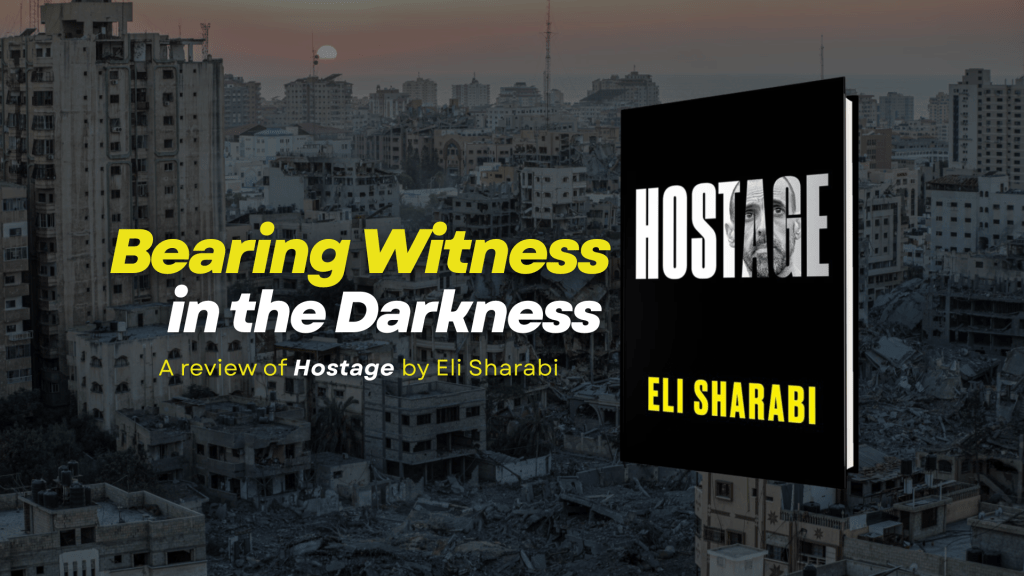
Few memoirs in recent memory have pierced my soul as deeply as Hostage, Eli Sharabi’s account of his 491 days in captivity after Hamas terrorists stormed Kibbutz Be’eri on October 7, 2023. Recently translated into English, it stands as the first firsthand narrative from a survivor of that dark day—an unflinching chronicle of pain, endurance, and faith’s fragile flame in a world unraveling.
Sharabi opens his story in the chaos of that morning—the sirens, the pounding on the door, the fear in his daughters’ eyes. Moments later he is torn from his family, dragged into Gaza, and thrust into an underworld of tunnels and torment. What unfolds is not simply a record of cruelty but a meditation on the human spirit: a father stripped of every comfort yet still clinging to the memory of love as his last possession.
As a father myself, I found these pages almost unbearable. Having walked through a kibbutz ravaged by that same attack, I could feel the weight of grief he describes—the silence that hangs in the air where life once thrived. Sharabi writes with a restrained eloquence that neither sensationalizes nor sanitizes. His suffering is laid bare, but so too is his resolve.
One moment in particular lingers: another hostage whispers, “He who has a why can bear any how.” Those quiet words become Sharabi’s lifeline. In the long, dark nights of captivity, meaning becomes the very air he breathes—thin, fragile, but sustaining. His “why,” the love of his wife and daughters, steadies him when every other certainty gives way. It is a haunting reminder that purpose, even when reduced to a whisper, can hold a soul together when theology and logic fall silent.
Throughout the narrative, Sharabi bears witness not only to physical deprivation but to the quiet miracles of courage and community among the captives. He becomes a source of hope to others, embodying what the apostle Paul called “sorrowful, yet always rejoicing.” His survival is not triumphalist; it is costly, raw, and rooted in grace that defies comprehension.
The moral clarity of Hostage is equally bracing. Sharabi names his captors for what they are—terrorists driven by an ideology of destruction—and he refuses to blur evil into moral equivalence. Reading his account, one cannot help but recoil at the chants that echo in our own streets, slogans that mask annihilation in the language of liberation. His testimony reminds us that to romanticize such violence is to betray the image of God in every human being.
Yet this is not a political polemic. It is, at its heart, a spiritual lament—a modern-day psalm from the pit. When Sharabi is finally freed, only to learn that his wife and daughters did not survive, the reader feels the air leave the room. Liberation becomes another form of captivity. And still, he chooses life. “Hope,” he seems to say, “is not the absence of pain but the refusal to let pain have the final word.”
For the church, Hostage is both mirror and mandate. It calls us to remember the suffering of others not as headlines but as holy ground. It urges us to pray for peace without naivety, to love the Jewish people without condition, and to stand against terror with moral clarity and compassion. Above all, it challenges us to believe that light can still break into the darkest tunnel.
This is not an easy book to read—but that is precisely why it must be read. Eli Sharabi’s testimony will stay with you long after the final page, a haunting and necessary reminder that faith, when refined by fire, still shines.





 Dr. Nathan J. Bonilla
Leave a comment