

This article examines the influence of late nineteenth-century American populism on the religious leadership and ecclesiological development of A.J. Tomlinson, the early Pentecostal figure whose role shaped multiple branches of the Church of God tradition. By situating Tomlinson’s theology within the social and political context of the southern Appalachians, the article demonstrates how populist assumptions informed his suspicion of institutional authority, his anti-educational posture, his doctrine of the one true visible Church, and his interpretation of the 1923 administrative crisis. The article further analyzes how symbolic identity markers, such as the 1933 church flag, and boundary-maintaining practices, including covenantal discipline, contributed to the formation of a sectarian identity in the body that would later become known as the Church of God of Prophecy, which has since undergone significant reform. The persistence of these patterns in derivative splinter groups underscores the lasting impact of populist ecclesiology on Pentecostal identity formation.
Introduction
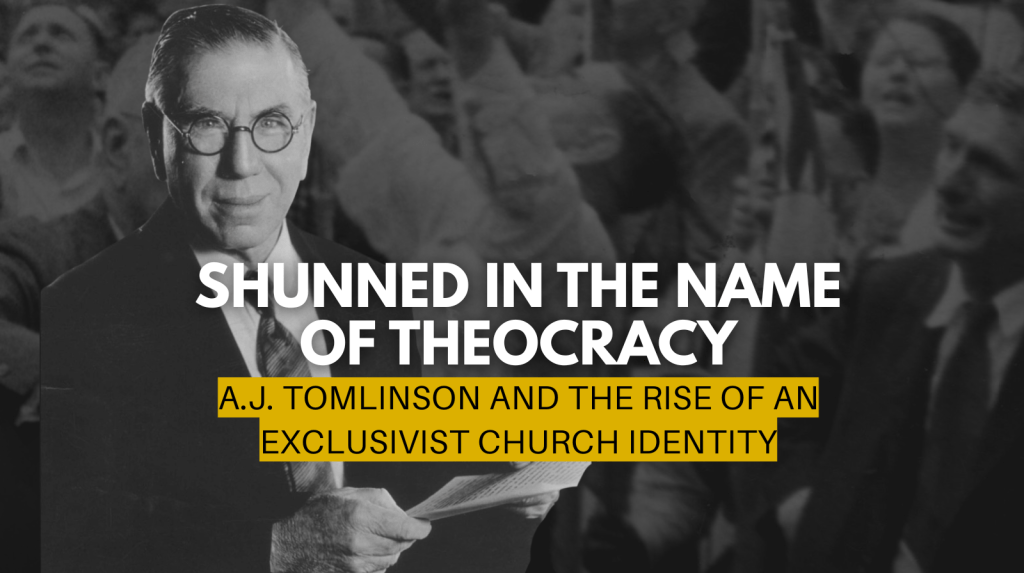
Ambrose Jessup Tomlinson (1865–1943) occupies a central position in the early history of Pentecostalism in the United States, particularly within the Church of God movement originating in the southern Appalachians. His leadership in the formative years of the Church of God at Cleveland, Tennessee, and his subsequent role in the organization that developed under his direction after the administrative rupture of 1923, exerted long-lasting influence on ecclesiology, governance, and identity formation in multiple Pentecostal bodies. While historians have examined Tomlinson’s administrative abilities, charismatic authority, and restorationist theology, less attention has been given to the cultural and political background that shaped his ecclesial worldview.
This article argues that Tomlinson’s ecclesiology was decisively influenced by the populist political culture of the late nineteenth century and that his subsequent leadership cannot be understood apart from this context. Populism, with its suspicion of elites, affirmation of grassroots authority, and emphasis on moral legitimacy derived from “the people,” provided conceptual frameworks later spiritualized in Tomlinson’s doctrine of the one visible Church of God, his opposition to “educated men,” his suspicion of theological institutions, and his interpretation of the 1923 crisis. These patterns contributed to the development of a sectarian identity within the reorganized body under his leadership. Though the body that would later become known as the Church of God of Prophecy has since rejected this sectarianism, the historical roots remain essential for understanding contemporary Pentecostal identity.
Populism and the Southern Appalachian Context
The southern Appalachian region in which Tomlinson was raised was marked by economic insecurity, geographic isolation, and deep distrust of institutional authority.1 Rural families in this environment often relied on subsistence agriculture and local networks rather than state or denominational structures. The late nineteenth century witnessed the rise of American populism, which sought to address the grievances of agricultural workers and rural citizens who felt marginalized by industrial capitalism, railroad monopolies, and distant political elites.2
Populism framed political conflict as a struggle between the virtuous common people and corrupt institutions.3 Tomlinson’s brief involvement in the Populist Party, evidenced by his candidacy for county auditor in 1892, indicates not only ideological sympathy but personal identification with these concerns.4 Populist discourse, which elevated grassroots insight above formal authority, provided a political vocabulary that Tomlinson later translated into ecclesial categories.
Appalachian Holiness revivalism intersected with this sociopolitical environment. Revivalist preachers often drew upon anti-institutional sentiment and promoted experiential religion over theological training.5 In such a setting, a populist political worldview and a revivalist religious ethos reinforced one another. Tomlinson’s early spiritual formation occurred precisely at this intersection, and it shaped his subsequent vision for the church.
The Formation of a Populist Ecclesiology
When Tomlinson joined the Holiness Church at Camp Creek in 1903, he entered a community composed largely of agricultural laborers and rural families.6 This demographic profile resembled the broader sociocultural world of southern Appalachia and reinforced his assumption that divine legitimacy resided among the marginalized rather than among recognized denominations or urban clergy.
Restorationist readings of Scripture allowed Tomlinson to interpret this small, rural congregation as the restored New Testament Church.7 Yet the interpretive move was not solely theological. It incorporated populist logic: the true Church of God would naturally arise among the humble and overlooked, not among established ecclesiastical structures. This conviction laid the foundation for his doctrine of the one true visible Church of God, which defined ecclesial legitimacy as singular rather than plural.
Tomlinson’s theory of “theocratic government,” in which a Spirit-anointed leader served as the visible representative of divine authority, also reflects populist political patterns.8 Populist movements often valorized charismatic leaders who embodied the will of “the people” against institutional elites. Within Tomlinson’s ecclesiology, this dynamic produced a model in which dissent was not merely disagreement but opposition to God’s designated leader.
The 1923 Administrative Crisis and Forced Resignation
The events of 1923 cannot be interpreted apart from this populist ecclesiology. Growing concerns within the Church of God regarding administrative centralization, financial irregularities, and Tomlinson’s exercise of authority culminated in the June 1923 meeting of the Council of Twelve (Elders’ Council). After several days of testimony, ten members of the council filed fifteen charges against Tomlinson, and the Court of Justice called for his removal from office. On 26 July 1923 the Court of Justice and the Supreme Council impeached Tomlinson, declared the office of general overseer vacant, and elected F. J. Lee as interim general overseer. Tomlinson rejected the legitimacy of these actions, insisting that only divine authority could depose him, and his supporters later portrayed the 1923 proceedings as an unlawful usurpation rather than a valid ecclesiastical judgment.
Tomlinson’s interpretation of the crisis drew heavily upon populist logic. He attributed the conflict to the influence of “educated men” who, in his view, had elevated institutional processes and formal knowledge over the guidance of the Spirit. This reading reinforced long-standing suspicion toward theological education and contributed to an enduring anti-intellectual posture within the group that reorganized under his leadership.
The body that would later be known as the Church of God of Prophecy initially embraced this narrative before eventually undergoing reform. However, derivative splinter groups have continued to perpetuate this populist anti-educational ethos.
Anti-Educational Sentiment and Populist Suspicion
Suspicion of formal theological study did not originate solely with Tomlinson but was widespread in Appalachian revivalism.9 His populist formation intensified this sentiment. The idea that “educated men” were responsible for the crisis of 1923 contributed to a durable pattern in which ministers within the reorganized body were discouraged from attending seminaries or Bible colleges. External theological literature was often viewed as a threat to doctrinal purity or divine revelation.
This pattern persisted for decades and remains visible in certain splinter groups today.10 The theological assumption underlying this posture was that the Spirit provides direct revelation to the exclusive, restored Church, and that external sources are unnecessary or potentially corrupt. Such claims reflect a populist epistemology transferred into ecclesiology, where grassroots insight is privileged over formal study.
The Covenant and Sectarian Boundary-Making
The Church Covenant introduced by R.G. Spurling and embraced by Tomlinson in 1903 was originally a simple instrument of Christian unity.11 After the 1923 division, however, the covenant became a tool for boundary maintenance within the reorganized body. Membership was framed not merely as joining a congregation but as entering the singular restored Church of God. Departing from the group was therefore interpreted not as a change in fellowship but as abandoning the true Church.
Mid-twentieth-century accounts document disciplinary actions in which departing members were publicly declared “delivered unto Satan.”12 In some contexts particularly in parts of Latin America this language acquired a meaning far removed from its Pauline context. It was interpreted as spiritual condemnation rather than corrective discipline, and it was accompanied by shunning and social ostracism.13
These practices reflect not New Testament ecclesiology but the fusion of restorationist claims with populist boundary-construction. The covenant became a mechanism of retention and identity protection within an exclusivist ecclesial system.
Symbolic Identity Formation: The 1933 Church Flag
In 1933, the reorganized body under Tomlinson adopted an official church flag.14 At the time, F. J. Lee was serving as General Overseer of the larger Church of God (Cleveland, Tennessee), and the flag functioned as a visible marker distinguishing Tomlinson’s reorganized group from the majority body. The flag served both theological and sociological purposes: it symbolized the group’s claim to exclusive continuity with the restored Church of God and reinforced internal cohesion through a distinctive emblem.
The reliance on symbolic identity markers is consistent with sectarian movements that emphasize visible differentiation.15 In subsequent decades, a variety of splinter groups emerging from the Tomlinson lineage adopted their own flags or reused the 1933 design, often without legal or institutional continuity. This replication indicates the durability of the symbolic system established under Tomlinson’s leadership.
Sectarian Identity in Derivative Groups
Although the body that would later become known as the Church of God of Prophecy has publicly rejected the exclusivist rhetoric of its earlier decades and substantially reformed its ecclesiology, derivative groups continue to exhibit the patterns rooted in Tomlinson’s populist ecclesiology. These include the claim to be the singular continuation of the New Testament Church, suspicion toward theological education, reliance on symbolic differentiation, and covenantal discipline that functions through fear rather than pastoral care.16
Sociological studies confirm that these groups maintain identity structures shaped less by biblical doctrine than by the cultural and political assumptions of the movements from which they descended.17 The persistence of these structures demonstrates the enduring power of populist ecclesiology in certain sectors of Pentecostalism.
Conclusion
A.J. Tomlinson’s ecclesiology cannot be separated from the populist political culture of the late nineteenth century. His suspicion of institutional authority, confidence in grassroots religious insight, anti-educational posture, doctrine of the one true visible Church, and interpretation of the 1923 crisis reflect patterns characteristic of populist worldview translated into religious categories. The subsequent development of covenantal boundary-making and symbolic identity formation further entrenched a sectarian ecclesiology within the reorganized body under his leadership.
While the modern Church of God of Prophecy has undergone substantial reform and no longer adheres to the exclusivist positions associated with its early decades, the populist imprint remains visible in various derivative groups that continue to perpetuate these patterns. Understanding the intersection of populism and Pentecostal ecclesiology is therefore essential for interpreting the historical development and contemporary expressions of this movement.
Footnotes
- R. G. Robins, A. J. Tomlinson: Plainfolk Modernist (Oxford University Press, 2004), 12–18.
- Lawrence Goodwyn, The Populist Moment (Oxford University Press, 1978), 45–72.
- Ibid., 57–63.
- Robins, Plainfolk Modernist, 22–25.
- Deborah Vansau McCauley, Appalachian Mountain Religion (University of Illinois Press, 1995), 301–322.
- Wade H. Phillips, The Church of God: A Study in Identity (White Wing Publishing, 1995), 54–58.
- Charles W. Conn, Like a Mighty Army (Pathway Press, 1977), 149–164.
- Robins, Plainfolk Modernist, 214–216.
- McCauley, Appalachian Mountain Religion, 315–345.
- A. Rodriguez, Sectarian Pentecostalism in the Global South (Ph.D. diss., 2019), 134–150.
- R. G. Spurling, The Lost Link (1911).
- Rodriguez, Sectarian Pentecostalism, 151–165.
- Ibid., 165–176.
- Phillips, A Study in Identity, 102–108.
- Ibid.
- Rodriguez, Sectarian Pentecostalism, 176–198.
- Ibid.
Bibliography
Conn, Charles W. Like a Mighty Army. Cleveland, TN: Pathway Press, 1977.
Goodwyn, Lawrence. The Populist Moment. New York: Oxford University Press, 1978.
McCauley, Deborah Vansau. Appalachian Mountain Religion. Urbana: University of Illinois Press, 1995.
Phillips, Wade H. The Church of God: A Study in Identity. Cleveland, TN: White Wing Publishing, 1995.
Robins, R. G. A. J. Tomlinson: Plainfolk Modernist. New York: Oxford University Press, 2004.
Rodriguez, A. Sectarian Pentecostalism in the Global South. 2019.
Sanders, Cheryl J. “Holiness and Anti-Intellectualism.” Wesleyan Theological Journal 22 (1987): 55–72.






 Dr. Nathan J. Bonilla
Leave a comment