
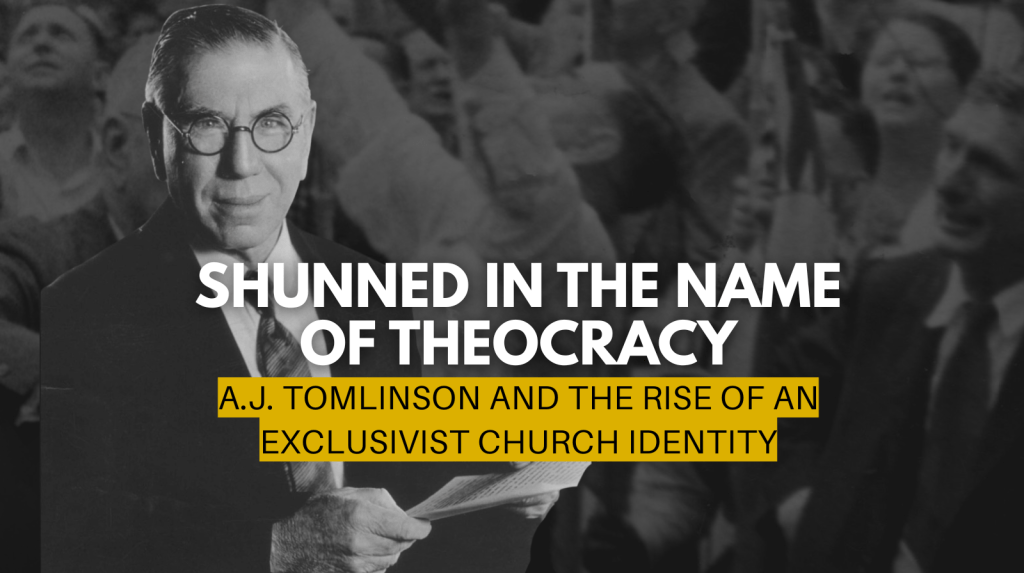
The early decades of the Church of God movement in the Appalachian South were shaped not only by revival fires and rapid organizational growth but also by a rising ecclesial rigidity that developed under the leadership of A. J. Tomlinson. His administrative talent and commanding personality helped define the character and structure of the Church of God in the years leading up to the 1923 administrative crisis. Yet alongside these accomplishments grew a deepening theological conviction, especially after the crisis, that the Church under his direction constituted the sole visible and divinely recognized Body of Christ on earth. Those who remained with the larger Cleveland, Tennessee body after 1923 were viewed by Tomlinson and his followers as a rebellious assembly led by elders who had rejected God’s theocratic order.
This exclusivist ecclesiology fostered an atmosphere in which social and spiritual shunning took root and became a defining feature of the Tomlinson movement in the aftermath of the 1923 split.
A. J. Tomlinson entered the Holiness Pentecostal world with a fervent belief in divine order and visible church government, a model he described as theocratic government. When he accepted the leadership role in 1903, first as pastor and soon after as General Overseer, he began shaping the Church of God with a clear sense of divine mandate. His rapid development of a centralized administrative system flowed from his growing conviction that the Church of God represented the restored New Testament Church in its purest form.
For Tomlinson, the true church was never an invisible or loosely connected community scattered among various denominations. It was a concrete and identifiable institution marked by uniform government, strict holiness teachings, and an unwavering openness to ongoing revelation through leaders whom he believed God had specially appointed. Tomlinson’s ecclesiology created not only a strong organizational identity but also a belief that loyalty to this visible church was essential to remaining within the bounds of the true Body of Christ.
The conviction that Tomlinson occupied a divinely ordained office did not merely reinforce his authority; it magnified the belief that the organization under his oversight was not simply a church among many, but THE Church in the fullest and most exclusive sense. Emphasis on the definite article became a defining marker of ecclesial identity, signifying that the movement he governed alone constituted the authentic and visible Church of God upon the earth.
This stress on the word “THE” has persisted in numerous splinter groups emerging from the same tradition. Some of these groups even attempted, as late as the mid 1990s, to secure legal registration of the name “The Church of God” in order to assert public theological primacy. Civil courts consistently rejected such efforts, recognizing that the attempt to codify the title reflected not a neutral naming dispute but a theological claim to singularity.
Although rulings have made clear that no body may legally claim exclusive rights to the name “The Church of God,” several splinter groups continue to violate these decisions by using the title as though it were theirs by divine right. In doing so, they perpetuate the rhetoric and exclusivist identity first articulated by Tomlinson, ignoring civil law while simultaneously proclaiming themselves the uniquely appointed Bride of Christ.
When this ecclesiological absolutism merged with the apocalyptic intensity of early Pentecostalism, it produced a powerful sense of eschatological urgency. Within this worldview, the Church of God was not simply a restored body but God’s solitary witness in the last days, the faithful remnant standing against a spiritually compromised religious world. Those who remained loyal to its institutional structure were framed as faithful saints. Individuals who questioned leadership, challenged procedural practices, or withdrew for reasons of conscience were not seen as dissenters within a human institution but as persons turning away from the Bride of Christ itself. Separation was described as a spiritual falling away, a rejection of divine order, and in some cases an abandonment of salvation.
Ecclesial loyalty thus became synonymous with loyalty to God, and institutional departure became equated with spiritual apostasy.
The exclusivist identity Tomlinson nurtured bore its most profound consequences after the 1923 administrative crisis, when he was removed from office on charges related to financial mismanagement and irregularities in administrative procedure. Tomlinson refused to accept this decision, declaring it illegitimate both spiritually and organizationally. He formed a separate body, initially insisting that he and his followers represented the only lawful continuation of the Church of God of the Bible.
After Tomlinson’s death in 1943, legal disputes over the use of the name “Church of God” continued for nearly a decade. These battles culminated in a 1953 decree of the Bradley County Chancery Court requiring his faction to add the suffix “of Prophecy” to its name in secular and business affairs. By the early 1950s the movement therefore adopted the title Church of God of Prophecy, a designation that still carried echoes of its earlier exclusivist claims. For Tomlinson’s followers, understanding themselves as the “church of prophecy” signified that they were a community fulfilling last days prophecies and thus, in their own estimation, the one true Church.
Among his adherents, the events of 1923 were memorialized as the division of 1923, a supposed moment when the faithful remnant withdrew from a rebellious majority. Yet historical analysis challenges this terminology. A true division requires an organization to split into roughly comparable factions, each retaining institutional continuity. In 1923, only Tomlinson and two elders departed, while the overwhelming majority of membership, ministers, and congregations remained with the Cleveland-based body. What occurred was not a division but an administrative removal followed by a minority schism.
The continued use of the term division reflects a theological narrative, not historical reality.
Nevertheless, Tomlinson and his followers elevated the crisis into a spiritual drama of loyalty and betrayal. The framework that emerged continues in numerous splinter bodies today, some of which still teach in ministerial programs that the 1923 action represented a rebellion against divine theocracy rather than a legitimate administrative correction. The majority Church of God, on the other hand, consistently viewed Tomlinson’s new body as schismatic. Thus two contrasting ecclesiastical identities emerged, each shaped by competing narratives of divine authority and spiritual legitimacy.
The theological consequences of this exclusivist worldview were immediate and severe. Because Tomlinson’s group believed it alone bore the mark of the true Church, anyone who left or was disfellowshipped was considered to have abandoned salvation. Questioning leadership or doctrine was interpreted as losing one’s spiritual vision of the Church; in some cases, individuals were accused of never possessing such a vision at all. Families were divided, ministers who changed allegiance were accused of spiritual treason, and members were discouraged from maintaining contact with anyone who departed. A culture of withdrawal, suspicion, and fear took root, creating lasting emotional and relational damage.
These patterns continue in various splinter groups today. Although many deny engaging in shunning, testimonies and internal communications show that forms of social and spiritual isolation remain common when members raise concerns or depart. Old practices survive beneath new rhetoric, framed by claims of divine revelation and prophetic calling.
Shunning, though rarely named as such, became a defining mechanism of control in these groups. Its theological foundation was the belief that separation from the institution equaled separation from Christ. The result was widespread emotional trauma, relational severance, and the loss of entire social worlds for those who left. Historical accounts preserve stories of families broken, friendships erased, and congregations permanently fractured.
The reformation era under Bishop Billy D. Murray in the early 1990s marked a decisive turning point for the Church of God of Prophecy. Murray led the denomination into a theological and structural reorientation, repudiating exclusivism and embracing the wider Body of Christ. Under his leadership, shunning was rejected, and the Church of God of Prophecy embraced reconciliation, transparency, and ecclesial humility.
Yet various splinter groups continue to employ shunning and exclusivist rhetoric, even extending these practices into digital spaces. On social media, some members act as informal enforcers, monitoring interactions and pressuring followers to avoid engaging with former members. Fear of leadership scrutiny leads individuals to sever online friendships or avoid liking posts. As author of this study, I have been told directly by individuals that they wished to remain friends privately but would cease public engagement due to organizational pressures.
The legacy of A. J. Tomlinson’s exclusivist ecclesiology is historically significant and pastorally sobering. His organizational genius and spiritual passion are undeniable, yet the belief that his body alone constituted the true Church inflicted profound and lasting harm.
The events of 1923 reveal how theological certainty, when absolutized, can weaponize authority and fracture human lives.
Today, the reformed Church of God of Prophecy demonstrates that repentance, humility, and institutional healing are possible. At the same time, the continued presence of exclusivist splinter groups shows how enduring and potent such ideas remain when combined with charismatic authority and claims of divine appointment. Their persistence underscores the need for ongoing vigilance, theological humility, and a commitment to the unity of the wider Body of Christ as a safeguard against future spiritual harm.
Bibliography
Conn, Charles W. Like a Mighty Army: A History of the Church of God. Cleveland, TN: Pathway Press, 1996.
Sherrill, Charles A. “Church of God of Prophecy.” Tennessee Encyclopedia. Tennessee Historical Society. First published October 8, 2017; last updated March 1, 2018.
Tomlinson, A. J. Diary of A. J. Tomlinson. Cleveland, TN: White Wing Publishing.




 Dr. Nathan J. Bonilla
Leave a comment