
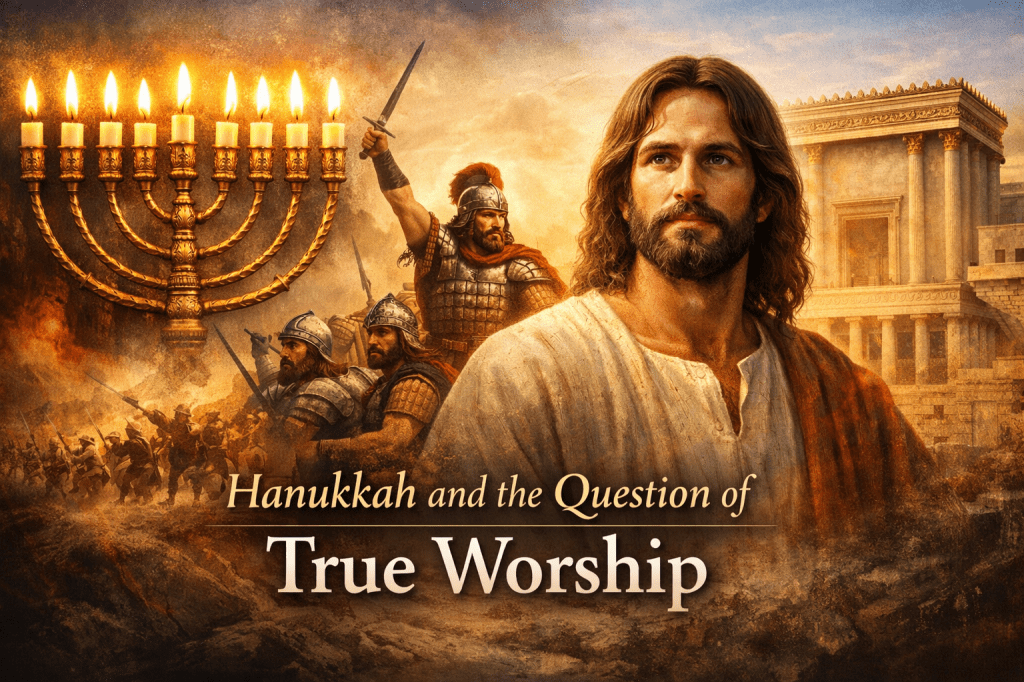
Hanukkah, the Jewish Feast of Dedication, is often reduced in popular discussion to themes of light and miracle. While these elements are historically rooted, they do not exhaust the significance of the festival within Second Temple Judaism. By the first century, Hanukkah functioned as a living reminder of Israel’s resistance to illegitimate religious authority and the unresolved question of who possessed the right to define holiness, worship, and covenant faithfulness. The Gospel of John’s decision to locate Jesus in the Jerusalem Temple during Hanukkah is therefore neither incidental nor merely chronological. It frames one of Jesus’ most direct identity claims within a Jewish historical moment already shaped by deep questions of authority and consecration (John 10:22–23).
“By the first century, Hanukkah functioned as a living reminder of Israel’s resistance to illegitimate religious authority and the unresolved question of who possessed the right to define holiness, worship, and covenant faithfulness.”
The Historical Foundations of Hanukkah
Hanukkah emerged from the crisis of the second century before the Common Era during the Seleucid domination of Judea under Antiochus IV Epiphanes. Antiochus enacted policies that suppressed core Jewish religious practices and desecrated the Jerusalem Temple through the introduction of pagan rites. These actions were not merely political. They represented a direct attempt to dismantle Jewish covenantal identity and redefine sacred space according to foreign authority (cf. Daniel 8:9–14; Daniel 11:31).
The revolt initiated by the priest Mattathias and carried forward by his son Judah Maccabee resulted in the recapture of Jerusalem and the purification of the Temple. The subsequent rededication of the sanctuary gave rise to the festival known as Hanukkah, meaning dedication. Although not mandated by the Torah, Hanukkah became a permanent fixture in Jewish communal memory, remembered as an act of faithfulness under coercion and a refusal to accept imposed definitions of holiness (1 Maccabees 4:36–59).
Hanukkah as Theological Memory Rather Than Resolution
While the Maccabean revolt restored Jewish worship, it did not resolve all theological or political tensions within Israel. The Hasmonean rulers who followed combined priestly and political authority in ways that unsettled many within the community. By the first century, the memory of Antiochus’s desecration remained vivid, yet questions concerning legitimate leadership, divine authorization, and the nature of true deliverance persisted (cf. Psalm 146:3; Jeremiah 17:5).
Hanukkah therefore functioned not merely as a celebration of what had been reclaimed, but as a theological memory that continued to speak. It recalled a moment when Israel discerned and rejected false authority, while quietly preserving the unresolved question of who ultimately possessed the authority to speak and act on behalf of God. Unlike biblical festivals rooted in Mosaic command, Hanukkah derived its authority from historical discernment, making it especially sensitive to claims of legitimacy and consecration (cf. Deuteronomy 13:1–5).
The Significance of Hanukkah in the Gospel of John
The Gospel of John explicitly notes that Jesus was present in Jerusalem during the Feast of Dedication and that He was teaching within the Temple precincts (John 10:22–23). This narrative decision is striking. Hanukkah was not a pilgrimage festival and carried no sacrificial requirement. John did not need to mention it, yet he chose to do so.
During this feast Jesus is confronted with a direct and pressing demand: “How long will you keep us in suspense? If you are the Messiah, tell us plainly” (John 10:24). This question is not asked in a vacuum. It is posed during a festival born from the rejection of false religious authority. Hanukkah therefore provides a historically charged setting in which claims to divine authorization would have been examined with particular seriousness (John 10:25–27).
“Hanukkah therefore provides a historically charged setting in which claims to divine authorization would have been examined with particular seriousness.”
Jesus’ Identity Claim Within a Context of Discernment
Jesus’ response does not align with expectations associated with militant or nationalist deliverance. He neither invokes the language of revolt nor appeals to dynastic legitimacy. Instead He points to His works and to His relationship with the Father, culminating in the declaration, “I and the Father are one” (John 10:30).
The reaction is immediate and severe. Charges of blasphemy arise and violence is contemplated (John 10:31–33). This intensity cannot be separated from the setting. Hanukkah exists because Israel once rejected a ruler who claimed divine authority. Standing within that memory, Jesus’ claim is weighed not as abstract theology but as a direct challenge to prevailing understandings of consecration and legitimacy (John 10:34–39).
Redefining Dedication and Sacred Authority
Hanukkah commemorates the restoration of sacred space through ritual purification. Jesus does not dismiss this memory. Instead He reframes the meaning of dedication itself. Rather than asserting control over the Temple, He speaks of being consecrated by the Father and sent into the world (John 10:36, NIV). Holiness, in this framework, is no longer confined to architecture or institutional power but is embodied in obedience, mission, and faithfulness to God (Micah 6:8; Hosea 6:6, NIV).
For Christian readers, this setting strengthens Christological confidence by grounding Jesus’ claims within Israel’s own theological vocabulary (John 1:14; John 2:19–21). His words emerge not as detached abstractions but as declarations shaped by Jewish categories of holiness and authority. For Jewish readers, the Johannine narrative reflects an internal Jewish debate of the first century concerning legitimacy and consecration, even where its conclusions are not shared (cf. Isaiah 1:10–17).
“Holiness, in this framework, is no longer confined to architecture or institutional power but is embodied in obedience, mission, and faithfulness to God.”
Methodological Scope and Interpretive Boundaries
The purpose of this study is not to recast Hanukkah as a Christian observance nor to reinterpret Jewish historical memory through later Christian theology. Rather, it examines how the Gospel of John employs a historically significant Jewish festival as narrative context for Jesus’ identity claims. Hanukkah is treated here as a Second Temple phenomenon shaped by questions of authority, consecration, and communal discernment (cf. Acts 5:38–39).
This analysis therefore distinguishes between historical description and theological interpretation. The former addresses the origins and function of Hanukkah within Jewish history. The latter considers how the Johannine narrative situates Jesus within that setting. The argument advanced is limited but meaningful: the Feast of Dedication provided a context in which claims to divine authorization would have been evaluated with heightened seriousness (Deuteronomy 18:18–22).
Ongoing Significance for Jewish and Christian Readers
For Christian readers, recognizing the Hanukkah setting of John 10 underscores the historical seriousness of Jesus’ ministry. His claims were not spoken in abstraction but articulated within Israel’s lived memory of resisting illegitimate holiness (Matthew 15:1–9). Such contextual awareness deepens rather than weakens confidence in Christian confession.
For Jewish readers, this analysis respects Hanukkah as a festival grounded in discernment and communal fidelity rather than theological anticipation. While the Johannine portrayal of Jesus represents a point of divergence between Jewish and Christian belief, the historical framework presented here reflects genuine first-century debates within Judaism itself (cf. Malachi 3:1–3).
Conclusion
Hanukkah was born from Israel’s refusal to accept corrupted worship and illegitimate claims to sacred authority (Exodus 20:3–6). It is within this context that the Gospel of John places Jesus in the Temple during the Feast of Dedication (John 10:22). In that setting Jesus does not evade scrutiny but accepts it fully. Whether one affirms or rejects His claims, understanding Hanukkah clarifies why this moment carried such weight in its original setting and why it continues to invite careful theological reflection (John 1:11–12).



 Dr. Nathan J. Bonilla
Leave a comment