
Abstract
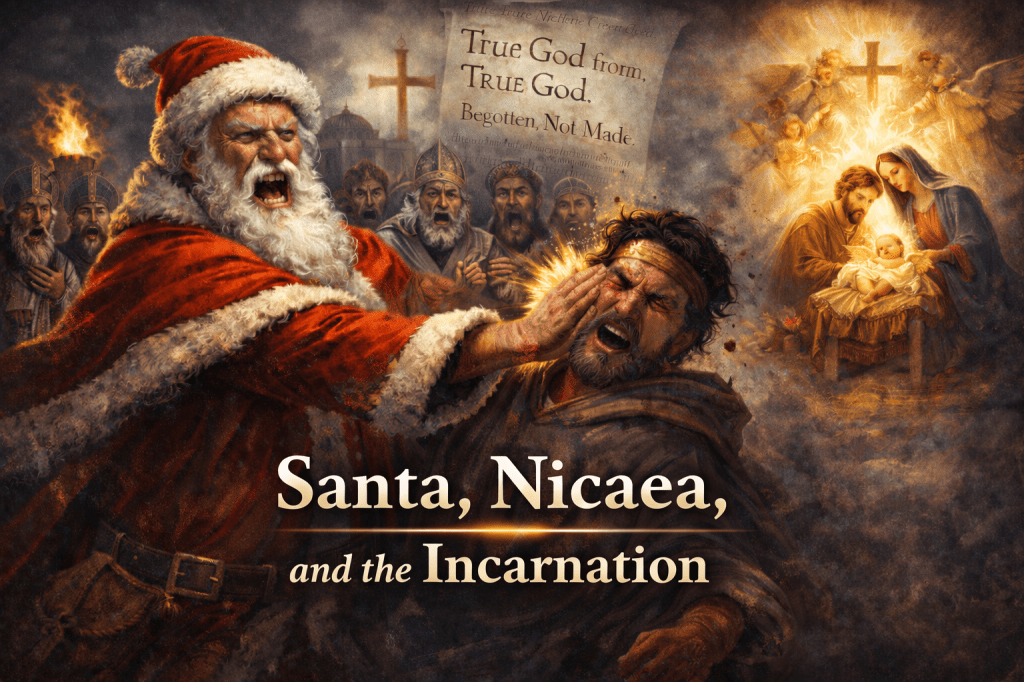
Every Christmas season a story circulates that the man who would later inspire Santa Claus was present at the Council of Nicaea, became so angry during the debate over Christ’s divinity that he struck an opponent, was removed, and later restored. Some repeat it as settled history. Others reject it as myth and dismiss the whole topic. This article takes a more careful approach. It separates what we can say with confidence from what belongs to later Christian tradition, then asks why the story continues to matter. Most importantly, it recenters the season where it belongs: Christmas is the confession of the Incarnation, that the eternal Son is truly God and truly became man for our salvation.
The Seasonal Claim That Refuses to Go Away
December has a way of surfacing questions people ignore the rest of the year. When faith becomes public, it becomes contested. That is why this story has traction. It blends something familiar and cultural, Santa Claus, with something weighty and ecclesial, the divinity of Christ. It also carries emotional energy. Many believers recognize the feeling behind it: someone speaks loosely about Jesus, and something in us rises.
But history and discipleship require more than emotional recognition. They require discernment. Before we ask whether the story happened exactly as told, we should ask what was actually at stake at Nicaea, and why the church treated that question as central rather than optional.
What Nicaea Was Actually About
The Council of Nicaea in 325 was convened because the church faced a serious division over the identity of the Son. In simplified terms, the conflict centered on whether Jesus Christ is fully divine, eternal with the Father, or whether He is a created being, exalted above all creation but still not equal with God.
This is not a side issue. It touches worship, salvation, and the meaning of Christmas itself. If the Son is not truly God, then the Incarnation becomes something less than God coming to save. Christmas becomes inspiration instead of redemption. The church did not gather at Nicaea to debate a philosophical curiosity. It gathered because the question threatened the coherence of the gospel the church preached and the Christ the church worshiped.
What the Creed Actually Says
I confess without hesitation that Jesus Christ is fully God, eternal with the Father, and worthy of worship. When people say Nicaea “decided Jesus was divine,” they usually mean the council confessed with precision what the church believed it had received and proclaimed. The creed that emerges is famous for its clarity. It speaks of the Son as “God from God,” “Light from Light,” “true God from true God,” and it insists He is “begotten, not made.” It also affirms the heart of Christmas, that “for us and for our salvation” He “came down” and “was made man.”
Notice what this does. It refuses two errors at once. It refuses the idea that Jesus is merely a creature. It also refuses a sentimental Christmas that celebrates a vague spirituality while avoiding the concrete claim that God the Son entered human history.
If you want a pastoral translation of “begotten, not made,” it is this: the Son is not part of the created order. He is not God’s highest project. He is of God, from God, sharing in God’s own life. That is why Christians worship Him without embarrassment.
At Christmas we are not celebrating a good man who points to God. We are celebrating Emmanuel, God with us.
Constantine’s Place in the Story
A fair question remains: why is an emperor involved at all.
Constantine was not a bishop, and he did not possess church office. He convened the council, provided support for travel and logistics, and urged unity because division in the church had social and political consequences in the empire. It is appropriate to critique the long term consequences of imperial involvement in church affairs. Those consequences are real and complex.
At the same time, it is historically careless to claim Constantine invented the divinity of Christ or forced a doctrine onto an unwilling church. The controversy existed before he convened the bishops, and the theological struggle at Nicaea was carried by bishops and theologians, not by imperial decree. Constantine could shape conditions and pressure the process, but he was not the author of the confession. The creed’s content is best understood as the church’s attempt to safeguard faithful speech about the Son under real doctrinal strain.
A balanced posture is simply this: Constantine’s involvement raises questions about power and process, but it does not explain away the church’s Christological confession, nor does it replace the theological reasons the bishops gave for that confession.
Saint Nicholas Before Santa
Now to the figure at the center of the Christmas rumor.
Nicholas of Myra was a real Christian bishop remembered especially in later tradition for generosity, pastoral concern, and courage. Over centuries, stories about his charity and protection of the vulnerable contributed to the development of gift giving traditions in parts of the Christian world, and eventually to the modern Santa Claus figure through cultural layering and secularization.
Was Nicholas present at Nicaea. The honest answer is that we cannot prove it. There are later lists of attendees that include a Nicholas associated with Myra, but Nicholas is not prominent in early accounts of the council, and the earliest narratives do not pause to highlight him. The best scholarly posture is caution. It is possible. It is not certain. That is not an insult to Nicholas. It is simply the difference between tradition and documentation.
The Slap Story: Tradition, Not Minutes
The most dramatic part of the story is also the least secure historically. The account that Nicholas struck Arius does not appear in the earliest records of Nicaea. It emerges much later in hagiographical tradition. In other words, it functions more like a moral narrative preserved by communities than like a transcript preserved by stenographers.
Some versions add that Nicholas was disciplined, removed, or imprisoned, then restored. Again, these details belong to later tradition rather than contemporary documentation.
So what should we do with it. We should handle it as tradition. We can say “later Christian tradition tells a story,” and we can still learn from what the tradition is trying to teach, without presenting it as if it were verified minutes from 325.
Why the Story Endures Even If It Is Late
Even when a tradition develops later, it often survives because it captures something psychologically and spiritually true.
First, it testifies to the seriousness of the doctrinal crisis. People do not tell stories like this about minor issues. They tell them when something foundational is threatened. The story communicates that the church understood the divinity of Christ to be worth defending, and not merely as an idea, but as a confession bound up with salvation and worship.
Second, it reveals the temptation of holy zeal. Anyone who has carried pastoral responsibility knows this terrain. Love for truth can become impatience. Conviction can become contempt. Defense of the faith can become defense of ego.
Even if Nicholas never raised a hand, the story warns that we can. And we should not be surprised. When the stakes are high, the flesh is close.
Christmas: The Doctrine Under the Carols
If we strip away the noise, the season calls us back to one central claim. The Son truly became man. That is why the creed’s incarnation language matters. Christmas is not primarily about nostalgia, family warmth, or cultural tradition. Those can be gifts, but they are not the center. The center is the Incarnation. God the Son entered our condition, not in appearance only, not as a temporary costume, but in true humanity.
That is also why debates over the divinity of Christ cannot be treated as secondary. If Christ is not fully God, then worship becomes confused. If Christ is not truly man, then redemption becomes abstract.
Christmas is the confession that God has come near in the Son, and that His nearness is not symbolic but real.
Zeal That Looks Like Christ
Here is the pastoral application that the season invites.
If the tradition about Nicholas is meant to teach anything, it is not that anger is holy. It is that doctrine matters, and also that how we defend doctrine matters. The One we confess at Christmas came in humility. He is gentle and lowly in heart. When our defense of truth becomes harsh, we begin to contradict the Lord whose truth we are trying to protect.
So the lesson is not to become less courageous. It is to become more Christlike. Strong conviction, yes. Clear confession, yes. But also patience, restraint, and a tone that reflects the Incarnation itself. God did not save the world by force. He saved the world by coming down.
Conclusion
Whether Nicholas attended Nicaea and whether he struck an opponent are secondary questions. The primary reality is the confession Nicaea preserved. The Son is “true God from true God,” “begotten, not made,” and “for us and for our salvation” He “came down” and “was made man.” [1]
If a December story about Saint Nicholas pushes us back toward the creed, it has served a good purpose. But we must not let Santa eclipse the Savior. And we must not let zeal eclipse Christlikeness. Christmas calls the church to confess the Incarnation with clarity and to embody that confession with humility.
Sources
- Nicene Creed text and early witnesses
https://www.newadvent.org/fathers/2804.htm
https://earlychurchtexts.com/public/eusebius_letter_to_his_church_about_nicaea.htm - Eusebius, Life of Constantine, material related to the council and imperial involvement
https://bkv.unifr.ch/works/cpg-3496-1/versions/the-life-of-the-blessed-emperor-constantine - Historical background on Nicholas and the development of later traditions
https://www.roger-pearse.com/weblog/2013/12/24/ancient-literary-sources-for-st-nicholas-of-myra/ - Discussion of the late attestation of the Nicholas and Arius story
https://www.roger-pearse.com/weblog/2015/02/28/did-st-nicholas-of-myra-santa-claus-punch-arius-at-the-council-of-nicaea/ - John 1:14 and the theological center of the Incarnation
https://www.biblegateway.com/passage/?search=John+1%3A14&version=ESV - John 10:22 to 39, Feast of Dedication setting in the Gospel of John
https://www.biblegateway.com/passage/?search=John+10%3A22-39&version=ESV



 Dr. Nathan J. Bonilla
Leave a comment