
Abstract
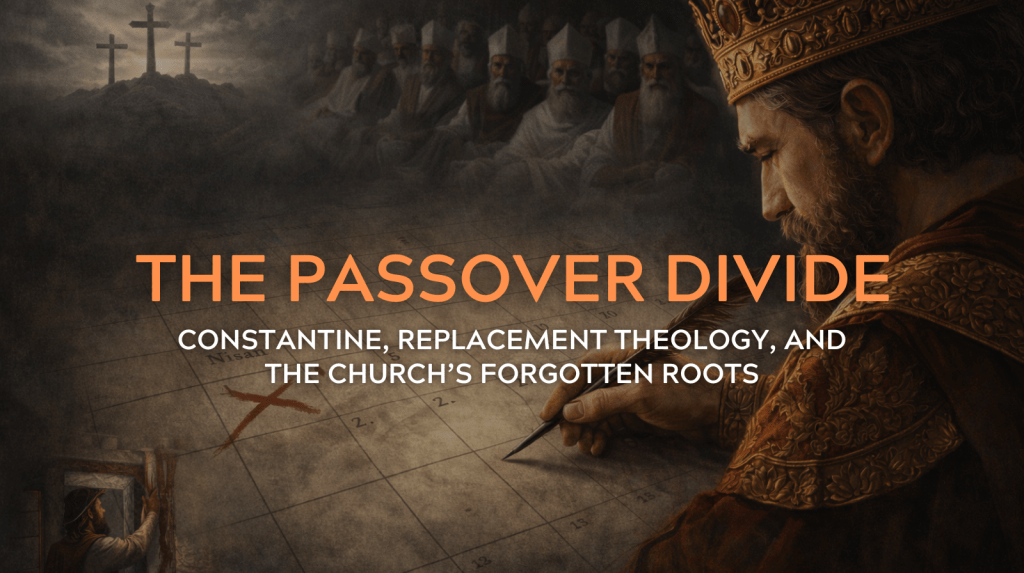
Few historical moments have generated more theological controversy than the Council of Nicaea in AD 325 under Emperor Constantine. Many argue that Constantine “corrupted” Passover, severed Christianity from its Jewish roots, and formalized a replacement theology that continues to influence Christian thought and even fuel antisemitism today. Others insist that the separation between Passover and Easter was merely calendrical and pastoral. This article examines the historical claims surrounding Nicaea, the so-called Passover controversy, and the emergence of replacement language. It further argues that modern evangelical Christians must reexamine the biblical foundations of Passover and consider recovering its Christ-centered observance in continuity with the early church prior to 325. Such recovery is not a return to legalism but a rejection of theological arrogance and an embrace of the covenantal faithfulness of God.
The Quartodeciman Controversy Before Constantine
Long before Constantine, the early church wrestled with how to commemorate the death and resurrection of Jesus. In the second century, a dispute arose between churches in Asia Minor and those in Rome. The churches in Asia Minor, often called Quartodecimans, observed the death of Christ on the fourteenth day of Nisan, the date of Jewish Passover, regardless of the day of the week. They appealed to apostolic tradition, especially the authority of the Apostle John.
Other churches preferred to celebrate the resurrection on the following Sunday. This difference was not initially framed as a rejection of Jewish roots but as a question of liturgical unity. The correspondence between Polycarp and Anicetus in the mid-second century demonstrates that disagreement existed without immediate rupture.
Thus, the controversy predates Constantine by nearly two centuries. The church was already navigating how to relate its worship to the Jewish calendar. The question was not whether Christ fulfilled Passover, but how that fulfillment should be liturgically remembered.
The Council of Nicaea and the Language of Separation
The Council of Nicaea in 325 addressed many issues, most notably Arianism. However, it also sought to unify the date of Easter. The council determined that the resurrection should be celebrated on the same Sunday throughout the empire, independent of the Jewish calendar.
Constantine’s own language, preserved in letters, reflects a troubling tone. He wrote that it was “unworthy” for Christians to follow the calculation of the Jews and that believers should have nothing in common with “that detestable crowd.” Such rhetoric reveals that by the fourth century, anti-Jewish sentiment had intensified within certain Christian circles.
Here is where the argument of corruption emerges. Critics contend that Constantine institutionalized a theological break from Israel and codified replacement ideology. While it is historically inaccurate to say that Constantine invented supersessionism, it is fair to say that his imperial authority accelerated the distancing of Christianity from its Jewish roots.
The deeper issue is not merely calendrical but theological. When Christian identity is defined in opposition to Judaism rather than in continuity with the story of Israel, replacement language becomes normalized. Over time, this rhetoric contributed to cultural and theological antisemitism.
Replacement Theology and Its Consequences
Replacement theology asserts that the Church has fully inherited Israel’s promises and that ethnic Israel no longer has a covenantal role in God’s redemptive plan. While the New Testament affirms the inclusion of Gentiles, it does not teach the cancellation of Israel.
Romans 11 remains decisive. Paul asks, “Did God reject his people? By no means.” He continues, “God’s gifts and his call are irrevocable.” If divine calling is irrevocable, then Israel’s election cannot be nullified by historical developments.
When the Church adopts replacement language, it subtly implies that God has discarded one people in favor of another. This theological posture has historically created fertile ground for antisemitism. If Israel is seen as rejected by God, then hostility toward Jews can be rationalized as participation in divine judgment. Such logic is foreign to the apostolic witness.
The tragic history of Christian antisemitism cannot be reduced solely to theology, yet supersessionist frameworks have undeniably contributed to it. The rhetoric of separation that gained momentum after Nicaea shaped centuries of Christian thought.
The Biblical Theology of Passover
Passover originates in Exodus 12 as a memorial of redemption. The blood of the lamb signified deliverance from judgment. The New Testament explicitly identifies Christ as the fulfillment of this pattern. Paul writes in 1 Corinthians 5:7, “For Christ, our Passover lamb, has been sacrificed.”
Jesus Himself instituted the Lord’s Supper within the context of Passover. Luke 22 situates the Last Supper squarely within the Passover meal. The early church’s remembrance of Jesus was therefore inseparable from the Passover narrative.
Observing Passover in a Christ-centered manner does not deny the resurrection. Rather, it anchors the cross and resurrection within the redemptive story of Israel. The early believers did not see themselves as replacing Israel but as participating in the promises fulfilled in Messiah.
Should Evangelicals Recover Passover?
The call to recover Passover is not a call to abandon Sunday worship or to impose Mosaic law upon Gentile believers. Acts 15 makes clear that Gentiles are not required to become Jews. However, recovering Passover as a Christ-centered remembrance reconnects believers to the biblical narrative.
Evangelicals often celebrate Good Friday and Easter without recognizing their Passover roots. Reintroducing Passover in a Christological framework corrects theological amnesia. It reminds the Church that salvation emerges from Israel’s story.
Furthermore, practicing Passover in solidarity with the Jewish roots of the faith counters replacement theology. It communicates humility rather than triumphalism. It affirms that the Messiah came from Israel and that God remains faithful to His covenant promises.
Such recovery must avoid cultural appropriation or superficial ritualism. The aim is theological restoration, not romantic nostalgia. The Church does not become Jewish, but it acknowledges that its Savior is.
Addressing Common Objections
Some argue that returning to Passover undermines Christian liberty. Yet Paul’s affirmation that Christ is our Passover lamb suggests that remembering this feast in light of Christ is not regression but fulfillment.
Others contend that Easter adequately commemorates the resurrection and that Passover is unnecessary. However, detaching resurrection from Passover risks severing the gospel from its covenantal context. Scripture presents redemption as a unified narrative, not a fragmented set of holidays.
Another objection claims that Constantine’s decision was merely administrative. While the council sought unity, the rhetoric of separation reveals deeper theological currents. Unity achieved at the expense of biblical continuity invites long-term distortion.
Conclusion
The controversy surrounding Constantine and Passover is not merely about dates but about identity. When the Church defines itself over against Israel rather than in continuity with her, replacement language flourishes. Such language has historically contributed to antisemitic attitudes that contradict the spirit of the gospel.
A careful reading of Scripture affirms both the inclusion of the nations and the enduring faithfulness of God to Israel. Recovering a Christ-centered observance of Passover does not deny the resurrection. It situates the resurrection within the redemptive drama that began in Egypt and culminates in Messiah.
Evangelicals today are called not to legalism but to theological maturity. Reclaiming Passover as part of our shared biblical heritage can serve as a corrective to supersessionism and as a visible affirmation that God’s gifts and calling are irrevocable.
Bibliography
Eusebius. Life of Constantine. Translated by Averil Cameron and Stuart G. Hall. Oxford: Clarendon Press, 1999.
Fredriksen, Paula. From Jesus to Christ: The Origins of the New Testament Images of Jesus. New Haven: Yale University Press, 2000.
Hagner, Donald A. The Jewish Reclamation of Jesus. Grand Rapids: Zondervan, 1984.
N. T. Wright. Paul and the Faithfulness of God. Minneapolis: Fortress Press, 2013.
Parkes, James. The Conflict of the Church and the Synagogue. London: Soncino Press, 1934.
Soulen, R. Kendall. The God of Israel and Christian Theology. Minneapolis: Fortress Press, 1996.
Wright, N. T. The Resurrection of the Son of God. Minneapolis: Fortress Press, 2003.

 Dr. Nathan J. Bonilla
Leave a comment