
Abstract
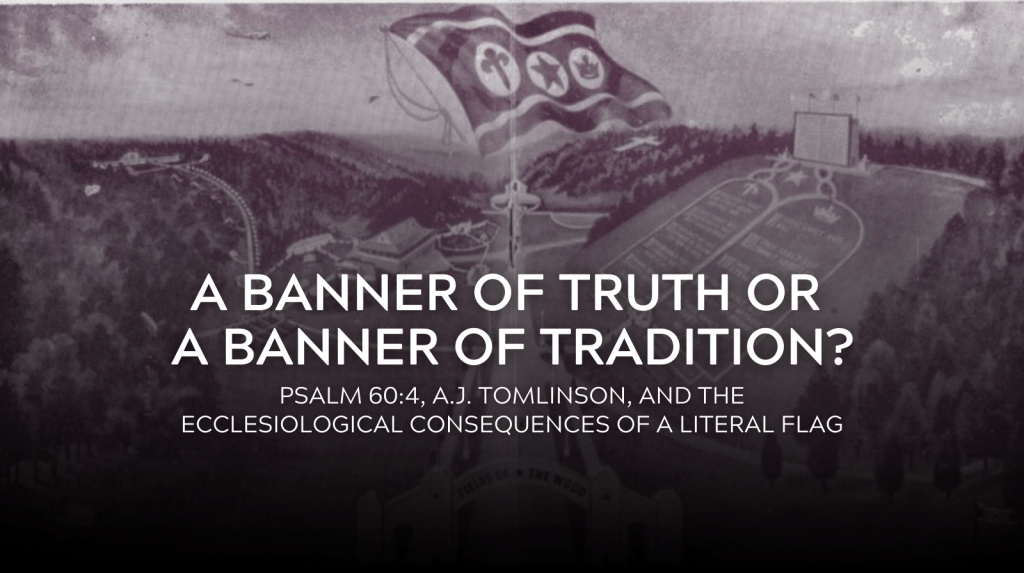
Psalm 60:4 declares in the King James Version, “Thou hast given a banner to them that fear thee, that it may be displayed because of the truth. Selah.” Within certain Pentecostal-Holiness traditions, this verse has been interpreted as divine authorization for the creation and institutional use of a literal church flag, particularly in the historical developments following the 1923 administrative crisis involving A.J. Tomlinson, when the banner of Psalm 60:4 was materialized into a denominational emblem and elevated as visible evidence of ecclesial legitimacy. This study argues that such an interpretation constitutes a significant hermeneutical distortion of poetic Scripture and that the banner motif, when read within its canonical trajectory, ultimately points to Christ Himself as the true rallying standard of the church; furthermore, the continued use and ceremonial elevation of similar flag variations among later splinter groups demonstrates that the theological claims attached to Psalm 60:4 remain active and increasingly intensified in contemporary ecclesial practice. By examining the text in its literary context, tracing its historical appropriation, and assessing its ecclesiological implications, this paper contends that the church’s identity must remain grounded in Christ rather than in institutional symbols that risk assuming devotional weight.
Psalm 60:4 in Its Literary and Historical Context
Psalm 60 is a national lament emerging from a period of military instability and divine chastisement. The psalmist describes the earth trembling, the people staggering, and the recognition of divine displeasure. Within this poetic lament appears the declaration: “Thou hast given a banner to them that fear thee, that it may be displayed because of the truth.” The Hebrew term nes refers to a signal, a raised standard, or rallying point, frequently used in military or prophetic imagery.
The text does not describe an object constructed by human hands, nor does it legislate the establishment of a permanent institutional emblem. Rather, the banner is portrayed as a divine provision in a moment of crisis. It signifies that truth remains upheld despite instability. The psalmist is not prescribing ecclesiastical architecture; he is proclaiming theological assurance.
To extract from this poetic declaration a binding denominational mandate violates foundational hermeneutical principles. Genre governs interpretation. The Psalms are saturated with metaphor.
When metaphor is literalized and institutionalized, Scripture is extended beyond its intended scope.
Psalm 60:4 affirms that God Himself provides a rallying point rooted in truth. It does not command the fabrication of a fabric standard.
Christ as the True Banner in Canonical Perspective
The banner motif reaches fuller clarity when traced through the broader biblical canon. In Exodus 17:15, Moses names an altar Jehovah-nissi, “The Lord is my banner.” The emphasis is unmistakable: the banner is not cloth but covenantal presence. God Himself is the rallying point.
Isaiah intensifies this imagery in messianic expectation. Isaiah 11:10 speaks of the Root of Jesse standing as an ensign to the peoples. The ensign is not an object but a person. The New Testament identifies Jesus Christ as the fulfillment of this prophetic vision. In John 12:32, Christ declares that when He is lifted up, He will draw all people to Himself. The cross becomes the visible standard of salvation.
Thus, Psalm 60 ultimately finds its fulfillment not in denominational fabric but in the crucified and risen Christ. He is the truth displayed. He is the rallying point for those who fear God. The church gathers under Him. The distinguishing mark of discipleship, according to John 13:35, is love—not emblematic display.
The Administrative Crisis of 1923 and the Institutionalization of the Banner
The historical literalization of Psalm 60:4 must be situated within the administrative division of 1923 in the Church of God headquartered in Cleveland, Tennessee. Following the separation of A.J. Tomlinson and the subsequent formation of what became the Church of God of Prophecy, questions of legitimacy and continuity became urgent.
In such a context, visible differentiation carries symbolic power. The adoption of a literal church flag in 1933 provided tangible reinforcement of exclusive ecclesial claims. The metaphor of Psalm 60:4 was transformed into material evidence of institutional identity. Possession and display of the flag functioned as a visible marker of belonging.
What began as poetic imagery became a denominational boundary marker. The shift from metaphor to mandate represents not merely a historical development but a theological reorientation—from Christ-centered rallying to symbol-centered identification.
Contemporary Splinter Groups and Ceremonial Escalation
The trajectory did not end with Tomlinson’s generation. Subsequent splinter groups have retained and intensified the use of the literal flag. Particularly notable are bodies publicly identified as “The Church of God,” historically associated with Robert J. Pruitt and presently under Oscar Pimentel, which have adopted substantially similar flag designs.
In recent years, the ceremonial use of the flag has expanded beyond symbolic identification into highly choreographed processions and public marches. The flag is carried with formal reverence, displayed prominently in services, and incorporated into ritualized acts of collective affirmation. The resemblance to traditional Roman Catholic devotional processions involving statues of saints and sacred icons is visually and ceremonially striking. While doctrinal structures differ, the observable ritual patterns often render the distinction difficult for outside observers.
Even more concerning is the experiential theology emerging in some congregations. There are contexts in which members have expressed reluctance to worship fully—or have concluded that God “was not in the service”—unless the flag was waved or unless a song uniquely associated with their denomination was sung. Such expectations subtly relocate spiritual validation from the proclaimed Word and the presence of Christ to institutional symbols and denominational cues.
When divine presence becomes psychologically tethered to a ritual involving a flag, the line between symbol and object of devotion becomes dangerously thin.
Furthermore, some within these movements assert that the design of the flag was revealed directly by the Holy Spirit. Yet historic Christian theology affirms that the Spirit who inspired Scripture (2 Peter 1:21) does not subsequently authorize practices that contradict sound exegesis. According to John 16:13–14, the Spirit glorifies Christ and illuminates what has already been revealed. Private revelation cannot override canonical clarity.
The dispute surrounding the design has also entered formal legal proceedings before the United States Patent and Trademark Office (Trademark Trial and Appeal Board, Opposition No. 91094180). While the legal dimensions lie beyond the scope of this paper, the ethical implications remain significant. Scripture calls believers to respect lawful authority (Romans 13:1–7) and to avoid misappropriation (Exodus 20:15). The church must act above reproach both spiritually and civilly.
Yet it must also be stated that certain denominational bodies, such as The Church of God (under the leadership of General Overseer Oscar Pimentel), have continued to employ a substantially similar flag design even after court rulings and formal opposition proceedings, thereby raising not only biblical concerns but also ethical and legal ones. When such practices are justified under the language of divine revelation, they risk compounding the problem by elevating subjective claims of spiritual guidance above both Scripture and lawful authority. This paper therefore calls for such practices to cease in matters of this nature and urges a return to the true blessings of God, which are found not in contested symbols or institutional emblems, but in faithful obedience to the written Word of God.
Ecclesiological Implications
The New Testament describes the church as a holy nation (1 Peter 2:9), yet this nationhood is covenantal and spiritual, not political. The church’s citizenship is heavenly (Philippians 3:20). Its unity is produced by the Spirit (Ephesians 4:3–6). Its rallying point is Christ.
The apostles never prescribed a banner. The early church was identified by holiness, sacrificial love, doctrinal fidelity, and gospel proclamation.
To insist that Psalm 60:4 mandates a literal flag risks binding consciences where Scripture does not bind them. The sufficiency of Scripture demands restraint.
The banner given by God is truth embodied in Christ. Under His standard the church stands. When institutional symbols begin to function as spiritual validators, the church must reexamine whether it has shifted from Christological centrality to symbolic dependency.
Conclusion
Psalm 60:4 proclaims divine faithfulness in poetic form. It does not legislate denominational symbolism. When interpreted in its historical and canonical context, the banner points to God Himself and finds fulfillment in Christ.
The administrative crisis of 1923, the adoption of a literal church flag in 1933, and the ceremonial intensification among later splinter groups illustrate how metaphor can be converted into mandate and symbol into devotional object. Yet the New Testament insists that the church’s true rallying point is Christ crucified and risen.
The church of Jesus Christ does not require a fabric emblem to authenticate its existence. It requires fidelity to the gospel, submission to Scripture, and love that reflects the character of its Lord. Christ alone is our banner. Under Him—and not beneath institutional cloth—the church stands.
Bibliography
Beale, G. K. A New Testament Biblical Theology: The Unfolding of the Old Testament in the New. Grand Rapids: Baker Academic, 2011.
Brueggemann, Walter. The Message of the Psalms. Minneapolis: Augsburg Publishing House, 1984.
Fee, Gordon D., and Douglas Stuart. How to Read the Bible for All Its Worth. 4th ed. Grand Rapids: Zondervan, 2014.
Goldingay, John. Psalms, Volume 2: Psalms 42–89. Grand Rapids: Baker Academic, 2007.
Grenz, Stanley J. Theology for the Community of God. Grand Rapids: Eerdmans, 2000.
McGrath, Alister E. Christian Theology: An Introduction. 6th ed. Oxford: Wiley-Blackwell, 2017.
Tomlinson, A. J. The Last Great Conflict. Cleveland, TN: White Wing Publishing House, 1913.
Wright, N. T. Paul and the Faithfulness of God. Minneapolis: Fortress Press, 2013.

 Dr. Nathan J. Bonilla
Leave a comment