
Disclaimer
This article is not written as an attack against members of churches that trace their heritage to A. J. Tomlinson following the 1923 Church of God administrative crisis, which led to his separation from the Church of God (Cleveland, TN) and the eventual formation of what would become the Church of God of Prophecy. While the Church of God of Prophecy has, since the early 1990s, taken intentional steps to distance itself from earlier sectarian tendencies, other splinter groups that emerged from this historical development appear to have continued to preserve and practice such patterns.
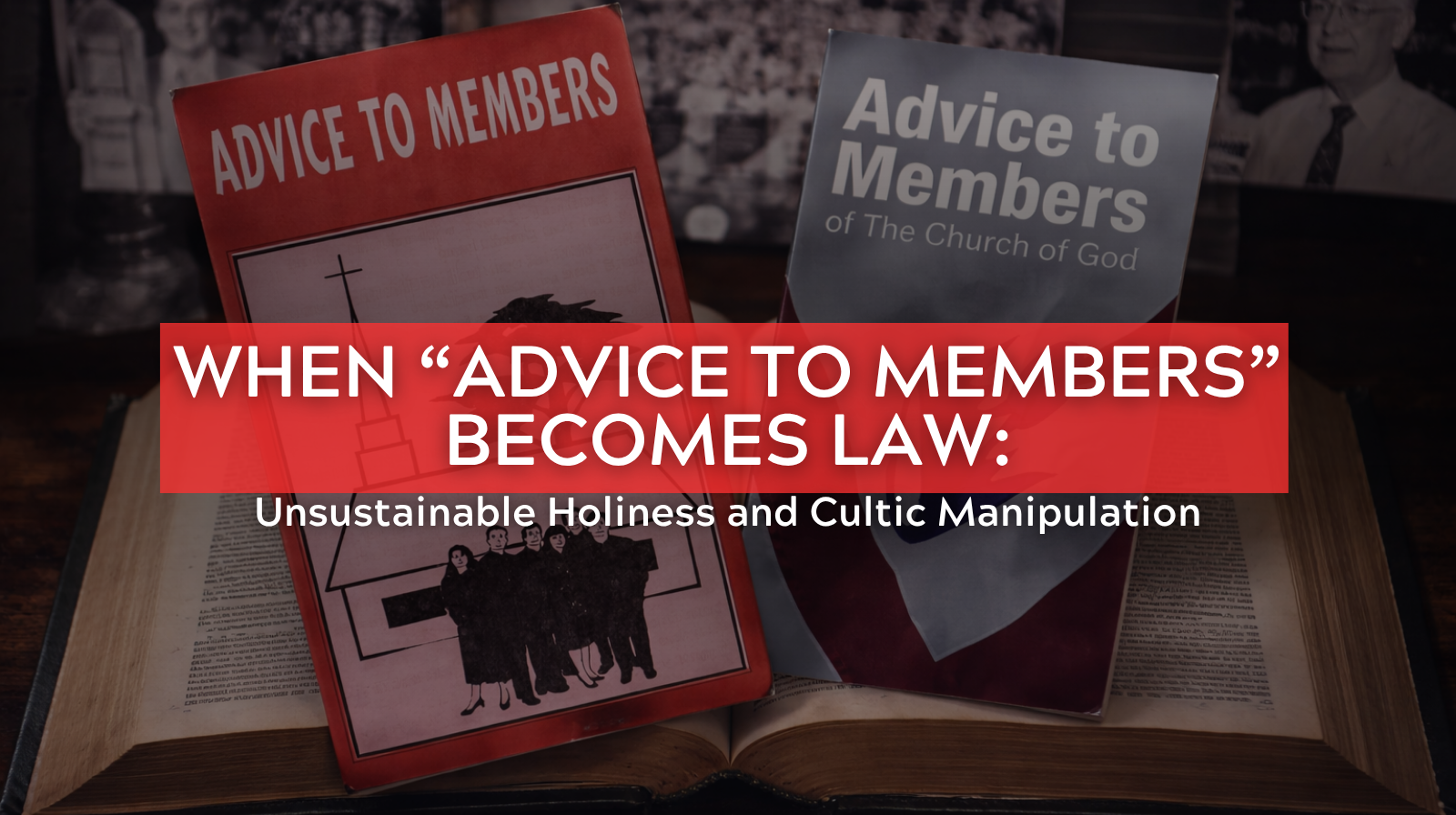
This article is likewise not intended as an attack against those within these movements. It is my conviction that there are sincere and devoted Christians among them, and nothing written here should be interpreted as a denial of that sincerity. Rather, this article engages specifically with the document known as Advice to Members, a widely circulated and influential text, which may be accessed here: https://shorturl.at/AwDCm.
The purpose of this study is to examine and critically evaluate what appear to be legalistic and cult-like elements within that document. This is done with the hope that those influenced by such teachings might come to greater spiritual clarity—recognizing where legalism and undue control may have obscured the gospel—and ultimately return to a more biblically grounded understanding of holiness, grace, and Christian liberty.
Abstract
A church enters dangerous territory when its “advice” begins to function like law and holiness is reduced to institutional lists that few truly uphold and almost no one can fully sustain. This article argues that documents such as the Advice to Members do not merely offer pastoral counsel. In practice, they often become behavioral codes by which holiness is measured, belonging is reinforced, and quiet hypocrisy is normalized. The problem is not the call to prayer, reverence, modesty, or moral seriousness. The problem is the way extra-biblical applications are elevated, surrounded with spiritual pressure, and treated as though they form the practical boundary of the narrow way. When that happens, believers are no longer being formed primarily by Scripture but by a religious culture of selective obedience. Such a system does not produce biblical holiness. It produces contradiction, burdens the conscience, and displays troubling signs of legalism and high-control religion.
Introduction
There is a profound difference between biblical holiness and institutional rule-keeping. Scripture calls believers to purity, reverence, prayer, self-control, modesty, charity, and separation from sin. But Scripture does not reduce holiness to a list of cultural taboos, inherited standards, or organizational expectations. The moment a church begins to do that, it places itself on dangerous ground.
That is the central problem with documents like the Advice to Members. They may insist that they are only giving counsel. They may even contain warnings against taking the advice in a harsh or legalistic spirit. Yet in actual church life, such documents often function as far more than advice. They become the visible code by which spirituality is judged. They become the practical outline of what “real saints” do and do not do. Once that happens, the title of the document matters very little. Advice has become law in everything but name.
This is not a small theological error. It is a spiritual one. Jesus warned, “You have let go of the commands of God and are holding on to human traditions” (Mark 7:8). Paul warned against systems of religion built around rules that have “an appearance of wisdom” but lack true power against the flesh (Colossians 2:23). The issue, then, is not whether holiness matters. It does. The issue is whether a church has the right to define holiness through institutional lists that go beyond Scripture and then burden the conscience with them.
Advice Is Not Neutral When It Functions Like Law
A church cannot honestly call something “advice” if members know they will be viewed as worldly, compromised, or spiritually suspect for not aligning with it. In that setting, the word advice becomes largely ceremonial. The real force of the document lies in its social and moral power.
This is why the Advice to Members must be evaluated not merely by what it says about itself, but by what it actually does in the life of the church. If it shapes who appears holy, who appears suspect, who seems submissive, and who seems questionable, then it is functioning as law. It may not be enforced with formal discipline at every point, but it still creates a moral code that governs behavior, reputation, and belonging.
Jesus described this kind of religious burden with remarkable clarity: “They tie up heavy, cumbersome loads and put them on other people’s shoulders” (Matthew 23:4). That text is deeply relevant here. A heavy spiritual burden does not cease to be a burden simply because leaders say it is only advice. If people live beneath it as a code, then a code is what it has become.
Holiness Is Bigger Than a List
Biblical holiness is never smaller than the heart. It is not merely about what one avoids outwardly, but about what kind of person one becomes before God. It includes motives, speech, purity, mercy, humility, self-control, love, truthfulness, and obedience. It cannot be reduced to approved and disapproved activities.
That is why legalism is always a distortion of holiness. It takes real biblical concerns and shrinks them into visible markers. Historically, sectors of the Holiness movement often slid in this direction, identifying holiness with “standards” and externally enforced taboos rather than the deeper work of Christlike transformation. Even holiness voices themselves have acknowledged this problem, noting that some came to identify sanctification with rules, lists, and outward prohibitions. More broadly, historians describe the Holiness movement as a nineteenth-century sanctification movement that later developed multiple visible boundary practices across its many branches.
Paul’s warning in Colossians 2 strikes directly at this problem. “Do not handle! Do not taste! Do not touch!” may look religious, but Paul says such regulations are “based on merely human commands and teachings.” He then adds that they “lack any value in restraining sensual indulgence” (Colossians 2:21–23). That is devastating. A list may create the appearance of seriousness. It does not create the reality of holiness.
The Problem of Selective Obedience and Quiet Hypocrisy
One of the clearest signs that a religious system is unhealthy is when almost no one consistently lives by its standards, yet almost everyone publicly affirms them. At that point the system is no longer producing honest holiness. It is producing performance.
That is exactly what often happens with documents like the Advice to Members. In real life, many who defend such lists do not actually keep them in a consistent and comprehensive way. Some parts are emphasized loudly. Other parts are quietly ignored. Some are applied to ordinary members. Others are overlooked in families with influence. The result is not integrity, but selective obedience.
This selective obedience breeds hypocrisy because it teaches people to survive inside the culture by public agreement and private editing. In practice, many simply do what they feel is the “real advice” and quietly set aside the rest. But once members are left to decide which parts of the list truly matter and which do not, the moral authority of the whole structure begins to collapse. The code remains on paper, but it no longer governs with consistency. That does not make the system healthier. It makes it more dishonest.
Worse still, honesty often becomes more dangerous than quiet contradiction. A person who openly questions the list may be treated as troublesome, but a person who silently disregards parts of it while still affirming the system may remain in good standing. That is not holiness. It is institutionalized pretense.
The Movie Contradiction Exposes the Weakness of the System
One of the most revealing contradictions in these lists is the condemnation of going to the movies while ignoring the reality that many who reject theaters have long since welcomed the same or worse content into their own homes.
If the actual concern is moral corruption, lust, violence, vulgarity, or worldly values, then the building itself is not the issue. The issue is what is being watched. In fact, bringing ungodly content into the home may be worse than encountering it in a public venue, because the home is the very place where Christian formation should be strongest.
It is one thing to condemn a movie theater as worldly. It is another to stream the same kind of corruption on a television, laptop, or phone and imagine that the problem has somehow become smaller because the location changed.
This is where the institutional list exposes its own shallowness. It attacks the venue instead of carefully discipling the conscience. It condemns motion picture houses, yet fails to address the much deeper question of what kind of entertainment is being normalized in private. That is why the standard becomes unrealistic and unsustainable. It was crafted for a cultural world in which the building itself symbolized compromise. But once the same content entered the home, the weakness of the method became obvious.
Biblical holiness requires deeper discernment than that. It asks what honors Christ, what shapes the heart, what corrupts the imagination, and what feeds the flesh. A prohibition against theaters without an equally serious reckoning with what is brought into the home is not a strong holiness ethic. It is an inconsistent one.
Shorts, Sports, and the Confusion of Culture With Scripture
The same problem appears in the treatment of shorts, sports, and leisure activities. Scripture certainly teaches modesty, self-control, and wise stewardship of the body and the mind. But it does not provide a universal holiness code for necklines, sleeve lengths, hemlines, public shorts, ballgames, skating rinks, bowling alleys, or every form of recreation across all cultures and times.
That does not mean anything goes. It means the church must distinguish between biblical principle and cultural application. To fail to make that distinction is to turn cultural preference into spiritual law. Once that happens, holiness becomes confused with the visible customs of a particular subculture.
A person may avoid shorts, sporting events, or certain public activities and yet remain deeply proud, bitter, harsh, ungracious, and spiritually immature.
Another person may be far more serious about truth, prayer, humility, purity, and love, yet be judged because they do not conform to inherited taboos. That is one of the great tragedies of legalism. It often rewards the appearance of separation while neglecting the deeper weight of actual sanctification.
Romans 14 is especially important here. Paul teaches that not all questions of conduct are handled in the same way. He warns believers not to turn disputed matters into mutual condemnation and reminds them that “the kingdom of God is not a matter of eating and drinking, but of righteousness, peace and joy in the Holy Spirit” (Romans 14:17). The principle is clear. When the church absolutizes matters where Scripture gives principle rather than exhaustive detail, it risks burdening the conscience beyond what God has said.
The Misuse of “Appearance of Evil”
One of the most common ways legalistic systems expand their reach is by stretching verses beyond their actual meaning. A prime example is 1 Thessalonians 5:22. In the New International Version of the Bible the text reads, “reject every kind of evil.” That is a clear call to reject evil in all its forms. It is not a command to avoid every action that might look questionable to the most cautious observer.
That difference matters greatly. If the verse means every kind of evil, then the church must focus on actual evil. But when the verse is turned into “avoid anything that may appear wrong to someone,” it becomes a tool for endless expansion. Almost any cultural taboo can then be defended in the name of holiness. That is how legalism grows. It takes a real biblical concern and stretches it into a universal weapon of suspicion.
The result is that believers are no longer mainly trained to reject evil. They are trained to avoid disapproval. That is not the same thing. One forms conscience before God. The other forms anxiety before the group.
The Disclaimer Does Not Save the Document
One of the most revealing features of the Advice to Members is that it contains its own warning against legalistic misuse. It says that holiness cannot be reduced to a list of prohibitions, that the New Testament principles of holiness are superior to any list, and that believers must not judge one another in nonessential matters of personal conviction. Those statements are right, and they are among the strongest lines in the document. But they do not solve the problem. They actually expose it.
The reason is simple. A disclaimer against legalism does not undo the practical force of a legalistic list. If the older sections of the document still present detailed behavioral codes in ways that shape spirituality, belonging, and visible holiness, then the later disclaimer functions more as insulation than correction. It allows leaders to say, “We do not mean this legalistically,” while the people still live beneath the weight of the list.
In that sense, the document speaks with two voices. One voice says, in effect, “Do not turn this into law.” The other says, “Here is the detailed standard by which saints should live.” The contradiction is obvious. And in lived church culture, the detailed code almost always carries more force than the disclaimer.
A High-Control Religious Culture
A document like this does more than regulate conduct. It creates a world. It tells members how to dress, where to go, who to associate with, how to behave in church, how to relate to leadership, what amusements to avoid, how to define modesty, and how to think about outsiders. That is more than discipleship. It is culture formation.
Culture formation itself is not wrong. Every church has culture. But when that culture is held together by fear, visible conformity, selective enforcement, and anti-critical reflexes, it begins to display the features of a high-control religious system.
That is why the repeated warnings against criticism and the strong push to “stand by” leadership should not be read naively. In a healthy church, warnings against gossip protect love. In an unhealthy church, such warnings can be used to suppress legitimate concerns. In a healthy church, support for pastors reflects partnership. In an unhealthy church, it can become a mechanism for insulating leaders from accountability.
The difference lies in whether the church permits truth to challenge the system or expects the system to define the boundaries of truth.
Once members are trained to think that questioning institutional lists is spiritually dangerous, that criticism is nearly always suspect, and that holiness is measured by cultural conformity, the church has moved beyond pastoral guidance into control.
A More Biblical Way Forward
The answer is not carelessness. The answer is not worldliness. The answer is not to laugh off modesty, discipline, reverence, or moral seriousness. The answer is to recover a more biblical doctrine of holiness.
The church should teach clear principles from Scripture. It should call believers to purity, modesty, discernment, prayer, humility, self-control, and love. It should teach families how to think biblically about entertainment, clothing, leisure, money, sexuality, speech, and witness. But it must not replace spiritual formation with institutional micromanagement. It must not act as though the holiness of God can be reduced to a denominational list.
Acts 17:11 gives the model. Believers must examine what they are taught in light of Scripture. Galatians 5:1 gives the warning: “It is for freedom that Christ has set us free.” Christian liberty is not license to sin. It is freedom from man-made bondage masquerading as godliness. And Romans 14 reminds the church that not every matter is to be handled as though it were of identical moral weight.
The church does not honor holiness by binding the conscience where God has not bound it. It honors holiness by teaching the whole counsel of God and by refusing to confuse Christ’s commands with inherited religious customs.
Conclusion
Whenever a church’s “Advice to Members” functions like law, and holiness is reduced to institutional lists that few can truly sustain, something has gone deeply wrong. What may begin as counsel becomes a code. What may begin as concern becomes pressure. What may begin as a call to holiness becomes a culture of contradiction, selective obedience, and quiet hypocrisy. A church cannot produce holiness by burdening believers with a list it does not consistently uphold itself.
It cannot condemn public movie theaters while ignoring the same or worse compromise in the home. It cannot turn cultural standards about shorts, sports, and recreation into practical tests of sanctification and then pretend it has done nothing more than offer advice. It cannot warn against legalism while preserving the very structure that makes legalism inevitable.
The issue is not whether holiness matters. The issue is whether holiness will be defined by Scripture or by institutional habit. Whenever external conformity becomes the practical measure of spirituality, legalism has already entered the room. And whenever that legalism is protected by fear, selective enforcement, and resistance to honest scrutiny, the church begins to display not the beauty of holiness, but the symptoms of a high-control religious system.
References and Suggested Reading
Robins, R. G. A. J. Tomlinson: Plainfolk Modernist. Oxford University Press.
https://www.amazon.com/J-Tomlinson-Plainfolk-Modernist-Religion/dp/0195165918
Phillips, W. H. Quest to Restore God’s House: A Theological History of the Church of God (Cleveland, Tennessee), Volume I: 1886–1923. CPT Press.
https://www.amazon.com/Quest-Restore-Gods-House-Formation-Transformation-Reformation/dp/193593144X
Stone, J. The Church of God of Prophecy: History and Polity. White Wing Publishing House and Press.
https://www.amazon.com/-/zh_TW/James-Stone/dp/0934942021
Kostlevy, W. Historical Dictionary of the Holiness Movement. Scarecrow Press.
https://www.amazon.com/Historical-Dictionary-Holiness-Movement-Kostlevy/dp/0810839555
Sutton, J. Why Love Hates Legalism: An Irreverent Indictment of Mean Religion. Frontline.
https://www.amazon.com/Why-Love-Hates-Legalism-Irreverent/dp/1629984701
Van Gelderen, P. Robots and Rebels: The Dangers of Growing Up a Legalist and How Biblical Parenting Sets Kids Free. Rejoice in the Lord Ministries.
https://www.amazon.com/Robots-Rebels-Legalist-Biblical-Motivations/dp/1620202581
DeYoung, K. The Hole in Our Holiness: Filling the Gap Between Gospel Passion and the Pursuit of Godliness. Crossway.
https://www.amazon.com/Hole-Our-Holiness-Filling-Godliness/dp/1433533340
Holy Bible, New International Version. Zondervan.
https://www.amazon.com/Holy-Bible-New-International-Version/dp/0310912369

Leave a Reply