
Summary
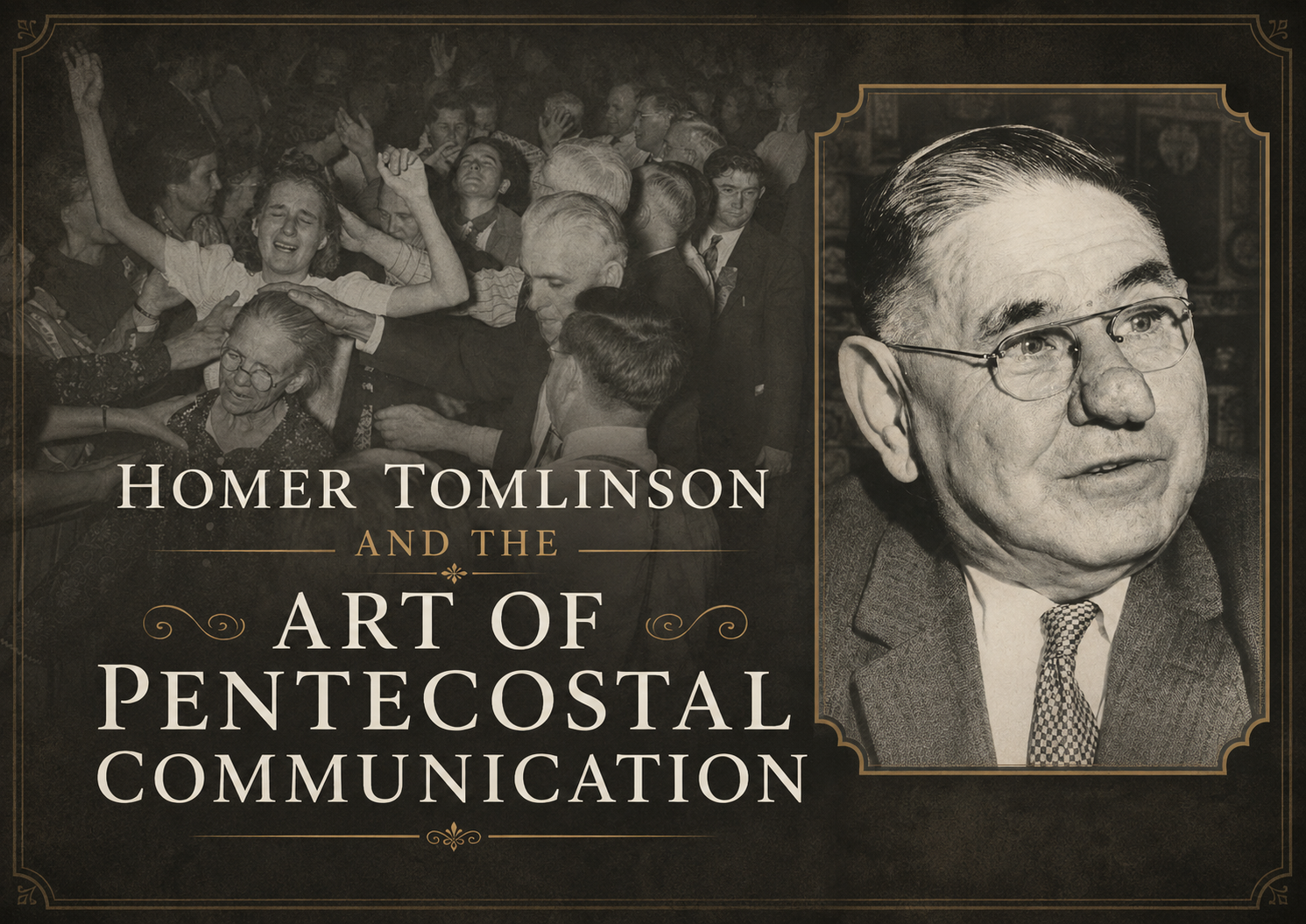
This article studies Homer A. Tomlinson within the broader Church of God movement and, more specifically, within the Tomlinson stream after the 1923 division, which later became known as the Church of God of Prophecy. While Homer is often remembered for later controversial claims, including his identification as “King of the World,” this article focuses on another side of his historical significance: his instinct for communication. Through story, print, pageantry, sacred memory, public ceremonies, radio, and recording, Homer and the Tomlinson stream reveal how Pentecostal movements learned to make their message visible and audible. The article does not defend every claim associated with Homer, but it argues that he should be studied as a complicated yet important religious communicator in Church of God history.
Remembering Homer with Care
Homer A. Tomlinson is not an easy figure to write about. For many readers familiar with Church of God history, his name is often connected to his later and more controversial public claims, especially his identification as “King of the World.” A serious historical analysis should not ignore those claims, nor should it pretend that they did not raise real concerns. Homer’s later independent course included public claims that became difficult for many in the Tomlinson stream to accept. Those claims belonged to Homer’s own path after his separation and should not be read back into A. J. Tomlinson’s leadership or the earlier Church of God movement.
Yet it would also be unfair to reduce Homer Tomlinson to that one controversial memory. History is rarely helped by caricature. A person may be deeply complicated and still historically significant. A leader may display unusual, even troubling, tendencies and still teach us something about the religious world that shaped him. This article does not attempt to defend every claim Homer made. It does not seek to mock him either. Instead, it asks a more careful question: what can Homer Tomlinson teach us about Pentecostal communication in the Church of God movement, especially in the Tomlinson stream after the 1923 division that later became the Church of God of Prophecy?
This distinction is important. The article is not speaking of all branches of the Church of God tradition in the same way. It begins with the broader Church of God movement, but its main concern is the Tomlinson stream after 1923, where A. J. Tomlinson and later M. A. Tomlinson carried forward a restorationist identity, a strong doctrine of the visible church, and a distinctive public culture. Within that world, communication was not a secondary matter. It was part of how the movement understood itself, preserved its memory, and projected its message.
A Son of the Church of God Movement
Homer did not appear out of nowhere. He was formed within the world of A. J. Tomlinson, W. F. Bryant, Camp Creek, Culberson, Burger Mountain, Cleveland, Tennessee, holiness preaching, mountain religion, and early Pentecostal restorationism. Long before the Tomlinson stream developed more formal departments and institutions, it already possessed a powerful communication culture. The people preached, testified, sang, published, gathered, marched, prayed, and told stories.
This is one reason Homer is so interesting. He was the son of A. J. Tomlinson, but he was also a son of a movement that knew how to turn memory into message. The early Church of God people did not merely hold doctrines quietly in the background. They dramatized them. They placed meaning on mountains, meetings, flags, Assemblies, testimonies, and printed pages. They believed God had acted in history, and therefore history itself had to be narrated.
In Quest to Restore God’s House, Homer appears in the Culberson world as part of the Tomlinson family and early circle of workers around 1900. That context matters because Culberson and Camp Creek were not simply locations. They were formative spaces where holiness zeal, persecution, mountain preaching, mission work, and restorationist hope came together.(1) Homer’s later instinct for public drama was rooted in that world. He inherited a people who believed the gospel should be declared boldly and visibly.
The Power of Voice and Mountain Preaching
One of the strongest examples of Homer’s communication instinct appears in his serialized story, “Almighty God of the Mountains,” published in The Joyful News from January 1936 through February 1937. This source must be handled carefully. It preserved details about A. J. Tomlinson, W. F. Bryant, Camp Creek, and Culberson, yet it was also described as “embellished as a parable.”(2) That means Homer should not always be read as a modern academic historian. He was doing something different. He was preserving memory through religious imagination.
Still, the value of his work should not be dismissed. Homer had an ear for voice. He tried to capture not only what early leaders believed, but how they sounded. In his description of W. F. Bryant’s preaching, Homer remembered A. J. Tomlinson as being struck by the “undecorated, unvarnished and bold truth” of Bryant’s message. He called Bryant “a preacher of bedrock righteousness.”(3) Those words tell us much about the kind of preaching that shaped the early movement. It was direct, emotional, rugged, and uncompromising.
Homer’s own way of preserving Bryant’s voice shows the art of Pentecostal communication. He did not merely say Bryant preached against sin. He tried to let readers hear Bryant’s mountain brogue, his urgency, his confrontation with evil, and his pastoral burden. Homer’s storytelling shows that early Pentecostal memory was not cold documentation. It was testimony. It was recollection with fire in it.
This is not the same as saying every detail must be received without question. A balanced historian must distinguish between memory, interpretation, and verifiable fact. But it does mean Homer’s writings help us understand the emotional and oral culture of the early Church of God world. He preserved the sound of a movement that believed truth had to be preached until it reached the conscience.
Story as Sacred Memory
In the Tomlinson stream, history was never merely history. It was sacred memory. Burger Mountain was not only a geographical place. It became a symbol of discovery, covenant, restoration, and divine direction. June 13, 1903 was not only a date. It became a theological marker. Fields of the Wood was not merely land. It became a visible teaching tool.
Homer understood this deeply. In the 1943 edition of A. J. Tomlinson Historical Notes, A. D. Evans quoted Homer’s Weapons of Warfare to describe the meaning of Burger Mountain. In Homer’s language, the Church of God name was “revealed as being all-sufficient for the body of Christ on earth” in the June 13, 1903 experience. Homer then described A. J. Tomlinson as coming upon the church at the foot of Burger Mountain and declaring, “This is the Church of God!” (4)
I do not write those words as a claim every Christian reader must accept. I do not believe one must accept all later exclusive or sectarian conclusions attached to this narrative. But historically, those words are important. They show how Homer communicated the meaning of June 13. He did not present it as a small administrative moment. He presented it as a dramatic moment of recognition. For Homer and the Tomlinson stream, Burger Mountain became a sacred stage where Bible, prophecy, place, and identity met.
This is why the subject needs to be handled with care. Historically, we can acknowledge how Homer and the Tomlinson stream understood Burger Mountain and June 13, 1903. Theologically, we can also ask whether all the claims later attached to that moment should be measured by Scripture, Christian unity, and the lordship of Jesus Christ. That approach allows us to honor the history without attacking it, while also being honest enough not to accept every conclusion uncritically.
Print Culture and the Church’s Public Voice
The early Church of God movement was a print movement before it was a broadcast movement. This is an important historical point. Before radio programs, television work, livestreams, websites, and social media, there were papers, tracts, magazines, minutes, reports, and published testimonies. Print gave the movement reach. It allowed scattered believers to feel connected to a larger body. It carried doctrine, news, exhortation, identity, and correction.
The Tomlinson stream after 1923 depended heavily on print to preserve its message and defend its identity. The White Wing Messenger became a central voice for the movement, while The Joyful News appeared in the 1930s to assist ministries such as the Women’s Missionary Band, Victory Leaders Band, and Sunday school work. (5) These publications were more than denominational paperwork. They were tools of formation.
Homer’s writings fit into this larger print culture. His serialized stories, dramatic descriptions, and historical recollections show a man who knew that print could carry spiritual emotion across distance. A sermon might be heard once and then forgotten. But a printed story could be read, reread, shared, quoted, and remembered. Homer understood that the page could become a pulpit.
This is where one sees a kind of early media imagination. Homer lived in a world before modern digital platforms, but he already understood something modern communicators know well: movements need narrative. A movement without a story becomes an institution without a soul. The Tomlinson stream did not merely publish information. It published identity.
Pageantry as Pentecostal Communication
When people today hear the word “media,” they usually think of screens. But historically, media is broader than television, phones, or computers. Media is anything that carries meaning. In that sense, the early Tomlinson stream used many forms of media: flags, banners, parades, songs, marches, testimonies, pageants, public ceremonies, and Assembly gatherings.
The 1937 All Nations Parade is a powerful example. The book A.J. Tomlinson Historical Notes describe a spectacle with thirty floats, 123 decorated cars, 418 banners, 789 flags, and 237 musical instruments. The parade reportedly included 2,010 men, women, and children, and someone called it one of the greatest parades ever witnessed in the state.(6) These details matter because they show that the movement communicated visually before it communicated through television. It wanted people to see the church’s public witness. It wanted the public to witness its sense of mission.
This kind of pageantry should not be dismissed too quickly. In the Bible, God often used visible signs, memorials, feasts, garments, processions, stones, and symbols to teach His people. The danger is not symbol itself. The danger comes when symbols replace obedience, or when public display becomes human exaltation. But at its best, sacred pageantry can help a people remember who they are and what they are called to do.
Homer had a natural place in this world. He understood the power of a scene. He knew that a gathered crowd, a raised flag, a mountain climb, a public prayer, and a dramatic statement could shape memory. At one Burger Mountain gathering, when rain came down, Homer reportedly said it was “the only kind of cathedral that could get the latter rain.” (7) That statement reveals his gift for religious imagery. He could take the weather, the mountain, the people, and Pentecostal expectation, and turn them into one memorable sentence.
Burger Mountain, Airplanes, and Modern Communication
The Tomlinson stream did not see sacred memory and modern technology as enemies. In fact, some of its leaders tried to interpret modern developments in light of biblical prophecy and church destiny. The historical notes around Burger Mountain speak of airplanes passing over the congregation, flags being raised, prayers for peace, and connections between sacred place and modern transportation. (8)
This is important for understanding Homer’s communication world. The movement was not merely looking backward. It was also trying to interpret modernity. Roads, airplanes, press coverage, radio, and later television were not simply secular tools. They could be woven into the church’s story. The message was old, but the means of carrying it could expand.
This does not mean every prophetic interpretation was sound. Some claims were strained. Some readings of events were probably too confident. But the impulse itself is worth noticing. The Tomlinson stream had a global imagination. It wanted the message to move. It saw the world becoming more connected and believed the church must not be silent.
That is why Homer’s communication style is historically significant. He stood at the intersection of mountain memory and modern publicity. He could speak the language of old-time holiness preaching, but he also understood the power of crowds, ceremonies, press, and public attention.
After 1923: Communication in a Divided Movement
The 1923 division changed everything. The broader Church of God movement fractured, and different streams began preserving different versions of the story. The Tomlinson stream continued under A. J. Tomlinson and later became known legally and publicly as the Church of God of Prophecy. In that post-1923 world, communication was not optional. It was necessary for survival.
Every divided movement has to explain itself. It must tell its people why it exists. It must preserve its own memory, define its own legitimacy, and carry its own claims into the future. That is what made publishing, pageantry, Assembly culture, and later broadcast communication so important in the Tomlinson stream. The movement’s identity was not only taught in doctrinal statements. It was performed and repeated in public life.
This also helps us understand why communication could become both powerful and dangerous. The same tools that preserve memory can also intensify exclusivity. The same symbols that inspire unity can also become sectarian boundary markers. The same public personality that gathers attention can also overshadow the body. This is where Homer becomes a cautionary figure as well as an instructive one.
The post-1923 Tomlinson stream shows how powerful communication could be in shaping a movement’s identity. Print, public ceremonies, mountain gatherings, radio, and recorded messages helped carry the church’s story beyond one local congregation. Yet Homer’s later independent course also shows why communication must remain under spiritual humility and biblical accountability. A gifted communicator can preserve memory, inspire people, and give a movement public visibility, but the messenger must never become greater than the message he carries.
From Print to Radio, Recording, and Television
Although Homer should not be credited with creating every later form of Church of God media, he belonged to the world that made such developments thinkable. The Tomlinson stream already understood the importance of carrying the message through every available means. Print had done that. Parades had done that. Public ceremonies had done that. Radio and recording would do it in another way.
The 1985 Church of God of Prophecy Business Guide explains that the Communications Department developed from the Broadcast Record Club, which originally raised funds to begin a radio broadcast for the church. Radio programs were prepared in 1952, the first broadcast was mentioned in 1954, and the Radio Department continued under that title until 1971, when it became the Communications Department because television work was being considered. (9)
This is one of the clearest institutional links between the earlier communication culture and later media development. The Church of God of Prophecy did not suddenly become interested in communication in the television age. The instinct was already there. The movement had long believed that the message must travel. What changed were the tools.
The same Business Guide also describes the role of the communications minister, who would deliver messages on the Voice of Salvation, answer mail from people needing spiritual guidance, promote the program among the churches, and participate in planning the radio ministry. (10) That description shows how broadcast ministry was understood not merely as publicity, but as pastoral and evangelistic work. People listened, wrote letters, asked for help, and encountered the church through media.
This is where Homer’s place in the story becomes meaningful. He was not simply a man with unusual claims. He was part of a stream that learned to communicate through page, platform, parade, microphone, and eventually screen. The movement’s media history did not begin with technology. It began with a burden to make the message known.
A Respectful Evaluation
Homer Tomlinson’s life shows both the strength and the danger of religious communication. On one hand, he had a remarkable gift for making a message visible and memorable. He knew how to tell a story, frame a scene, use symbols, preserve memory, and capture public attention. He seemed to understand that religious movements are not carried by doctrine alone, but also by language, memory, image, sound, and the ability to help people see themselves as part of a larger story.
On the other hand, Homer’s life also warns us about the danger of personality-driven religion. Communication can serve Christ, but it can also serve the ego. Public ceremony can exalt the gospel, but it can also exalt the messenger. Symbols can help the church remember its mission, but they can also become tools of control or self-importance. That is why all Christian communication must remain under the lordship of Jesus Christ.
This is not only a lesson about Homer. It is a lesson for the whole church. In every generation, the church must communicate. It must preach, publish, teach, sing, testify, broadcast, translate, record, and send. But the church must never confuse visibility with faithfulness. Being seen is not the same as being holy. Being heard is not the same as being true. Having a platform is not the same as having the anointing.
Conclusion: The Message Must Remain Greater Than the Messenger
Homer Tomlinson and the Tomlinson stream after 1923 remind us that communication matters in Church of God history. The movement understood that a message must be carried. It must be preached from pulpits, printed in papers, sung in gatherings, embodied in public ceremonies, broadcast over radio, and eventually considered for television. The Church of God of Prophecy did not inherit a silent tradition. It inherited a tradition of proclamation.
Yet the final lesson must be spiritual. Communication is a gift, but it is also a stewardship. The goal is not to make the messenger famous. The goal is to make Christ known. Homer’s life shows both the power and danger of religious communication. He could preserve memory with force, turn a phrase with beauty, and make a scene unforgettable. But his later claims also remind us that the messenger must never become greater than the message.
The art of Pentecostal communication is not merely the art of being seen or heard. It is the sacred responsibility of bearing witness. The church may use print, pageantry, radio, recording, television, and every modern tool available, but it must do so with humility, truth, and consecration. If Homer Tomlinson teaches us anything, perhaps it is this: a movement must learn how to communicate, but it must never allow communication to replace Christ-centered obedience. The message must remain greater than the messenger, and Christ must remain greater than them all.
Endnotes
- Wade H. Phillips, Quest to Restore God’s House: A Theological History of the Church of God, Volume I, 1886–1923, discussion of the Tomlinson family and workers at Culberson around 1900.
- Phillips, Quest to Restore God’s House, discussion of Homer Tomlinson’s “Almighty God of the Mountains,” published in The Joyful News from January 1936 through February 1937. Phillips notes that the story preserves details from 1899–1904, while also acknowledging its embellished, parabolic character.
- Homer Tomlinson, “Almighty God of the Mountains,” quoted in Phillips, Quest to Restore God’s House, where Homer describes W. F. Bryant’s preaching as “undecorated, unvarnished and bold truth” and calls Bryant “a preacher of bedrock righteousness.”
- Homer A. Tomlinson, Weapons of Warfare, quoted in A. J. Tomlinson Historical Notes, introduction by A. D. Evans, where Homer describes the June 13, 1903 Burger Mountain event and records the phrase, “This is the Church of God!”
- A. J. Tomlinson Historical Notes, discussion of the 1936 Assembly and the appearance of The Joyful News alongside the growing influence of the White Wing Messenger.
- A. J. Tomlinson Historical Notes, account of the 1937 All Nations Parade, including floats, decorated cars, banners, flags, musical instruments, and public participation.
- A. J. Tomlinson Historical Notes, Burger Mountain gathering, where Homer introduced participants and reportedly said the rainy outdoor setting was “the only kind of cathedral that could get the latter rain.”
- A. J. Tomlinson Historical Notes, Burger Mountain ceremonies, including references to airplanes, flags, prayers for peace, and the connection between sacred memory and modern public symbolism.
- Church of God of Prophecy Business Guide (1985), “Communications Department Development,” explaining the development from the Broadcast Record Club, radio programs prepared in 1952, first broadcast mentioned in 1954, and the 1971 change from Radio Department to Communications Department.
- Church of God of Prophecy Business Guide (1985), “Communications Minister,” describing the Voice of Salvation radio ministry, correspondence with listeners, promotion among churches, and planning responsibilities.

Leave a Reply