
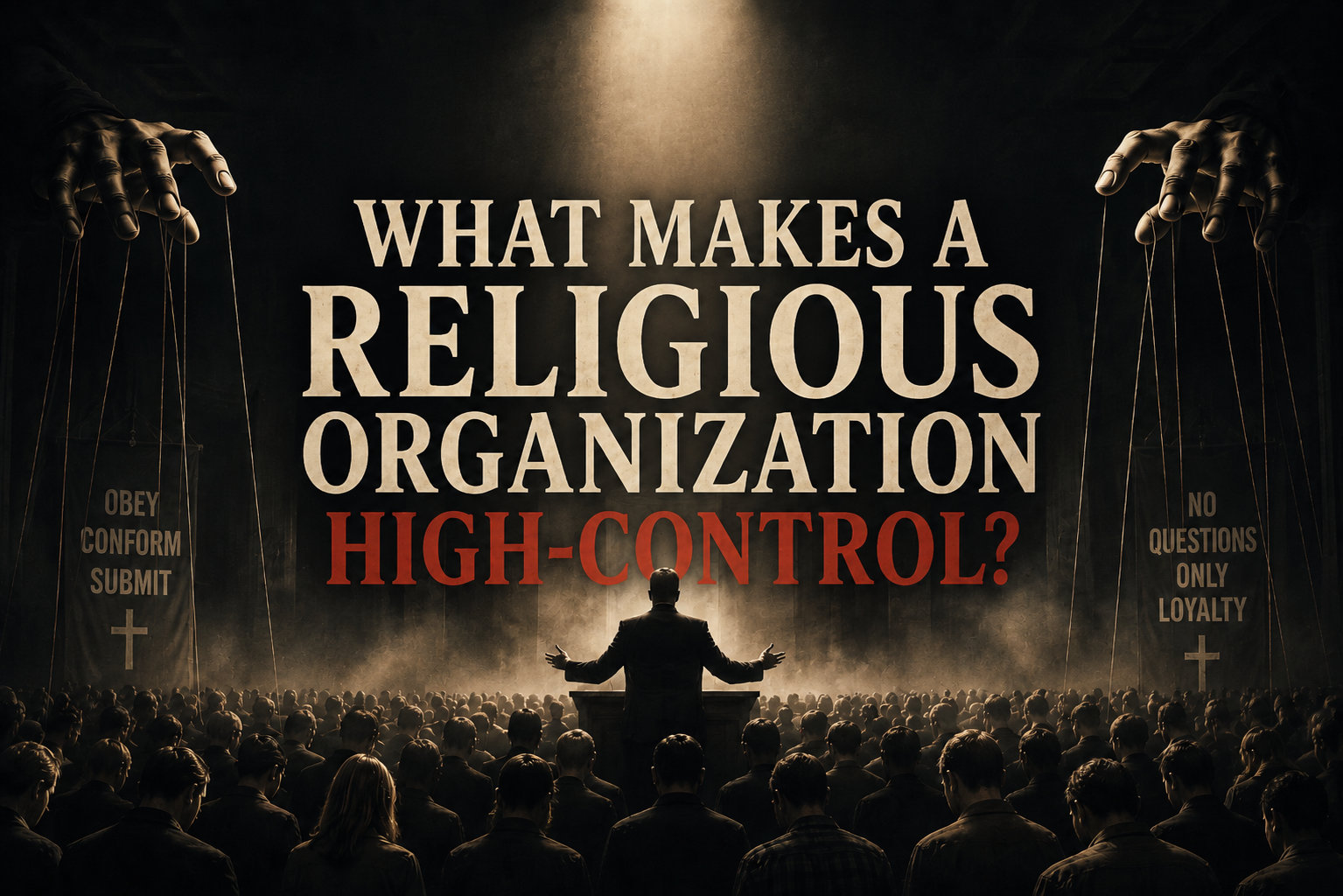
Moving Beyond Labels to Recognizable Patterns
Some religious organizations are obviously restrictive. Their rules are visible, their authority structures are rigid, and the consequences of disobedience are clearly understood. The more difficult situations are those in which people appear to possess meaningful choices, yet the surrounding culture has made nearly every alternative spiritually, relationally, or personally costly. A member may technically be free to ask questions, consult other sources, disagree with leadership, decline an expectation, or leave. But when exercising those freedoms threatens relationships, reputation, ministry, belonging, or one’s sense of spiritual security, the existence of a choice does not necessarily mean the person experiences meaningful freedom.
This is where the language of high control can be helpful, but it must also be used carefully. The term should not become another label for every demanding church, strong leader, conservative community, hierarchical denomination, or religious organization whose practices seem unfamiliar. Christianity itself makes serious demands upon those who follow Christ. Jesus called His disciples to obedience, sacrifice, holiness, repentance, community, and costly faithfulness. A church is not controlling merely because it expects commitment, establishes moral boundaries, practices discipline, or asks members to submit to legitimate leadership.
The deeper question is how such commitment is formed and maintained. Does the organization persuade through Scripture, truth, wisdom, and responsible pastoral care, or does it gradually create an environment in which only one response feels spiritually safe? Does authority help people mature, or does it make them increasingly dependent upon the institution? Can members reach different conclusions without having their motives or spirituality called into question? Can leaders be corrected without the person raising the concern becoming the problem? These questions move us beyond labels and toward patterns revealing how control actually functions.
High Control Is Not a Diagnosis
The phrase high-control religious organization sounds precise, but it should not be treated as though it were a universally agreed clinical or sociological diagnosis. The history of terms such as cult, high-demand group, and high-control group shows these labels have often been used differently across academic, therapeutic, religious, and popular settings.¹ This does not make the language useless. It simply means we should resist the temptation to treat a descriptive term as though it automatically settles every question about an organization.
This matters because labels can sometimes end the conversation too quickly. Once an organization is called a cult, some people may assume every member is deceived, every leader is malicious, and every experience inside the group must have been false. Others may react in the opposite direction and dismiss every criticism because they believe the label itself is unfair. Neither response helps us understand how power, belonging, fear, and authority are actually operating.
A more responsible approach is to examine influence along a spectrum. Recent scholarship recognizes religious and social influence can range from relatively ordinary forms of commitment and devotion to patterns involving exploitation, manipulation, and undue control.² Research into spiritual abuse likewise suggests harm can occur along a continuum and is not limited to organizations commonly described as cults.³ This allows us to ask better questions without requiring the most extreme label first.
The question is therefore not merely whether a church is strict, unusual, demanding, or deeply committed. The more important question is whether several forms of pressure have begun working together to reduce meaningful choice and make institutional conformity increasingly necessary for spiritual security and belonging.
When the Range of Acceptable Choices Narrows
High control often develops not by eliminating choice completely but by narrowing which choices are considered faithful. A person may still be told he or she is free to decide, yet the culture communicates only one decision will preserve spiritual approval. Someone can disagree with a teaching, but disagreement may be interpreted as pride. A member can seek outside counsel, but outside voices may already have been defined as spiritually unsafe. A person can decline a ministry assignment, but the decision may raise questions about commitment. Someone can leave, but departure may alter friendships, family relationships, reputation, and the way others understand the person’s standing with God.
This is why coercion in a religious setting can be more complicated than a direct threat. Recent research on spiritual abuse describes systematic patterns capable of including manipulation, enforced accountability, censorship, pressure to conform, restrictions upon personal autonomy, unquestioning obedience, isolation, spiritual threats, and claims of authority presented as difficult or impossible to challenge.⁴ Not every factor will be present in every situation, and one troubling incident does not automatically establish a high-control culture. The concern grows when several of these practices become predictable and mutually reinforcing.
The difference between persuasion and coercion becomes especially important. Christian leaders are supposed to persuade. Preaching seeks to persuade people toward truth. Teaching shapes belief. Pastoral counsel influences decisions. Churches establish convictions and call people to live according to them. The problem begins when persuasion is reinforced by consequences making an alternative conclusion too costly to consider honestly.
Two people may therefore display the same outward behavior for very different reasons. One follows a church standard because of settled biblical conviction. Another follows the same standard because disagreement could affect family relationships, ministry opportunities, reputation, or spiritual standing. From the outside, both appear equally committed. Yet one is acting from conviction while the other may be responding primarily to fear. High-control cultures often become difficult to recognize precisely because outward conformity does not reveal what produced it.
When the Organization Controls the Meaning of Experience
One of the deeper expressions of control occurs when an organization gains influence not only over what members should do but also over how members are expected to interpret what happens to them. Human beings respond to events according to the meaning they assign to those events. When one institution becomes the primary interpreter of nearly every spiritual experience, it can acquire extraordinary influence over how members understand their own lives.
A leadership correction may be interpreted as God’s correction. Emotional discomfort may be described as conviction. Doubt may be explained as spiritual attack. A family member’s concern may be treated as evidence outsiders do not understand the truth. A former member’s testimony may be dismissed before it is examined because departure has already been interpreted as bitterness, deception, or rebellion. Even personal distress can be reframed in a manner protecting the organization: the problem is no longer what happened to the person but the person’s supposedly unhealthy response to what happened.
Research into the lived experience of spiritual abuse has identified precisely this kind of tension. Participants described environments in which leaders were experienced as representing God’s highest spiritual authority, making disagreement with leadership feel like opposition to God. The same research identified fear, guilt, submission to authority, performance-based acceptance, and an increasing conflict between what people experienced internally and what they believed they were required to accept externally.⁵ The danger is not merely an incorrect interpretation by a leader. Every pastor will eventually misunderstand something. The deeper danger appears when the organization becomes the unquestioned interpreter of every challenge to itself.
At this point, the system can become difficult to correct because every possible response has already been given a meaning. Agreement demonstrates faithfulness. Disagreement demonstrates rebellion. Staying confirms commitment. Leaving confirms deception. Silence proves unity. Criticism proves hostility. Once those interpretations are established, very little evidence remains capable of forcing the organization to reconsider its assumptions.
When Members Learn to Monitor Themselves
A mature system of control does not require leaders to watch every person constantly. Over time, members can learn to monitor themselves. They discover which subjects are safe, which friendships invite questions, which theological ideas should remain unexplored, which conversations should not be repeated, and which expressions of disagreement may alter how others view them. Eventually, direct enforcement becomes less necessary because people begin anticipating the reaction of the organization before they make decisions.
The internal question slowly changes. Instead of asking only, “Is this faithful to Christ?” the member also begins asking, “What will happen if they know?” A book may remain unread because someone could question why it was purchased. A concern may remain unspoken because raising it could affect future ministry. A friendship may be limited because association with the wrong person could produce suspicion. A member may carefully edit what is said around certain people because honest conversation might eventually find its way to leadership.
When this occurs, control has moved from external expectation to internal self-regulation. The institution no longer needs to forbid every behavior because members have learned to anticipate institutional judgment. The most powerful rules in an organization are sometimes the ones never formally written.
This also explains why visible unity can be misleading. An organization may appear remarkably unified because everyone genuinely shares deep convictions and loves one another. But an organization may also appear unified because dissent has become too costly to express. Silence can look like agreement. Compliance can look like conviction. Stability can look like peace. The absence of public disagreement does not tell us why disagreement is absent.
When Relationships Increase the Cost of Dissent
Christian community is supposed to create deep belonging. Churches become places where people worship, serve, raise children, build friendships, discover calling, receive care, and create memories spanning generations. None of this is unhealthy. In fact, much of it reflects the beauty of the body of Christ. The difficulty begins when belonging becomes so closely tied to institutional conformity, making disagreement a threat to a person’s entire social and spiritual world.
Imagine a person’s closest friends, immediate family, ministry opportunities, spiritual identity, and sense of calling are all concentrated within one organization. A theological disagreement now threatens far more than a change in opinion. It may affect marriage, parents, children, friendships, ministry, reputation, and the story through which the person has understood his or her entire Christian life. If the organization has also taught other churches are spiritually inferior, compromised, deceived, or outside the fullness of God’s will, leaving may feel less like changing congregations and more like abandoning spiritual safety.
This is where the real cost of dissent becomes visible. The organization may never explicitly say, “You are not allowed to leave.” It may not need to. Members already know what leaving could mean.
The practical question is therefore not simply whether membership is technically voluntary. In most churches operating within a free society, the answer will obviously be yes. The more revealing question is what happens when a person actually exercises this freedom. Can someone leave while retaining dignity? Can friendships continue without every relationship becoming a rescue mission? Can years of faithful service still be remembered with gratitude? Can remaining members continue normal relationships with those who depart, or are such relationships quietly discouraged?
The cost of departure tells us something important about the reality of belonging. Healthy community grieves when people leave, but it does not need to destroy their reputation in order to explain their departure.
When Correction Can No Longer Reach Leadership
Every Christian organization needs feedback. Leaders possess limited knowledge, organizations develop blind spots, policies have unintended consequences, and even sincere people can become convinced their interpretation of events is more complete than it actually is. Healthy organizations survive these limitations because corrective information can reach the places where decisions are being made.
High-control systems gradually weaken the process. People begin softening bad news before bringing it to leadership. Those who repeatedly raise concerns acquire reputations for negativity or disloyalty. Former members are considered unreliable because they left. Outside criticism is dismissed because outsiders do not understand the organization. Internal criticism is dismissed because faithful members should trust leadership. Eventually, everyone capable of providing corrective information has already been placed into a category making their information easier to reject.
This creates one of the most serious organizational problems a church can face: the system becomes increasingly unable to learn from its own failures. The leadership may sincerely believe correction is welcomed, but the surrounding culture filters correction before it ever reaches the center. Members defend leaders before leaders are required to answer. Uncomfortable information is softened, spiritualized, or redirected. People who have invested deeply in the organization may feel compelled to protect it because acknowledging a serious problem would require reconsidering too much of their own history.
A healthy Christian organization must be capable of discovering it is wrong. This does not mean every accusation is true, every criticism is fair, or every dissatisfied member should determine organizational policy. It means the system must contain enough humility and accountability for truth to reach leadership even when such truth is unwelcome.
The question is not whether leaders sometimes make mistakes. They will. The question is whether the organization still possesses a meaningful pathway through which those mistakes can be identified, acknowledged, and corrected.
Diotrephes and the Desire to Be First
Third John offers a striking biblical picture of several unhealthy patterns operating together. John describes Diotrephes as one “who loves to be first” and says he refuses to welcome apostolic representatives. John continues by explaining Diotrephes spreads “malicious nonsense,” refuses to welcome other believers, prevents those who want to welcome them, and “puts them out of the church” (3 John 9–10).
We should be careful not to force modern terminology onto every New Testament conflict. John does not call Diotrephes the leader of a high-control organization, and we should not pretend he does. Yet the behaviors are instructive because they reveal what can happen when a desire for prominence becomes connected with control over information, relationships, and belonging.
Diotrephes does not merely disagree with John. He attempts to control who will be heard, who will be welcomed, how others will be described, and what happens to members who refuse to cooperate with his position. Several mechanisms of influence have converged around one center of authority: personal preeminence, resistance to outside correction, damaging speech about opponents, regulation of relationships, and exclusion from the community.
John’s response is equally important. He does not interpret resistance to Diotrephes as rebellion against church authority. He intends to expose what is occurring. Spiritual leadership does not become immune from examination simply because it is exercised within the Church.
The passage gives us one of the clearest tests of Christian authority: what do leaders do when they cannot control the response of others? Do they persuade, explain, listen, and remain accountable, or do they begin controlling access, relationships, reputation, and belonging?
What Paul Refused to Call Spiritual
Paul addresses another troubling form of religious authority in Second Corinthians 11. The Corinthians had become remarkably tolerant of leaders who projected strength and superiority. Paul tells them, “In fact, you even put up with anyone who enslaves you or exploits you or takes advantage of you or puts on airs or slaps you in the face” (2 Cor. 11:20).
His language is intentionally severe. The Corinthians appear to have accepted treatment Paul regarded as incompatible with healthy spiritual leadership. What is especially striking is Paul’s refusal to praise their willingness to submit. He does not present enduring domination as evidence of humility. He exposes the absurdity of tolerating leaders who exploit them.
This challenges a misunderstanding capable of becoming deeply rooted in religious cultures: the assumption of a direct link between greater submission and greater spirituality. Scripture certainly calls Christians to humility and appropriate submission, but submission is not a virtue when it becomes cooperation with exploitation. Enduring mistreatment from an impressive religious leader does not automatically make a person more faithful.
Religious environments can sometimes mistake certainty for spiritual authority, domination for strength, and unquestioning compliance for unity. A leader who speaks with absolute confidence may appear more spiritual than one who openly acknowledges limitations. A pastor who controls every decision may appear more decisive than one who shares authority. Yet the New Testament does not ask whether a leader can command obedience. It asks whether the leader’s authority reflects the character of Christ.
High Control Is Cumulative
This is why no single warning sign should be used carelessly. A strong pastor does not automatically create a high-control church. A strict standard does not establish coercion. A close-knit community does not prove unhealthy dependency. A church warning people about false teaching is not necessarily restricting information. A difficult disciplinary decision is not automatically punishment for dissent.
The concern increases when several patterns begin reinforcing one another. Concentrated authority becomes more dangerous when the same authority also controls interpretation. Interpretive control becomes more powerful when outside information is distrusted. Information restriction becomes more effective when members’ closest relationships exist only within the group. Relational dependency becomes more frightening when departure carries spiritual consequences. Spiritual fear becomes more controlling when disagreement can affect ministry, reputation, and belonging. At this point, practices appearing ordinary in isolation have begun functioning together as a system.
This is the cumulative test. How much meaningful freedom remains when the patterns are considered together?
A person outside the organization may look at one expectation and reasonably conclude, “No one forced you to do this.” In a narrow sense, such a conclusion may be true. But the person inside the culture was not responding to one expectation in isolation. He or she was responding to the combined weight of theology, relationships, authority, reputation, identity, spiritual fear, family, and anticipated consequences. Human decisions are made within systems of meaning, and Christian leaders should care not only whether people are technically free but also whether our organizational practices make honest discernment unnecessarily costly.
High control is therefore not best understood as one leader’s personality or one unusual policy. It is better understood as an environment in which multiple pressures converge until the range of spiritually acceptable choices becomes increasingly narrow.
The Difference Between Commitment and Dependency
A healthy church should produce committed people. It should form believers who love Scripture, serve sacrificially, give generously, care for one another, embrace holiness, respect leadership, and participate seriously in the mission of Christ. None of those outcomes should embarrass us simply because controlling organizations may imitate them.
The distinguishing question is what happens to the person as commitment deepens. Healthy commitment should produce maturity. High control tends to produce dependency.
Paul’s description of Christian leadership in Ephesians 4 offers an important contrast. Christ gives leaders to the Church “to equip his people for works of service” as the body of Christ is built up and moves toward maturity (Eph. 4:12–13). The purpose of leadership is not to make God’s people permanently dependent upon leaders. Leadership equips the saints so they can become mature participants in the life and mission of Christ.
This gives pastors and Christian leaders a difficult but necessary question to ask: Are the people under our care becoming more capable of reading Scripture responsibly, exercising wisdom, recognizing error, making thoughtful decisions, receiving correction, and following Christ without constant institutional approval? If their growth in discernment makes us nervous, we should examine what we have come to believe leadership is for.
Mature believers will not always agree with us. They may sometimes reach conclusions we believe are wrong. They may ask questions we would prefer not to answer. They may identify weaknesses in systems we helped build. Their maturity does not remove the need for teachers or community, but neither should leadership require permanent spiritual childhood in order to preserve its own importance.
Healthy authority is not threatened when people grow. It was given for this very purpose.
Recognizing the Pattern Without Becoming Suspicious of Everyone
There is a danger on both sides of this conversation. Some Christians may minimize controlling behavior because they fear questioning authority will produce rebellion. Others, after recognizing genuine spiritual harm, may begin seeing control in every church structure, every pastoral correction, or every strong conviction. Neither response is healthy.
The answer to religious control is not a Christianity without authority, doctrine, boundaries, discipline, community, or accountability. The Church needs pastors and teachers. Believers need correction. Christian freedom is not the freedom to make personal preference the highest authority. The healthier path is neither domination nor isolation. It is authority remaining accountable to Christ and understanding its own limits.
Responsible discernment therefore asks patient questions. Is this pattern repeated or isolated? Is the expectation biblical or primarily institutional? Can the leader be questioned? Is disagreement answered or punished? Can information move freely enough for the organization to correct itself? Are people becoming mature or increasingly dependent? Are departures treated with dignity? Does the organization need to control the reputation of those who disagree with it?
Those questions are more useful than quickly attaching a label. They allow us to take warning signs seriously without turning every imperfect church into a destructive religious system.
Authority Under Christ
The final measure of Christian authority is not how effectively it preserves an organization. It is how faithfully it reflects Jesus Christ.
Jesus possessed an authority no human pastor, bishop, denomination, ministry, or movement could ever claim. Yet His authority never required Him to manipulate people into loyalty. He could speak hard truth without controlling relationships. He could call people to costly obedience without making their spiritual identity dependent upon institutional approval. He could correct His disciples without preventing them from maturing. His leadership did not make His followers smaller so He could remain indispensable.
This distinction should shape every Christian leader. The people entrusted to us do not belong to us. Their consciences do not belong to us. Their calling does not belong to us. Their relationship with God does not depend upon our approval. We teach, shepherd, correct, encourage, warn, and protect, but we do so as stewards of people who already belong to Christ.
A high-control religious culture develops when human systems begin occupying too much of this sacred space. Authority becomes difficult to question. Interpretations become protected. Choices narrow. Members learn to monitor themselves. Relationships raise the cost of dissent. Correction no longer reaches the center. Eventually, institutional security can begin to feel inseparable from spiritual security.
Christian leadership should move in the opposite direction. It should form believers who are grounded enough in Scripture to examine what they are taught, humble enough to receive correction, wise enough to exercise conscience responsibly, and secure enough in Christ to recognize no human institution stands between them and their Lord.
The question is therefore not whether a religious organization has authority, expectations, strong convictions, or committed members. Those realities can exist within healthy churches. The deeper question is what happens when authority, information, belonging, fear, interpretation, and consequence begin working together. When only one response feels spiritually safe, when honest disagreement becomes personally dangerous, and when the system can no longer receive correction without attacking the person who brings it, Christian formation has begun moving toward something else.
Christ did not give leaders to His Church so the people of God would become dependent upon us. He gave leaders to equip His people for maturity in Him. This difference is not small. It may be one of the clearest boundaries between spiritual leadership and religious control.
Endnotes
- Joseph P. Laycock, “A Cult by Any Other Name: Is ‘High Demand Group’ a Useful Category?,” Nova Religio: The Journal of Alternative and Emergent Religions 28, no. 1 (2024): 90–104, especially 90–95. Laycock traces the history and changing use of terminology such as high-demand group and high-control group and cautions against treating such terms as though they constitute universally agreed scientific classifications.
- Stephanie Alice Baker, Eugene McLaughlin, and Chris Rojek, Cults (Abingdon, UK: Routledge, 2024), 12–29, especially 27–29, https://doi.org/10.4324/9781003335115. The authors discuss cultic influence as operating along a continuum, including distinctions between relatively benign forms of influence and forms involving exploitation and undue control.
- David J. Ward, “The Lived Experience of Spiritual Abuse,” Mental Health, Religion & Culture 14, no. 9 (2011): 899–915, especially 900–901, https://doi.org/10.1080/13674676.2010.536206. Ward argues harm connected with religious group membership may occur along a continuum and notes spiritual abuse is not limited to organizations commonly described as cults.
- Lisa Oakley, Kathryn Kinmond, and Peter Blundell, “Responding Well to Spiritual Abuse: Practice Implications for Counselling and Psychotherapy,” British Journal of Guidance & Counselling 52, no. 2 (2024): 189–206, especially 190, https://doi.org/10.1080/03069885.2023.2283883. Their revised definition of spiritual abuse describes a systematic pattern of coercive and controlling behavior within religious contexts and identifies examples including manipulation, enforced accountability, censorship, pressure to conform, restrictions upon autonomy, unquestioning obedience, isolation, spiritual threats, and claims of unchallengeable divine position.
- Ward, “The Lived Experience of Spiritual Abuse,” 902–13. Ward’s qualitative analysis identified themes including leadership representing God, spiritual bullying, acceptance through performance, spiritual neglect, fear and guilt, submission to authority, and growing tension between participants’ internal experiences and the external expectations of their religious communities.

Leave a Reply