
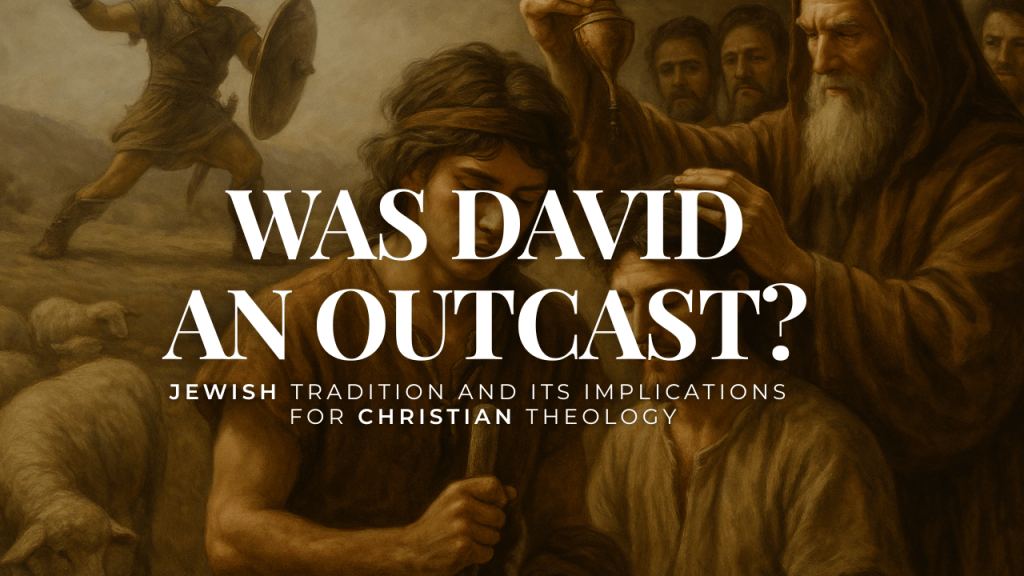
This article explores rabbinic traditions suggesting that King David may have been born outside the bounds of covenantal marriage and the implications of such views for Jewish and Christian understandings of sin. Drawing on Talmudic and Midrashic sources, it contrasts Judaism’s rejection of inherited sin (ḥet yirusha) with Paul’s doctrine of original sin. The discussion situates David’s potential marginalization within the broader biblical motif of God exalting the lowly. It also draws Christological parallels between David’s social rejection and the suspicions surrounding Jesus’ birth. Engaging Jewish interpretive traditions, the article argues, deepens Christian understanding while affirming the necessity of Christ’s atonement.
Introduction
King David stands as one of the most celebrated figures in biblical history, revered as the poet of Israel, the valiant warrior-king, and the progenitor of the Messiah. His life story, however, is one marked not only by divine favor but also by moments of profound alienation and scandal. While Christian readers often focus on David’s moral lapses—his sin with Bathsheba and his numbering of the people—rabbinic traditions draw attention to an earlier and more surprising controversy: the possibility that David himself was born under circumstances that cast doubt on his legitimacy within the covenant community.
This idea, while not explicitly stated in the Hebrew Bible, finds its roots in interpretative readings of key texts such as Psalms 51:5, 69:8, and the narrative of 1 Samuel 16. Jewish exegetes, employing a hermeneutic sensitive to familial and social dynamics in ancient Israel, have suggested that David’s isolation and the suspicion he endured in his youth were not accidental but indicative of a deeper societal rejection. Such a reading does not detract from David’s significance; rather, it aligns with a recurring biblical motif: God’s election of the marginalized and despised to accomplish His purposes.
The theological implications of this interpretation extend beyond David’s biography. They intersect with broader questions of human nature and sin. Judaism teaches that individuals are born morally neutral, possessing bechirah chofshit (free will) to choose good or evil, and it rejects the notion of inherited sin. Christianity, by contrast, affirms the doctrine of original sin, asserting that humanity’s sinful nature is a consequence of Adam’s transgression and that divine redemption through Christ is necessary. These divergent views influence how interpreters understand the psalms attributed to David and how they conceptualize human alienation from God.
This article aims to examine the rabbinic tradition concerning David’s birth, analyze its scriptural underpinnings, contrast Jewish and Christian doctrines of sin, and explore the theological resonance between David’s social rejection and the suspicions surrounding Jesus’ birth. In doing so, it argues that engaging with Jewish perspectives can enrich Christian theological reflection, even as one maintains a commitment to apostolic doctrine.
I. Rabbinic Traditions on David’s Birth
A. The Talmudic Framework
The Babylonian Talmud, particularly in Yevamot 76b–77a, presents a striking narrative suggesting that King David’s legitimacy was a point of contention within his own household. Jesse (Yishai), David’s father, is portrayed as a righteous man of great piety, yet plagued by doubts regarding his Moabite ancestry through Ruth. Deuteronomy 23:3 declares, “An Ammonite or Moabite shall not enter into the congregation of the Lord; even to their tenth generation shall they not enter.” Though later rabbinic rulings clarified that this prohibition applied only to male Moabites, based on the gendered form of the Hebrew (Moavi), Jesse reportedly remained uncertain and feared his lineage might be tainted.
Midrash Tehillim on Psalm 118 embellishes this tension by recounting Jesse’s decision to separate from his wife, Nitzevet bat Adael, to avoid perpetuating what he perceived as a questionable line. Jesse planned to conceive a child with a concubine, believing this would ensure his descendants’ halakhic acceptability. Nitzevet, aware of this plan and seeking to preserve her bond with her husband, allegedly switched places with the concubine on the night of conception, mirroring the narrative of Leah and Rachel’s deception in Genesis 29. As a result, she conceived David. To the community, however, the situation appeared scandalous, and rumors of infidelity tarnished Nitzevet’s reputation. David was born under a cloud of suspicion and treated as a mamzer (a child born of a forbidden union), a label carrying severe social and legal implications in Jewish law.
This perceived illegitimacy profoundly impacted David’s early life. According to rabbinic sources, Jesse’s other sons distanced themselves from David, treating him not as a sibling but as a servant. They assigned him to shepherding duties far from the family’s home—a role often romanticized in biblical literature but here representing rejection and exclusion. In ancient Israelite society, shepherding was a menial task, frequently relegated to those of lower social standing or even hired hands. For David, it may have symbolized not pastoral tranquility but familial exile.
The narrative of Samuel’s visit to anoint a king in 1 Samuel 16 further underscores this theme. Jesse presented his seven eldest sons, omitting David entirely. Only when Samuel inquired, “Are here all thy children?”, did Jesse reluctantly mention his youngest: “There remaineth yet the youngest, and, behold, he keepeth the sheep” (v. 11). The Hebrew word qatan, translated “youngest,” can also imply insignificance or unworthiness, suggesting Jesse’s hesitance to acknowledge David as a legitimate heir. This omission, viewed through the rabbinic lens, reinforces the notion of David’s marginalization within his own family.
This Talmudic and Midrashic narrative illustrates how communal perceptions of legitimacy and purity could profoundly shape individual destinies in ancient Israel. While these accounts are noncanonical, their presence in Jewish tradition reflects an attempt to grapple with the paradox of divine election: How could God choose as Israel’s greatest king a man whose very birth was suspect? The answer lies in the recurring biblical theme of God exalting the lowly and using the rejected to fulfill His purposes.
B. Scriptural Clues and Literary Patterns
The biblical text itself, though silent on the precise details of David’s birth, contains subtle indications that align with the rabbinic interpretation of his marginalization. One of the most compelling is found in Psalm 69:8: “I am become a stranger unto my brethren, and an alien unto my mother’s children.” The Hebrew terms used here, zar (stranger) and nokhri (alien), carry strong connotations of estrangement and exclusion. Rather than denoting simple familial discord, these words suggest a deeper level of rejection, potentially reflective of David’s societal status as perceived by his family and community. Jewish commentators often view this verse as autobiographical, reading it as David’s lament over his treatment by those closest to him.
Another key verse is Psalm 51:5, which states, “Behold, I was shapen in iniquity; and in sin did my mother conceive me.” While Christian exegetes—especially from the Augustinian tradition—have historically interpreted this as evidence for original sin, Jewish interpretations differ markedly. Many rabbinic authorities suggest that David is referring not to a universal human condition but to the particular circumstances of his conception. If Nitzevet’s pregnancy was surrounded by scandal, David’s words could reflect his personal awareness of the shame and suspicion cast upon him from birth. This reading underscores the cultural reality in ancient Israel, where questions of lineage and legitimacy held immense social and religious weight.
The narrative in 1 Samuel 16 further reinforces the impression of David’s marginalization. When Samuel arrives in Bethlehem to anoint a new king, Jesse assembles his sons but excludes David from the gathering. Only after Samuel asks, “Are here all thy children?” does Jesse acknowledge David’s existence: “There remaineth yet the youngest, and, behold, he keepeth the sheep” (v. 11). The Hebrew word qatan (קָטָן), while denoting the youngest in age, can also suggest insignificance or unworthiness. This dual meaning amplifies the possibility that David’s omission was not merely a practical oversight but a deliberate act reflective of his perceived status within the family.
Additionally, Psalm 27:10 offers a poignant reflection: “When my father and my mother forsake me, then the Lord will take me up.” While many commentators have read this verse metaphorically, Jewish exegetes often take it more literally, linking it to David’s early experiences of familial rejection. If David indeed grew up under a shadow of suspicion regarding his parentage, this verse can be seen as an expression of profound trust in God’s acceptance in the face of human abandonment. Such readings emphasize the resilience of David’s faith and his deep emotional engagement with God—a hallmark of his psalmody.
Together, these scriptural passages, when read through the lens of rabbinic interpretation, paint a picture of a young man shaped by exclusion and misunderstanding. They reveal a David whose spiritual intimacy with God may have been forged not in the halls of privilege but in the crucible of rejection. This perspective aligns with a broader biblical pattern: God’s election of the least likely candidate—whether Joseph, the youngest son of Jacob; Moses, the stammering fugitive; or David, the shepherd boy suspected of illegitimacy.
II. Jewish and Christian Views on Inherited Sin
A. Judaism’s View of Sin and Innocence
Judaism’s understanding of human nature fundamentally differs from that of Christianity, particularly regarding the concept of inherited sin. The Jewish tradition affirms that human beings are born b’tzelem Elohim (“in the image of God”), possessing inherent dignity and moral neutrality. Unlike Christian theology, which sees humanity as tainted by Adam’s fall, Judaism teaches that each person begins life free from guilt and is endowed with the capacity for bechirah chofshit (free will) to choose between good and evil. The Talmud (Berakhot 60b) underscores this belief, noting that a child is born without moral blemish and only acquires the yetzer ha-tov (good inclination) and yetzer ha-ra (evil inclination) as they mature.
This emphasis on free will is reinforced by Ezekiel 18:20, which states, “The son shall not bear the iniquity of the father, neither shall the father bear the iniquity of the son.” Jewish exegetes interpret this as a direct repudiation of any notion of generational guilt or congenital sinfulness. Each individual stands accountable for their own actions, and divine justice does not impute the sins of the parents to the child. In this framework, David’s lament in Psalm 51:5—“Behold, I was shapen in iniquity; and in sin did my mother conceive me”—is read not as a universal confession of original sin but as a personal expression of the social stigma surrounding his conception.
Furthermore, Judaism’s focus on teshuvah (repentance) underscores its anthropology. Since individuals are not born depraved, repentance is seen as a process of returning to one’s inherent goodness rather than overcoming an inherited corruption. The Midrash (Deuteronomy Rabbah 2:24) observes that God created humans with both inclinations to test their righteousness, but no one is predestined to fail. This contrasts sharply with Augustinian views of original sin, which posit a radical corruption of human will necessitating divine grace for any righteous action.
David’s potential marginalization, therefore, would not have been interpreted by Jewish thinkers as evidence of intrinsic sinfulness but rather as the result of external circumstances—namely, the community’s perception of his mother’s alleged impropriety. Such an interpretation reinforces the Jewish emphasis on societal dynamics and individual moral responsibility rather than an ontological fallenness inherited from Adam.
B. Paul’s Doctrine of Original Sin in Romans
Christian theology, particularly as articulated by Paul, offers a contrasting view of human nature. In Romans 5:12, Paul writes, “Wherefore, as by one man sin entered into the world, and death by sin; and so death passed upon all men, for that all have sinned.” This verse forms the cornerstone of the doctrine of original sin, asserting that Adam’s transgression resulted in the corruption of human nature itself. All of Adam’s descendants inherit a propensity toward sin, rendering humanity incapable of achieving righteousness apart from divine intervention.
This anthropology finds further development in Romans 7, where Paul describes the internal conflict between the desire to do good and the power of sin dwelling within: “For the good that I would I do not: but the evil which I would not, that I do” (v. 19). This tension underscores the pervasive reach of sin in human existence and the necessity of Christ’s redemptive work to restore the fractured relationship between God and humanity.
The doctrine of original sin was formalized in the writings of Augustine of Hippo, who drew heavily on Paul’s epistles. Augustine argued that humanity’s will was so thoroughly corrupted by the Fall that only God’s grace could enable a person to choose good. This view, transmitted through Western Christianity, shaped centuries of theological reflection and remains central to most Protestant and Catholic formulations of soteriology.
Paul claims that this understanding of sin was not merely a product of philosophical reasoning but a revelation received from Christ Himself: “For I neither received it of man, neither was I taught it, but by the revelation of Jesus Christ” (Galatians 1:12). For Christians, therefore, the universality of sin is not a speculative doctrine but a revealed truth essential to understanding the gospel.
The divergence between these two frameworks—Judaism’s focus on free will and Christianity’s emphasis on inherited sin—offers a fascinating backdrop for reading David’s psalms. Where Jewish interpreters see Psalm 51:5 as David lamenting societal judgment, Christian theologians often view it as a cry from the depths of original corruption, longing for divine renewal. This difference highlights how theological presuppositions shape the interpretation of shared sacred texts.
III. Reading Scripture Through a Jewish Lens
A. Benefits of Jewish Hermeneutics for Christian Theology
Engaging Jewish hermeneutics provides Christian readers with a valuable corrective to certain interpretative blind spots. The Hebrew Scriptures, known in Jewish tradition as the Tanakh, were written within a specific cultural, linguistic, and historical milieu. Jewish exegesis—particularly Midrashic and Talmudic approaches—preserves layers of meaning often overlooked by later Christian readers who approach the text through Greco-Roman philosophical categories. By reading the Psalms through Jewish eyes, one recovers the lived realities of figures like David, whose poetic laments may have been shaped not merely by theological abstractions but by tangible experiences of rejection, familial tension, and societal stigma.
This approach also highlights the communal and relational dimensions of the biblical text. In Jewish thought, the covenantal community serves as the primary locus of identity and moral formation. Thus, David’s possible exclusion from family gatherings and his assignment to shepherding duties are not incidental details but clues to his standing within the covenant family. Reading 1 Samuel 16 with this sensitivity suggests that Jesse’s omission of David may reflect more than oversight; it may indicate the lingering effects of communal suspicion toward his birth.
At the same time, Jewish interpretation often resists universalizing individual experiences. Whereas Christian theology tends to extrapolate from David’s laments a doctrine of universal human depravity, Jewish readings tend to situate these texts within the specific historical and biographical context of David’s life. This perspective allows for a nuanced understanding of texts like Psalm 51:5 and Psalm 69:8, which may blend personal confession with reflections on unjust social marginalization.
B. Cautions and Theological Boundaries
While the Jewish lens offers valuable insights, Christians must approach it with discernment. The denial of inherited sin (ḥet yirusha) within Judaism contrasts sharply with Pauline anthropology. For Christian readers committed to the doctrine of original sin, the insights gained from Jewish exegesis must be integrated carefully, ensuring they do not undermine core doctrinal commitments. The New Testament repeatedly affirms the universality of sin (Romans 3:23) and humanity’s need for redemption, themes which cannot be reduced merely to social alienation or ethical failure.
Moreover, Midrashic literature often employs imaginative expansions of the biblical narrative, blending historical memory with theological reflection. While these expansions are spiritually rich, they do not claim to represent strict historical accounts. Thus, the story of Nitzevet’s secret union with Jesse and David’s alleged illegitimacy must be regarded as a theological motif rather than a verifiable event. For Christian theology, such motifs serve as lenses for exploring the theme of divine election rather than as definitive accounts of historical fact.
Nonetheless, engaging with these traditions fosters humility and a deeper appreciation for the Jewish roots of the Christian faith. It reminds us that God’s redemptive work has always unfolded within concrete historical contexts, often in ways that subvert societal expectations and hierarchies. By situating David’s story within its Jewish interpretative context, Christians gain a richer understanding of how God elevates the marginalized—not only in Israel’s history but ultimately in the person of Jesus Christ.
IV. David and Jesus: A Theological Comparison
A. Social Rejection as a Theological Motif
The possibility that David endured marginalization from his family and community finds a striking parallel in the New Testament portrayal of Jesus. Both figures, though divinely chosen, were subjected to social suspicion regarding their births. In John 8:41, Jesus’ opponents declare, “We be not born of fornication”—a thinly veiled insult aimed at the circumstances of His conception. This accusation mirrors the stigma David may have borne, as recounted in rabbinic traditions that viewed his mother’s pregnancy as questionable. Both narratives underscore a recurring biblical theme: God often elects individuals whom society regards as illegitimate or unworthy.
This theme extends throughout Scripture. Joseph, the eleventh son of Jacob, was scorned by his brothers and sold into slavery, yet God elevated him to a position of power in Egypt. Moses, born under the threat of infanticide and raised in Pharaoh’s household, fled as a fugitive before becoming Israel’s deliverer. David’s rise from a shepherd boy—possibly estranged from his family—to Israel’s king fits within this pattern of divine reversal. Similarly, Jesus, born in obscurity in Bethlehem and raised in Nazareth (“Can any good thing come out of Nazareth?” – John 1:46), fulfills this trajectory as the ultimate expression of God’s choice of the lowly.
B. Redemptive Patterns in Marginalization
The parallels between David and Jesus extend beyond their social rejection to their roles as covenantal representatives. David, despite his questionable standing, became the archetype of the Messianic King. His life of suffering, perseverance, and ultimate vindication prefigures the sufferings of Christ. Yet while David’s marginalization was eventually overcome through his anointing and coronation, Jesus’ rejection culminated in crucifixion—a humiliation that paradoxically became the locus of redemption.
Both David and Jesus embody the mystery of God’s preference for the humble and marginalized. In Philippians 2:7–8, Paul writes of Christ: “But made himself of no reputation, and took upon him the form of a servant… he humbled himself, and became obedient unto death, even the death of the cross.” Here, Christ’s voluntary embrace of marginalization becomes the means by which He redeems humanity from sin. David’s story, when viewed through this Christological lens, anticipates the pattern of suffering leading to glory—a pattern fulfilled in the life, death, and resurrection of Jesus.
Moreover, both figures demonstrate that divine election does not conform to human standards of legitimacy or worthiness. David was the overlooked son; Jesus, the misunderstood rabbi. Yet in both cases, God’s purposes triumphed over social stigma, illustrating that redemption often begins on the margins of society. For Christians, this parallel deepens the appreciation of Christ’s identification with the outcast and affirms the gospel’s radical message of inclusion.
V. Conclusion
The rabbinic tradition concerning David’s questionable birth, while not found in the canonical Scriptures, offers a profound lens through which to view his life and theological significance. By situating David as a figure potentially marked by familial suspicion and social marginalization, these interpretations highlight the recurring biblical motif of God exalting the lowly. From the barren wombs of Sarah and Hannah to the overlooked son of Jesse, divine election consistently overturns human hierarchies and expectations. David’s story thus becomes a testament to the grace of God, who chooses what the world deems unworthy to accomplish His redemptive purposes.
This Jewish perspective, however, must be understood within its theological context. The rejection of inherited sin (ḥet yirusha) and the affirmation of bechirah chofshit (free will) shape how Jewish interpreters read texts like Psalm 51:5 and Psalm 69:8. These passages are seen not as universal confessions of human depravity but as reflections of David’s personal experience of social alienation. By contrast, Pauline Christianity understands these same texts within the framework of original sin, viewing David’s lament as expressive of humanity’s shared fallen condition inherited from Adam. This doctrinal divergence underscores the importance of theological presuppositions in shaping scriptural interpretation.
Yet, engaging with Jewish hermeneutics does not threaten Christian orthodoxy; rather, it enriches it. By appreciating the historical and cultural dimensions preserved in rabbinic tradition, Christians gain a fuller picture of the world in which David lived and the factors that may have shaped his psalmody. These insights deepen our understanding of the emotional and spiritual realities behind his words, even as we hold firmly to the revealed truth of humanity’s need for redemption through Christ.f
Finally, the parallels between David and Jesus remind us that marginalization is not a barrier to divine purpose but often the very context in which God’s grace is most fully revealed. Both figures demonstrate that divine election operates according to God’s wisdom, not human social constructs. For Christians, this culminates in the gospel: Jesus Christ, the greater Son of David, identified with the outcast, bore the world’s rejection, and through His death and resurrection became the cornerstone of salvation. The scandal of David’s story finds its ultimate resolution in the scandal of the cross.
Works Cited
- Babylonian Talmud. Yevamot 76b–77a.
- Berakhot 60b. Babylonian Talmud.
- Deuteronomy Rabbah 2:24. Midrash Rabbah.
- Midrash Tehillim on Psalm 118.
- Telushkin, Joseph. Jewish Literacy: The Most Important Things to Know About the Jewish Religion, Its People, and Its History. William Morrow, 2001.
- Augustine of Hippo. Confessions. Translated by Henry Chadwick. Oxford University Press, 1991.
- Paul, Apostle. Epistle to the Romans. Holy Bible, King James Version.
- Paul, Apostle. Epistle to the Galatians. Holy Bible, King James Version.
- Ezekiel 18:20. Holy Bible, King James Version.
- Psalms 51, 69, 27. Holy Bible, King James Version.
- John 8:41. Holy Bible, King James Version.
- Philippians 2:7–8. Holy Bible, King James Version.
- Wright, N.T. Paul and the Faithfulness of God. Fortress Press, 2013.






 Dr. Nathan J. Bonilla
Leave a reply to Dr. Nathan J. Bonilla Cancel reply