
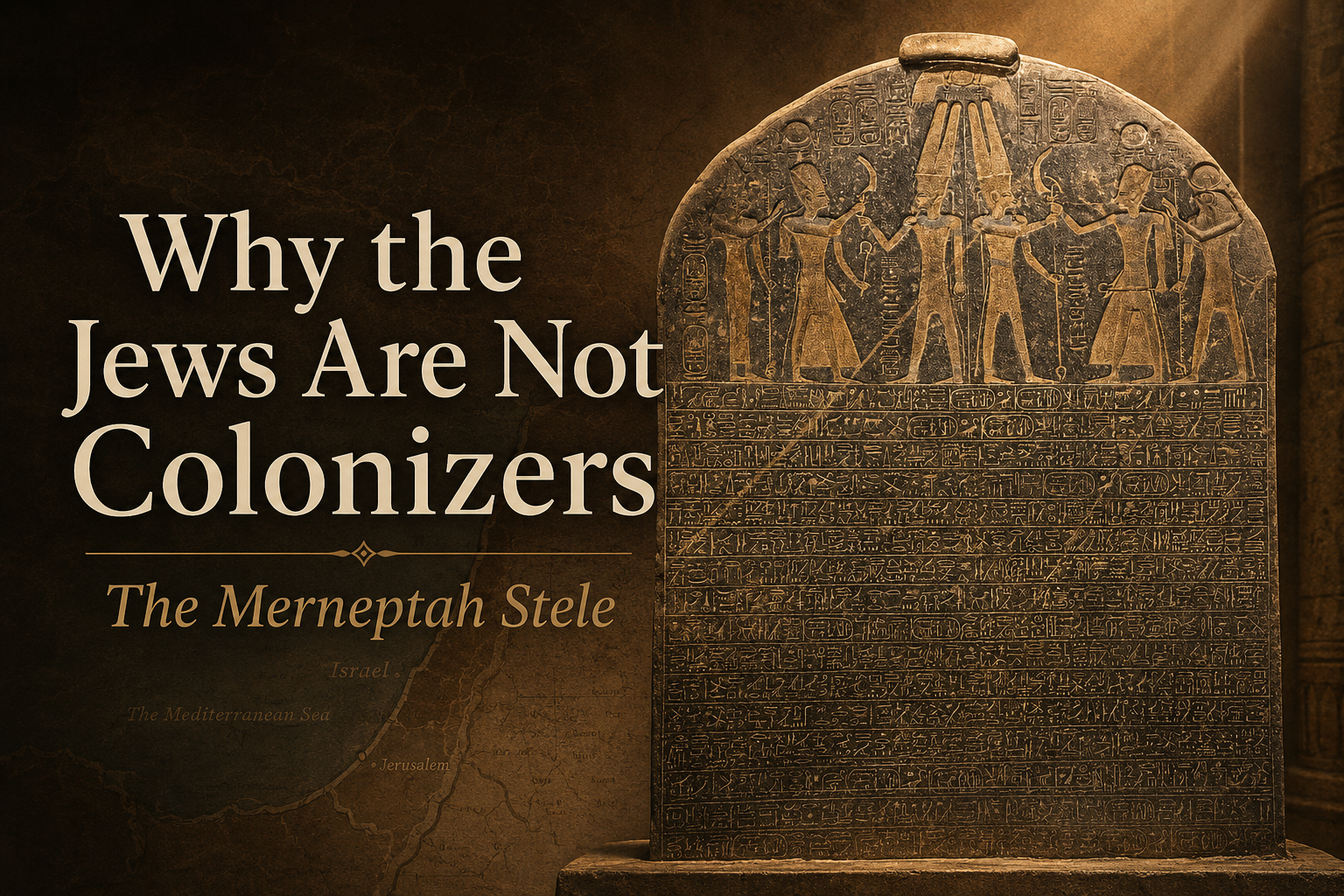
The claim that Jews are colonizers in the land of Israel often assumes that Jewish presence there is late, foreign, and politically manufactured. The Merneptah Stele makes that claim much harder to defend. This Egyptian inscription, usually dated to around 1208 BCE, is widely regarded as the earliest broadly accepted extrabiblical reference to Israel in Canaan.[1][2] While the stele does not answer every modern political question, it does provide important archaeological evidence that Israel was already known in the land more than three thousand years ago. For that reason alone, the language of “colonizer” appears historically weak and historically misleading.
Modern discussions about Israel are rarely helped by exaggerated language. Few words are used more carelessly in this debate than the word colonizer. It is often used as though it settles the matter before the evidence is even considered. But historical claims cannot be established by moral intensity alone. They must be tested against the record. And when the ancient record is allowed to speak, it becomes much harder to argue that the Jewish people are late foreign intruders in the land of Israel.
That is what makes the Merneptah Stele so important. This article is not claiming that one inscription solves every political, moral, or theological question related to the modern Middle East. It does not. But it does address one crucial issue: whether Israel, and by implication the Jewish people connected to that name, can be dismissed as a recent outsider presence in the land. The stele strongly suggests otherwise.
What follows, then, is not an attempt to romanticize history or to flatten the complexity of the present moment. It is a modest but necessary historical argument. The Jews should not be called colonizers in their ancestral homeland, not because every modern debate is simple, but because the archaeological evidence places Israel in the land in deep antiquity. At the same time, a serious historical account should also acknowledge the long-standing presence of non-Jewish communities in the land and should speak of them with dignity. Truth does not require erasure. It requires clarity.
Why This Stone Still Matters
One of the great problems in modern conversations about Israel is that slogans often replace history. “Colonizer” is one of those slogans. It is emotionally powerful, politically useful, and often historically careless when it is applied without regard for the ancient record. If a people can be shown to have been present in a land in deep antiquity, and if that people is named there long before the rise of the empires and ideologies now used to judge the conflict, then the charge of colonial intrusion becomes at least historically questionable. That is why the Merneptah Stele matters. It does not merely offer a religious memory or a biblical tradition. It offers archaeological witness from ancient Egypt itself.[1]
The Merneptah Stele is commonly dated to the late thirteenth century BCE, usually around 1208 BCE, and it is widely treated as the earliest known extrabiblical reference to Israel.[1][2] That point should not be missed. This means Israel is not first known from modern politics, medieval migration, or nineteenth-century nationalism. Israel is known in the land in the Late Bronze Age. In other words, the Jewish connection to the land is not a recent ideological construction. It is rooted in antiquity. Dr. Gerald McDermott makes a similar broader point in the introduction to The New Christian Zionism: Fresh Perspectives on Israel and the Land, where he argues that limiting Zionism to the nineteenth century contradicts its longer history and that Jews have been on the land for more than three thousand years while regarding it as their cultural and religious home. The Merneptah Stele does not create Jewish memory. It confirms that Israel was already there in the ancient world.
What the Merneptah Stele Actually Says
The stele itself was erected by the Egyptian pharaoh Merneptah after military victories, and its closing lines mention several places and peoples in Canaan.[1] A commonly cited translation of that section reads as follows:
“Canaan is plundered with every evil;
Ashkelon is carried off;
Gezer is seized;
Yanoam is made as that which does not exist;
Israel is laid waste, his seed is not;
Hurru has become a widow because of Egypt.”[1][2]
That quotation matters because it lets the reader see the key line for himself: “Israel is laid waste, his seed is not.” Like many ancient royal inscriptions, the language is triumphal and likely exaggerated. Pharaohs often boasted in sweeping ways about their victories. But the historical importance of the text does not depend on taking every line as literal military reporting. Its importance lies in the fact that Israel is named at all, and named there in connection with Canaan in the late thirteenth century BCE.[1][2]
What makes the inscription especially significant is not only that the name “Israel” appears, but that Egypt distinguishes Israel from nearby city-states such as Ashkelon, Gezer, and Yanoam. In the standard reading of the inscription, those neighboring entities are treated as places, while Israel is marked as a people.[1][2] That distinction matters because it suggests that by the late thirteenth century BCE Israel was already recognized as a social entity in the land. In other words, Egypt did not describe Israel here as a foreign colony, a recently imported power, or a mere city-state. It identified Israel as a people in Canaan.
That does not mean the stele tells us everything we may want to know. It does not describe borders. It does not provide a full ethnography. It does not settle every debate about early Israel’s social structure. Careful historical writing should admit that. Still, a strong case can be made that the inscription does something foundational: it places Israel in the land at an early historical moment and does so from a source outside the Bible. For arguments about indigeneity, that matters enormously. Colonizers are not normally identified in the same land more than three thousand years ago by one of the great powers of the ancient Near East.[1][2]
Why “Colonizer” Is the Wrong Word
The word “colonizer” usually implies that a people arrived from elsewhere, imposed itself as an outside power, and lacked native roots in the land in question. That framework may fit some historical cases, but it appears strained when applied to the Jews in relation to Israel. If ancient Egypt already knew Israel in Canaan in the thirteenth century BCE, then the Jewish relationship to the land has to be discussed in categories older and deeper than colonial analogy. One may debate modern policy. One may critique governments. One may discuss war, diplomacy, justice, and minority rights. But the archaeological evidence from the Merneptah Stele strongly suggests that the Jewish people are not historically alien to the land.[1][2]
This is where modern rhetoric often outruns evidence. To call Jews colonizers in Israel is, at minimum, to speak as if Jewish rootedness in the land began recently. The Merneptah Stele undermines that assumption. It suggests that Israel was already there as a named people in the land long before Rome, Byzantium, Islam, the Ottomans, or the modern European colonial world that activists often use as their interpretive grid. McDermott’s broader historical observation is helpful here as well. In that same introduction, he argues that while political Zionism took modern form in the nineteenth century, Jewish attachment to the land did not begin there. It reaches back millennia. A people named in the land in 1208 BCE should not be dismissed as late foreign intruders.
What This Find Can and Cannot Prove
Responsible writing should also say what the Merneptah Stele does not prove. It does not by itself resolve the entire modern Israeli-Palestinian conflict. It does not erase the presence or dignity of other peoples who have lived in the land. And it does not provide a full biblical theology of promise, covenant, exile, and return. It would be an overstatement to force the stone to do more than it actually does. But what it does do is still substantial. It gives us early archaeological evidence that Israel belonged to the historical landscape of Canaan in deep antiquity.[1][2]
That also means defending Jewish indigeneity should not require erasing the long-standing presence of non-Jewish communities in the land. Arabs, Christians, Muslims, Druze, and others have also lived there for generations, and a historically responsible argument should say so plainly. To affirm that the Jews are not colonizers is not to deny that others also possess attachment, memory, and lived history there. It is simply to reject the false claim that the Jewish people are strangers to the land. In that same spirit, the modern State of Israel formally pledged in its Declaration of Independence to ensure equality of social and political rights for all inhabitants and to guarantee freedom of religion, conscience, language, education, and culture.[4] Those stated ideals matter, even though the application of national ideals in any modern state can still be debated and scrutinized.
Why Historical Erasure Matters
Historical arguments should begin with historical realities. One of those realities is that Israel is not first visible in the modern world but in the ancient one. In that respect, the Merneptah Stele stands as a quiet witness against erasure. Elie Wiesel warned that one of the great crimes against the Jews was not only violence against Jewish bodies but war against “Jewish religion, Jewish culture, Jewish tradition, therefore Jewish memory.” That observation remains relevant because careless historical language can participate, even if unintentionally, in the weakening of Jewish memory by severing the Jewish people from their ancient homeland.
To deny the ancient rootedness of the Jewish people in the land of Israel is not the same thing as the crimes Wiesel survived, and it would be irresponsible to collapse those categories. But it does move in the direction of historical forgetting. The Merneptah Stele pushes back against that forgetting. It reminds the reader that the Jewish story in the land is not a recent invention but part of the long and difficult record of the ancient Near East.
A Final Word About Christ
For Christians, this discussion should not end with archaeology alone. The Merneptah Stele may help establish that Israel was in the land in deep antiquity, but the larger biblical story points beyond a stone inscription to the God who acts in history. Jesus was not detached from that story. He was born a Jew, came through the history of Israel, ministered in the land of Israel, and fulfilled the promises of God within that real and particular history.
Christianity does not begin by erasing the Jewish story. It begins by entering it through Christ.
That matters pastorally as well as historically. If Christians speak of the Jews as though they were alien to the very history that gave us the patriarchs, the prophets, the apostles, and the Messiah himself, then Christians speak against their own roots. A faithful Christian response should therefore reject false historical language, honor the dignity of all who live in the land, and remember that the gospel comes to the world through the story of Israel and through Jesus Christ, the Jewish Messiah. In him, history is not erased; it is redeemed.
Conclusion
If this article were trying to prove everything, it would prove nothing. So the point here is modest but important. The Merneptah Stele does not solve every question, but it does settle at least one crucial part of the conversation: Israel was known in the land of Canaan in the late thirteenth century BCE.[1][2] That fact alone should make serious readers cautious about describing the Jews as colonizers in their ancestral homeland.
A better and more historically responsible way to speak would be this: the Jewish people may have experienced exile, dispersion, and return, but they are not a foreign invention in the land of Israel. At the same time, a balanced account should also acknowledge that non-Jewish communities have long lived in the land and should be spoken of with dignity and moral seriousness. The Merneptah Stele does not end the conversation. It does, however, change its tone. And in an age of slogans, that is already no small thing. the question is not whether Jewish presence in the land is ancient. The Merneptah Stele strongly suggests that it is.
References
[1] Biblical Archaeology Society, “The Merneptah Stela: Israel Enters History.”
[2] Dermot Nestor, “Merneptah’s ‘Israel’ and the Absence of Origins in Biblical Scholarship,” Currents in Biblical Research 13, no. 3 (2015): 293–329.
[3] Gerald R. McDermott, ed., The New Christian Zionism: Fresh Perspectives on Israel and the Land (Downers Grove, IL: IVP Academic, 2016).
[4] The Declaration of the Establishment of the State of Israel, 1948.
[5] Elie Wiesel, Night, trans. Marion Wiesel (New York: Hill and Wang, 2006).
Further Reading
Readers who want to explore this subject further may wish to begin with McDermott’s The New Christian Zionism, especially the introduction’s discussion of Jewish continuity in the land. For the Merneptah Stele itself, the article by Dermot Nestor is useful for showing how the inscription has functioned in modern scholarship. And for a moral reflection on memory, erasure, and Jewish continuity, Wiesel remains indispensable.

Leave a Reply