
Summary
This article examines an overlooked expression of concern for Jewish people within the early post-1923 Tomlinson stream of the Church of God movement. On July 7, 1934, almost fourteen years before the establishment of the modern State of Israel, the White Wing Messenger introduced Ralph E. Baney as a missionary preparing to work among Jewish communities. The publication described Jewish people as the “Chosen People,” promoted Baney’s book Jehovah’s Covenant People, Israel, and connected his calling with Jerusalem. Although portions of the article reflect the missionary assumptions and cultural language of the 1930s, the source provides important evidence that Jewish identity, covenant, Jerusalem, and the suffering of Jewish people remained matters of Christian concern within this early Church of God setting.
Almost Fourteen Years Before the State of Israel

On July 7, 1934, the White Wing Messenger published an article titled “Preparing for Missionary Work Among Jewish People.” The date is one of the most historically significant features of the article. It appeared almost fourteen years before the establishment of the modern State of Israel on May 14, 1948.(1)
This means the interest expressed in Jewish people cannot simply be explained as a response to Israel’s later statehood. It came before the establishment of the modern Jewish state, before the Six-Day War of 1967, and before public support for Israel became a prominent feature of many American evangelical and Pentecostal communities.
The article appeared within the post-1923 Tomlinson stream of the Church of God movement, the body that later became known as the Church of God of Prophecy. The masthead described the publication as serving “The Church of God Over Which A. J. Tomlinson Is General Overseer,” and it listed A. J. Tomlinson as editor and publisher.(2) The article itself was written by Homer A. Tomlinson, who was then serving as a pastor in New York.
This was therefore not an outside observation about Jewish people or an isolated report placed in a secular newspaper. It appeared in one of the movement’s principal publications and was presented to Church of God readers as a significant missionary concern.
The pre-1948 setting deserves particular attention. The language of covenant, chosenness, and Jerusalem was being applied to living Jewish people before the political developments of 1948 reshaped Christian conversations about Israel. Whatever theological conclusions one may draw from the article, it reveals that Jewish identity already occupied an important place within at least one stream of early Church of God missionary thought.
Ralph E. Baney and His Preparation for Jewish Mission
The White Wing Messenger introduced Ralph Baney as the son of the Reverend J. B. Baney, superintendent of the Church of God Mission Orphan’s Home in Dyersburg, Tennessee. According to Homer Tomlinson, Ralph believed that God had called him to labor among Jewish people.
The article states that Baney had prepared for this work for approximately three years through what it described as “a broad curriculum of his own pattern.” His preparation reportedly included study in both a Bible school and a Jewish synagogue. Homer explained that Baney pursued this study so that he might understand Jewish people and approach them in a way that could be heard and understood.(3)
Baney’s purpose remained distinctly Christian, for he hoped Jewish hearers would come to recognize Jesus as the Messiah. Yet his approach also reflected a serious commitment to preparation, learning, and understanding. His studies in both Bible school and the synagogue suggest that he believed ministry among Jewish communities required careful attention to Jewish religious life before attempting to communicate his message.
That impulse deserves consideration. Christian witness can become careless when Christians speak about Jewish people without understanding Jewish history, religious traditions, or the deeply Jewish setting of the New Testament. Baney’s approach remained shaped by the missionary culture of his period, but his willingness to study within a synagogue suggests that he recognized the need to listen and learn before speaking.
“Jehovah’s Covenant People, Israel”
The most revealing feature of the 1934 article is its language concerning Jewish identity. Homer referred to Jewish people as the “Chosen People.” Baney’s eighty-two-page book was titled Jehovah’s Covenant People, Israel.(4)
Those expressions are historically important because they were used in the present tense. The publication did not speak only about the ancient Israelites as a people whom God had once chosen. Contemporary Jewish people were still being described through the language of covenant and election.
This evidence should not be taken to mean that every early Church of God minister rejected all forms of supersessionism, sometimes called replacement theology. Early Church of God writers often drew upon Israel’s history, government, and covenant life as theological patterns for understanding the visible church. Even so, the language surrounding Baney’s ministry shows that contemporary Jewish people were still regarded as chosen, covenantal, and worthy of sustained Christian concern.
Nevertheless, the 1934 article does not speak as though Jewish identity had disappeared or become historically meaningless. It treated Jewish people as a living covenant people whose religious life, history, and future deserved Christian attention.
The advertisement for Baney’s book encouraged readers to learn about Jewish festivals, songs, and ceremonies. It argued that these practices contained valuable lessons concerning Jesus Christ, who was Himself Jewish. Although the advertisement interpreted Jewish religious life through Christian theological convictions, it also acknowledged that Christianity cannot be properly understood when detached from its Jewish setting.
This concern was not entirely foreign to earlier Church of God thought. R. G. Spurling, one of the foundational figures of the movement, wrote that “Israel was God’s chosen people, even before they went into Egypt.” Spurling used Israel’s covenantal organization as part of his argument for a visible and covenanted church, but his statement nevertheless preserved recognition of Israel’s historical election.(5)
The 1934 White Wing Messenger continued to use this covenantal vocabulary. Jewish people were not presented merely as an illustration from the biblical past. They were treated as a living people whose relationship to biblical history remained significant.
Jerusalem Before 1948
Homer Tomlinson wrote that Baney had “set his face toward Jerusalem.” The statement carried more than geographical meaning. Jerusalem held biblical, historical, and theological importance for the movement.
When the article appeared in 1934, Jerusalem was not the capital of a modern Jewish state. The city remained under the British Mandate for Palestine, and the political future of the region remained unsettled. Yet Homer connected Baney’s calling directly with Jerusalem and with Jewish communities wherever they might be found.
This gives the article a distinctive pre-1948 significance. The concern represented in its pages did not begin after Israel became a modern nation and attracted international attention. It emerged while Jewish people remained widely dispersed and were facing intensifying hostility in Europe.
The language about Jerusalem should therefore be read as evidence of an early Church of God interest in the Jewish people and the biblical land before the establishment of the State of Israel. It does not necessarily represent a fully developed modern Christian Zionism. It does, however, demonstrate that Jerusalem and Jewish identity remained spiritually meaningful within this missionary vision.
The Great Commission and the Jewish People
The article placed Jewish mission within the Great Commission. Homer argued that the command to “go into all the world” must also include Jewish people. The movement’s global missionary vision, therefore, was not considered complete if Jewish communities were overlooked.
The missionary framework was evangelical. Baney desired to speak about Jesus as the Messiah. Yet Christian evangelism should never be confused with contempt for Jewish people. At its best, Christian witness grows from love, humility, and the conviction that the gospel is good news. It should never become coercion, ridicule, cultural disrespect, or an excuse for antisemitism.
The history of Christian-Jewish relations makes this distinction essential. Jewish communities have often endured forced conversion, social exclusion, false accusations, persecution, and violence within societies that identified themselves as Christian. Any contemporary discussion of Jewish mission should recognize this painful history.
The more constructive element of the 1934 article was its insistence that Jewish people should be understood rather than ignored. It recognized Jesus as Jewish, treated Jewish ceremonies as worthy of study, and reminded Church of God readers that Jewish people belonged within the church’s concern for the world.
From Missionary Interest to Concern for Jewish Suffering
Later newspaper reports strongly suggest that the Ralph E. Baney described in the White Wing Messenger was the same missionary, writer, and lecturer who became known for work connected with Palestine, Germany, and Jewish communities during the years preceding the Holocaust.
The identification is not based only on a shared name. The newspaper accounts identify a Reverend Ralph E. Baney who was an author, a missionary to Palestine, a student of Jewish life, and a public lecturer on the persecution of Jewish people in Nazi Germany. This combination of details closely corresponds with the young Church of God worker introduced in 1934.
A 1941 announcement in the Zeeland Record identified the Reverend Ralph E. Baney as a “missionary to Palestine.” The notice announced that he would show slides depicting the torture of Jewish people in Germany.(6)
Another report, published in the Walkerton Independent in June 1941, described Baney as a world traveler, missionary, and author who had visited Germany five times. According to the report, Baney had secretly photographed Nazi mistreatment, carried uncensored images out of the country, and publicly described what he had witnessed.(7)
The newspaper also reported that Baney’s Christian work among Jewish people brought him into direct contact with persecuted Jewish communities. It claimed that he was arrested repeatedly, subjected to abuse in a concentration camp, and eventually expelled into Czechoslovakia in poor physical condition.
A separate report concerning a 1940 appearance associated Baney with the Society of Christian Approach to the Jews and stated that he had lived and worked among persecuted Jewish people. His lectures reportedly included accounts and images of Jewish acquaintances who had suffered under Nazi rule.(8)
The newspaper accounts offer valuable evidence of Baney’s public ministry, although some details remain difficult to verify independently. Their descriptions suggest that his work in Europe involved significant personal risk and direct contact with persecuted Jewish communities, even as further archival research may provide a fuller picture of his activities.
Even so, the reports reveal how Baney was publicly understood. His ministry appears to have developed beyond missionary interest alone. He became a public witness against Nazi brutality and an advocate who called attention to Jewish suffering.
This development is especially important. Christian concern for Jewish people should never end with theological discussion or evangelistic intention. It should also oppose antisemitism, persecution, false accusations, and violence. Baney’s reported willingness to share in the danger faced by Jewish communities suggests that his concern became personal and costly.
Reading the 1934 Language with Historical Care
The 1934 account also bears the marks of the cultural and missionary setting in which it was written. Its genuine concern for Jewish people appears alongside expressions and assumptions that require careful evaluation today.
For example, Homer Tomlinson made broad statements about Jewish participation in the commercial life of New York City. Such generalizations reduced a diverse community to a single economic image and reflected stereotypes already circulating within American society. These claims should not be accepted as reliable descriptions of Jewish life, particularly because similar ideas have often contributed to suspicion and hostility toward Jewish communities.
The advertisement for Baney’s book also described Jewish people as being “in darkness.” This language reflected the evangelical convictions of those promoting his missionary work, but it did not fully express the wider Christian belief that all humanity stands in need of divine grace. When applied collectively to Jewish people, such wording may overshadow their enduring history, religious tradition, and covenantal identity.
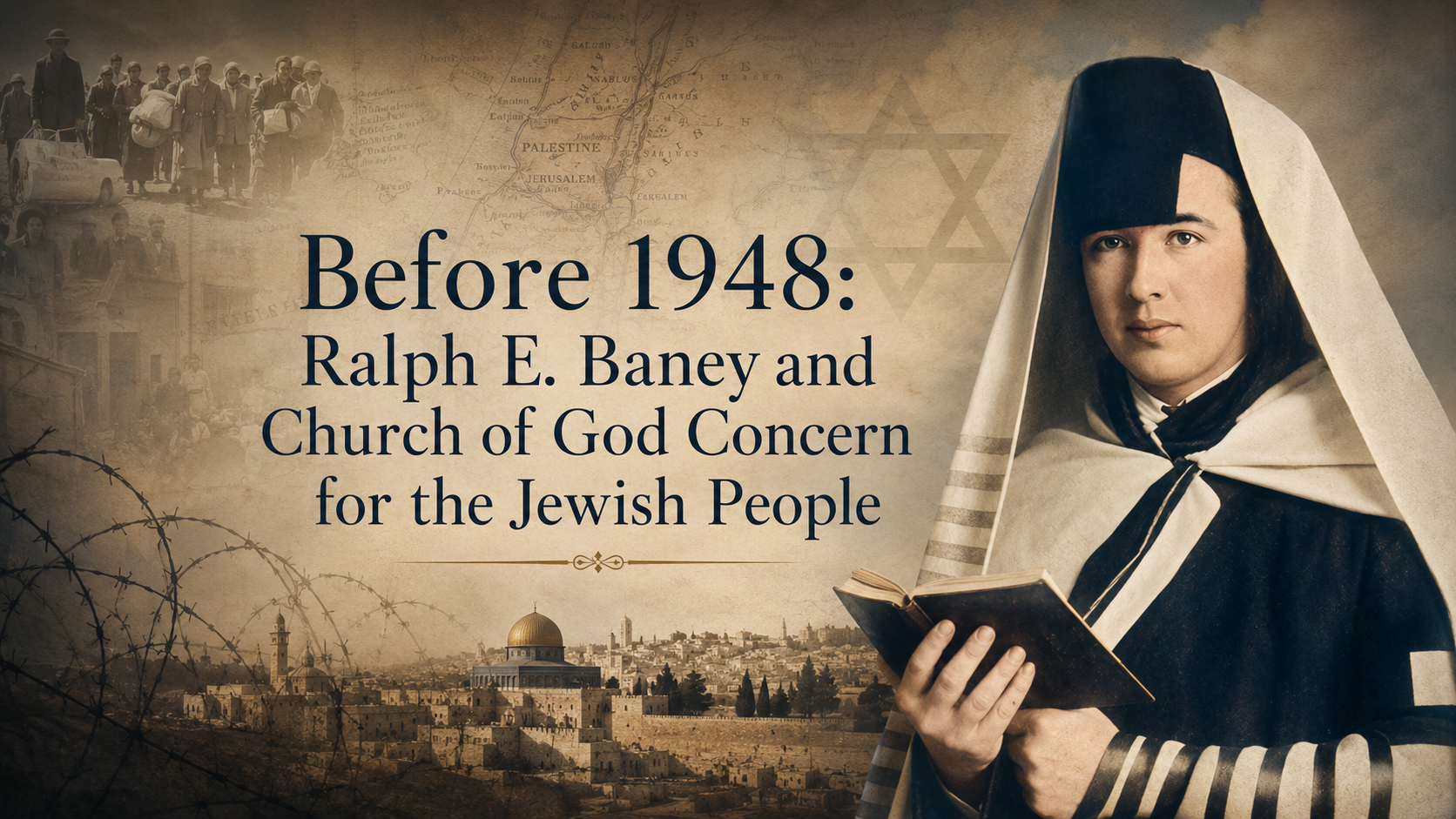
The accompanying photograph presented Baney dressed in clothing associated with an Orthodox Jewish rabbi. The image was likely intended to demonstrate his familiarity with Jewish customs and his preparation for ministry. Even so, it may also reflect a tendency among some Christian missionaries of the period to represent another religious community through costume and symbolism rather than through the voices and experiences of its own people.
These features should neither be ignored nor allowed to define the entire account. The same publication that contained these limitations also expressed serious interest in Jewish history, worship, covenantal identity, Jerusalem, and the suffering of Jewish communities. The source therefore reveals both the sincere concern and the cultural assumptions present within this early Church of God missionary vision. Recognizing both allows the history to be examined with honesty, fairness, and appropriate care.
An Overlooked Strand of Church of God History
The early Church of God movement did not articulate one uniform or fully developed theology concerning Israel. Its writers approached the relationship between Israel and the church from several perspectives, sometimes emphasizing Israel’s continuing covenantal significance and at other times drawing upon Israel’s history, government, and worship as patterns for understanding the visible church.
Some writings drew heavily upon Israel as a model for the visible church. Others emphasized fulfillment of Old Testament patterns within the New Testament church. Yet the Baney material reveals another important emphasis within the tradition. It continued to describe contemporary Jewish people as chosen and covenantal, connected Christian responsibility with Jerusalem, and encouraged the study of Jewish religious life.
The historical record therefore appears more complex than a simple choice between total replacement theology and modern Christian Zionism. The 1934 article emerged before many of the theological categories used today had become common in Pentecostal discussion. Its language reflects an earlier missionary world in which Jewish people could be understood simultaneously as a covenant people, a distinct living community, and a people to whom Christians believed the gospel should be presented.
Romans 9–11 provides an important biblical framework for approaching this tension. Paul proclaimed salvation through Christ, yet he also asked, “Did God reject his people?” and answered, “By no means!” (Romans 11:1 NIV). He warned Gentile believers against arrogance and reminded them that they did not support the root, but that the root supported them.
This biblical balance calls Christians to maintain conviction without contempt. Christian faith confesses Jesus as Messiah and Lord, but it should never use that confession to justify hostility toward the Jewish people through whom the covenants, the Scriptures, the patriarchs, and the human ancestry of the Messiah came.
Conclusion: Recovering an Early Concern
The story of Ralph E. Baney deserves a place within Church of God history. In 1934, almost fourteen years before the establishment of the modern State of Israel, the White Wing Messenger introduced him as a missionary preparing to work among Jewish people. The publication called Jewish people the “Chosen People,” promoted a book titled Jehovah’s Covenant People, Israel, and connected Baney’s calling with Jerusalem.
Later newspaper reports strongly suggest that Baney went on to serve as a missionary connected with Palestine and Jewish communities in Europe. He appears to have documented Nazi persecution, shared in the suffering of Jewish acquaintances, and publicly warned American audiences about the violence being committed against Jewish people.
This history should not be idealized. The 1934 article contains stereotypes, paternalistic assumptions, and missionary language that must be evaluated critically. Yet those limitations should not prevent us from recognizing the larger historical evidence. Before Israel became a modern state, voices within the early Church of God movement were already calling Christians to remember Jewish people, study their history and religious traditions, recognize their covenantal identity, and respond to their suffering.
The importance of this history lies in what it reveals about an early Church of God concern for Jewish people. It reminds us that, even before the establishment of the modern State of Israel, voices within the movement were calling Christians to remember the Jewish people, study their history and religious traditions, recognize the Jewish foundations of the Christian faith, and respond to Jewish suffering with compassion.
Jesus cannot be separated from Israel’s story. The apostles were Jewish. The Scriptures came through the Jewish people. The covenants, the promises, the patriarchs, and the human ancestry of the Messiah belong to Israel’s history. Christian faithfulness therefore requires more than curiosity about Jewish people. It requires gratitude, truthfulness, love, humility, and the courage to stand against antisemitism wherever it appears.
Endnotes
- The modern State of Israel was formally proclaimed on May 14, 1948. See “Declaration of the Establishment of the State of Israel,” May 14, 1948.
- The White Wing Messenger 11, no. 14 (July 7, 1934), 1–2. The masthead described the publication as maintained in the interest of “The Church of God over which A. J. Tomlinson is General Overseer” and listed A. J. Tomlinson as editor and publisher.
- Homer A. Tomlinson, “Preparing for Missionary Work Among Jewish People,” The White Wing Messenger 11, no. 14 (July 7, 1934), 1.
- “Jehovah’s Covenant People Israel: Their Festivals, Songs and Ceremonies,” advertisement, The White Wing Messenger 11, no. 14 (July 7, 1934), 3.
- Wade H. Phillips, Quest to Restore God’s House: A Theological History of the Church of God, Volume I, 1886–1923 (Cleveland, TN: Church of God of Prophecy, 2014), discussion of R. G. Spurling’s covenantal understanding of Israel and the visible church.
- “Bible Witness Church,” The Zeeland Record (Zeeland, MI), May 29, 1941, 4. The announcement identified the Reverend Ralph E. Baney as a missionary to Palestine who would show slides concerning the torture of Jewish people in Germany.
- “World Traveler to Speak Here,” Walkerton Independent (Walkerton, IN), June 5, 1941, 1.
- “Early German Conquests Bring More ‘Undesirable Elements’ Under Nazi Rule,” Times Observer, October 2022, discussing a July 17, 1940, newspaper report concerning Ralph E. Baney’s lecture on Palestine and the persecution of Jewish people in Germany.


Leave a Reply