
The Difference Between Official Teaching and Lived Reality
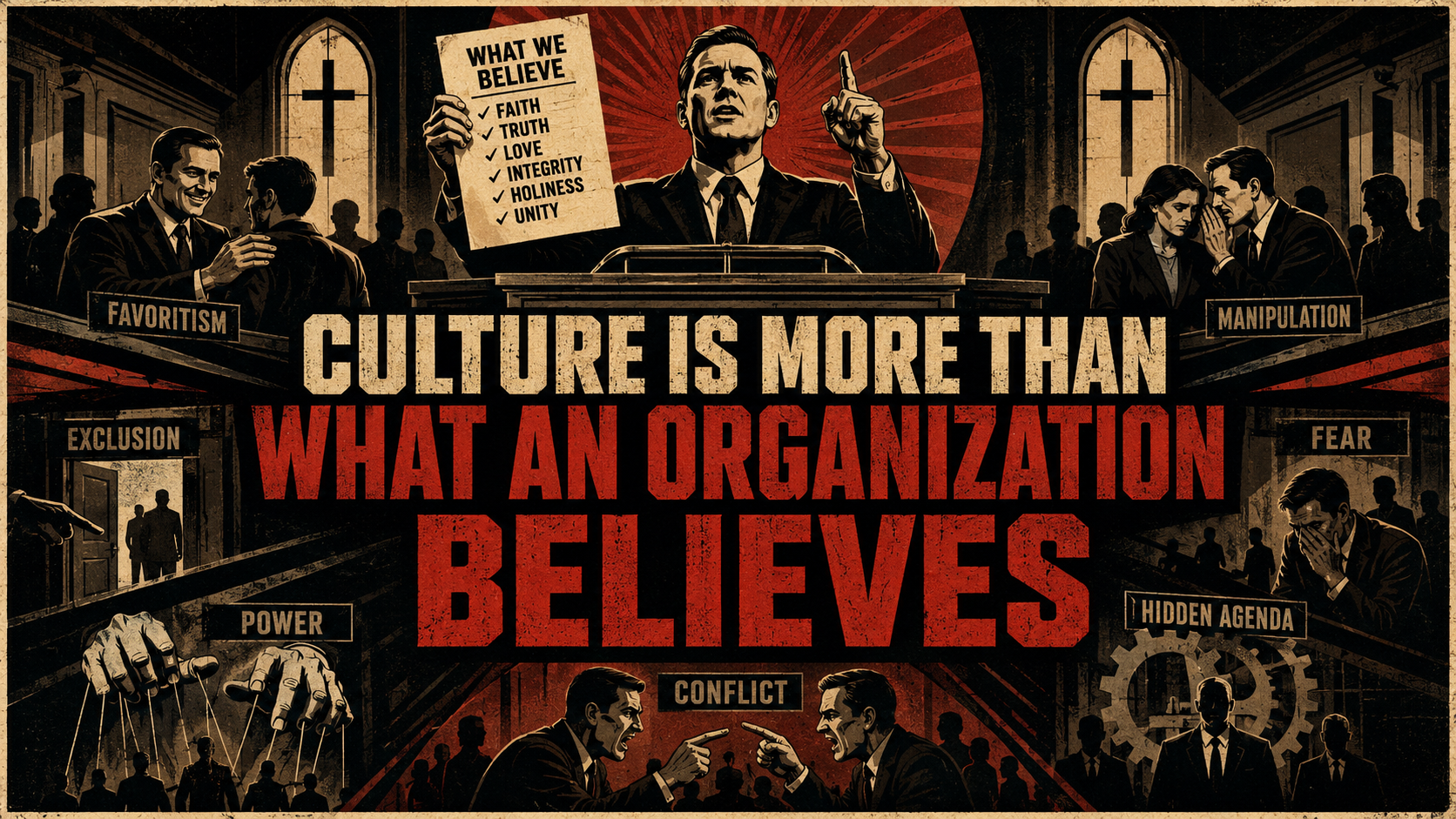
Most Christian organizations can explain what they believe. They have statements of faith, constitutions, membership covenants, ministerial guidelines, mission statements, doctrinal publications, and carefully worded descriptions of the values they hope will characterize their communities. These documents matter because doctrine matters. What a church believes about God, Scripture, salvation, holiness, leadership, the Church, and Christian discipleship inevitably shapes its identity. Yet one of the most important lessons I have learned through studying organizational culture is that knowing what an organization says it believes does not necessarily tell us what it is like to live within that organization. To understand a religious culture, we must examine not only what has been written and officially affirmed but also what people repeatedly experience.
That distinction was not always clear to me. For many years, I assumed that if I understood an organization’s doctrine, government, history, membership expectations, and official teachings, I understood the organization itself. I knew how to read statements, compare teachings with Scripture, examine church polity, and identify the theological claims upon which an organization had built its identity. What I did not always know how to examine were the unwritten expectations beneath those teachings: what happened when someone disagreed, which questions created discomfort, what behaviors brought a person closer to leadership, what mistakes were easily forgiven, which mistakes followed someone for years, and how people were treated when they no longer fit comfortably within the institutional story.
Organizational culture gave me language for something I had experienced but had not always known how to describe. A church may sincerely proclaim love while developing relational patterns that make belonging conditional. It may affirm biblical authority while allowing one interpretation of Scripture to become practically unquestionable. It may teach servant leadership while creating structures in which those holding the greatest authority experience the least meaningful accountability. None of these contradictions necessarily appear in a statement of faith, because culture often operates beneath the level of formal teaching. It is learned through experience, reinforced through repetition, and eventually accepted as simply the way things are.
Culture Goes Deeper Than What Is Written
Edgar Schein and Peter Schein describe organizational culture as the accumulated shared learning of a group as it responds to problems of external adaptation and internal integration. When particular responses appear to work, those responses gradually acquire legitimacy and eventually become accepted as the proper ways to perceive, think, feel, and behave.¹ This definition is important because it moves culture beyond slogans, doctrines, and written policies. Culture is not simply what an organization announces about itself; it is also what people learn about reality by living together within the organization over time.
Schein’s framework distinguishes among visible artifacts, espoused beliefs and values, and deeper underlying assumptions.² Artifacts include the visible parts of organizational life: architecture, titles, ceremonies, dress, publications, organizational charts, vocabulary, rituals, and observable practices. Espoused values are the principles the organization says it believes, such as integrity, accountability, excellence, compassion, teamwork, holiness, biblical authority, or servant leadership. Beneath both are assumptions that may rarely be stated because they have become so deeply accepted that people simply take them for granted. These assumptions often provide the strongest clues to what the culture actually believes about authority, belonging, disagreement, failure, loyalty, and truth.
In a church, the distinction can become especially important because religious organizations possess powerful symbols and theological language. A congregation may display Scripture throughout its building, describe Christ as the head of the Church, affirm the authority of the Bible, preach about humility, and publish statements emphasizing love and restoration. Those visible and verbal expressions should not be dismissed; they may represent sincere convictions held by many people within the organization. Yet the deeper cultural question asks what happens when those values are tested. If Christ is truly understood as the head of the Church, can a human leader be corrected? If Scripture is the final authority, can established interpretations be examined? If restoration is genuinely valued, what happens to someone who has failed? If love defines the community, what happens when someone no longer agrees with the organization?
Those questions reveal why culture cannot be diagnosed merely by reading documents. The constitution may tell us how authority is formally structured, but culture tells us how authority actually functions. A written policy may describe a process for raising concerns, but culture determines whether people feel safe using it. An organization may say membership is voluntary, but culture reveals whether someone can leave without losing relationships, reputation, spiritual standing, or the respect of people they once considered family. Written expectations are certainly part of culture, but lived expectations often possess greater formative power because members encounter them every day.
What We Say We Value and What We Actually Practice
Chris Argyris provides another helpful way of understanding this gap through his distinction between espoused theory and theory-in-use. Espoused theory describes what individuals or organizations say guides their behavior, while theory-in-use refers to the assumptions and rules that can actually be inferred from what they do. Argyris discovered that these two can differ substantially and that people may not even recognize the inconsistency.³ The issue is not necessarily conscious deception. People can genuinely believe that they value openness, honesty, fairness, participation, and respect while responding to threatening situations in ways that undermine those same commitments.
This becomes particularly revealing within religious organizations. A ministry may sincerely say, “We welcome questions,” while members gradually learn that certain questions carry social consequences. Leaders may genuinely affirm, “Everyone is accountable,” while the organization develops an unwritten understanding that accountability becomes increasingly difficult as authority increases. A church may describe itself as a family, yet a person who raises concerns may suddenly discover how dependent that family relationship had been upon continued agreement. In each situation, the official value may remain unchanged, while lived experience teaches members what the practical boundaries actually are.
Argyris observed that organizations frequently develop defensive patterns when difficult subjects threaten established relationships or existing systems. People may publicly agree during meetings while expressing their real concerns privately afterward, or they may avoid addressing the central issue because speaking honestly has become too costly.⁴ Religious organizations are certainly not unique in developing these patterns, but spiritual language can make them more difficult to recognize. Silence may be called submission, avoidance may be called unity, and discomfort with criticism may be reframed as protecting the work of God.
The strongest cultural lessons are therefore sometimes communicated without anyone deliberately teaching them. Members watch what happens to other members and adjust accordingly. When someone raises a difficult question and immediately becomes regarded with suspicion, others learn something about questioning. When a respected member disagrees with leadership and gradually loses influence, others learn something about disagreement. When a former member is consistently described as bitter, deceived, rebellious, or spiritually unstable, those remaining learn something about the consequences of departure. Nothing needs to be written into policy because culture has already taught the lesson through observation.
What Leaders Reward Becomes Culture
Leadership plays a central role in this process because leaders continuously teach people what matters through what they notice, reward, tolerate, correct, celebrate, and protect. Schein identifies several primary mechanisms through which leaders embed culture, including what they consistently pay attention to, how they react during crises, how they allocate resources, what they model, what they reward, and whom they recruit, promote, or remove.⁵ These actions may communicate more clearly than the organization’s published values because members learn very quickly which behaviors produce approval and which behaviors carry consequences.
Consider a church that repeatedly states that people matter more than programs. That value becomes credible when leaders demonstrate it during situations where protecting a person costs the organization something. If declining attendance produces greater concern than a wounded member, the culture receives a message. If a successful ministry leader is treated differently from an unknown member when both commit similar offenses, the culture receives another message. If leaders preach transparency but respond defensively whenever unfavorable information becomes public, people gradually learn that transparency is valued only when it does not threaten institutional reputation.
The same principle applies positively. When leaders admit mistakes without making excuses, confession becomes culturally acceptable. When pastors invite difficult questions and respond without retaliation, intellectual and spiritual honesty become safer. When influential leaders submit themselves to the same standards expected of everyone else, accountability becomes credible. When an organization protects a vulnerable person even when doing so may embarrass the institution, the community learns that human dignity matters more than image. In each case, culture is being taught through behavior rather than merely through words.
For this reason, pastors and Christian leaders teach culture long after they leave the pulpit. They teach when someone criticizes them, when an employee disappoints them, when a ministry fails, when money becomes tight, when an accusation is made, when an unpopular person requires protection, and when the institution itself has done something wrong. These moments reveal values because there is a cost attached to them. It is relatively easy to speak about humility when nothing threatens our position, but humility becomes visible when acknowledging error may change how others perceive us.
The Environment People Actually Experience
Benjamin Schneider, Mark Ehrhart, and William Macey describe organizational climate as the shared perceptions and meanings people attach to policies, practices, procedures, and the behaviors they observe being rewarded, supported, and expected.⁶ Their distinction between climate and culture is useful because it helps us understand the immediate experience of organizational life. Culture concerns deeper values and assumptions, while climate helps describe what people repeatedly perceive in the environment around them.
This explains why two congregations with nearly identical doctrinal statements may feel completely different. One church may have an environment in which people feel safe acknowledging uncertainty, asking questions, raising concerns, and respectfully disagreeing with leadership. Another congregation may affirm precisely the same doctrines while people carefully measure their words because they have learned that certain conversations carry consequences. Nothing in the statement of faith needs to change for the lived environment to become substantially different.
This also means that doctrinal orthodoxy and organizational health cannot simply be treated as interchangeable categories. Sound doctrine matters profoundly, and an emotionally healthy atmosphere cannot compensate for serious theological error. Yet theological accuracy does not automatically guarantee healthy organizational behavior. A church can confess the Trinity, affirm biblical authority, proclaim Christ’s resurrection, preach salvation by grace, and defend orthodox Christian doctrine while simultaneously developing unhealthy patterns of favoritism, fear, poor accountability, defensive leadership, or misuse of power.
Christian faith should therefore lead us to care about both theological faithfulness and organizational faithfulness. If we believe that human beings bear the image of God, our organizational practices should protect their dignity. If we believe leaders are stewards rather than owners, our structures should make meaningful accountability possible. If we believe truth matters, difficult information should not need to be hidden for the institution to survive. If we believe in grace and restoration, those ideas should become recognizable in the way failure is handled. Theology should not remain suspended in the abstract; it should eventually become visible in organizational life.
Jesus and the Distance Between Profession and Practice
Scripture repeatedly addresses the danger of saying one thing while practicing another. Matthew 23 provides one of the clearest examples when Jesus confronts the teachers of the law and the Pharisees. His criticism is striking because He does not begin by saying that everything they teach is false. Instead, He tells His hearers not to imitate their behavior because “they do not practice what they preach” (Matt. 23:3). The problem was not merely theological vocabulary but the contradiction between religious teaching and lived practice.
As Jesus continues, He exposes a leadership culture involving heavy burdens placed upon others, concern for public recognition, religious status, outward appearance, and the neglect of justice, mercy, and faithfulness. His words should not be carelessly applied to every leader we dislike, nor should “Pharisee” become an easy insult for anyone who holds strong convictions. Nevertheless, the principle remains important for Christian leadership: correct religious language does not make unhealthy behavior righteous. Spiritual authority must be evaluated not only according to what it teaches but also according to what it produces and how it is exercised.
Paul confronts another example in Galatians 2 when Peter withdraws from fellowship with Gentile believers because of pressure from certain Jewish Christians. Peter had not formally rejected the gospel. His theological confession had not suddenly changed, and he had already witnessed God’s work among Gentiles. Yet Paul says that Peter and those following him were “not acting in line with the truth of the gospel” (Gal. 2:14). Their behavior was communicating something their theology denied.
This is an important lesson for organizational culture. Sometimes a church contradicts its theology without formally changing a single doctrine. Its statement of faith may remain completely intact while its patterns of leadership, relationship, discipline, or belonging communicate another message. The contradiction exists not necessarily at the level of confession but at the level of embodiment.
The Theology Hidden Inside Our Practices
James makes this connection unmistakable when he confronts favoritism in the Christian assembly. He instructs believers in the Lord Jesus Christ not to show favoritism and then describes a situation in which a wealthy person receives preferential treatment while a poor person is assigned an inferior place (James 2:1–4). Nothing in the congregation’s creed needed to change for a theological contradiction to emerge. Their treatment of people had become a practical confession about whose presence mattered more.
Church culture works in similar ways. Who is heard communicates something about dignity. Who can be corrected communicates something about authority. Whose failures are forgiven communicates something about grace. How financial contributors are treated communicates something about partiality. How disagreement is handled communicates something about truth. How former members are described communicates something about the boundaries of Christian belonging. Practices are not theologically neutral because they teach people what our stated beliefs mean when those beliefs encounter real human beings.
This is one reason I have become increasingly convinced that Christian leaders must learn to examine organizational culture theologically. We often examine sermons for doctrinal accuracy but rarely examine organizational behavior with the same seriousness. Yet members may learn as much about leadership, grace, holiness, belonging, and God’s character from how they are treated as they learn from what they hear preached. A congregation may forget the precise wording of a sermon while remembering for decades what happened when their family experienced a crisis or when they dared to disagree.
Protecting the Organization We Believe Ourselves to Be
One of the most difficult problems develops when an organization becomes deeply committed to an idealized understanding of itself. It may believe itself to be exceptionally loving, uniquely biblical, remarkably unified, unusually faithful, specially governed, or particularly committed to restoration. These convictions may originate in sincere experiences and may contain significant truth, but they can become dangerous when the organization loses the ability to hear evidence that complicates the story it tells about itself.
Imagine that an organization understands itself as a loving family and someone reports being mistreated. A healthy response allows the person’s experience to challenge the organization’s assumptions: perhaps the community has not been as loving as it believed, and something needs to change. An unhealthy response protects the organizational identity first. Because the organization is loving, the person must have misunderstood what happened; perhaps they are bitter, rebellious, overly sensitive, divisive, or spiritually unhealthy. The institution’s self-description becomes so authoritative that the lived experience of the member is interpreted through it rather than allowed to test it.
Argyris’s work on organizational traps helps explain how such patterns become resistant to learning. Organizations may profess openness, honesty, respect, and care while developing defensive reasoning that prevents them from examining inconsistencies between those values and actual behavior.⁷ The problem becomes especially difficult when even the inconsistency itself becomes unsafe to discuss. People know something is wrong, but the culture has made the problem and the conversation about the problem equally threatening.
Religious organizations have an additional vulnerability because their institutional identities may be connected to sacred claims. Leaders may sincerely believe that protecting the organization is equivalent to protecting God’s work, preserving unity, defending truth, or guarding the Church from division. Yet the sacredness of the mission should increase accountability rather than diminish it. If an organization acts in the name of Christ, its willingness to tell the truth about itself should be greater, not smaller.
When Inconsistency Becomes Harm
Every church will experience some distance between its stated ideals and lived reality. No congregation consistently embodies everything it teaches because Christian communities are composed of imperfect human beings who are still learning, failing, repenting, and maturing. A church may genuinely value hospitality and occasionally fail to welcome someone. A pastor may sincerely teach patience and respond impatiently on a difficult day. These inconsistencies call for humility and correction, but they do not automatically establish a high-control culture.
The concern becomes more serious when unhealthy behaviors become systematic, predictable, protected, and resistant to examination. Research on spiritual abuse describes recurring patterns involving coercive and controlling behavior within religious contexts, including manipulation, censorship, enforced accountability, pressure to conform, limitations upon autonomy, unquestioning obedience, isolation, spiritual threats, superiority, and claims of unchallengeable divine authority.⁸ The significance of such research lies not in providing an easy label for every difficult church experience but in showing that repeated patterns of spiritualized control deserve serious examination.
David Ward’s qualitative research on the lived experience of spiritual abuse similarly identified themes involving leaders being experienced as representing God, spiritual bullying, performance-based acceptance, spiritual neglect, and internal tension among people attempting to reconcile their experiences with what they had been taught.⁹ That internal tension is particularly significant because it describes what can happen when official teaching and lived experience begin telling different stories. The member may believe the organization is loving while simultaneously experiencing fear. They may believe leaders are accountable while repeatedly observing that certain leaders cannot be challenged. Eventually, maintaining both narratives becomes increasingly difficult.
This is why lived experience should not be dismissed simply because it conflicts with official values. Experience is not infallible, and one person’s interpretation does not automatically define an entire organization. Nevertheless, repeated experiences across different people and different situations may reveal patterns that written policies do not. Responsible leadership therefore listens for patterns without assuming that either institutional claims or individual perceptions are automatically beyond examination.
Listening to the Stories That Do Not Appear in the Celebration
Every religious organization tells stories about itself. Churches remember revivals, conversions, missions, sacrifices, answered prayers, courageous founders, buildings constructed, ministries launched, and seasons of difficulty that were overcome. These stories provide continuity, identity, gratitude, and a sense of shared purpose. They should be preserved, because organizational memory can remind communities of God’s faithfulness and of people whose sacrifices deserve honor.
Yet mature Christian organizations must also be willing to listen to the stories that do not appear in anniversary celebrations. What happened to the person who raised a legitimate concern? How was the family treated after disagreeing with leadership? What happened to the minister who could no longer affirm an institutional position? What patterns do former members describe? Are certain stories consistently absent because they complicate the preferred narrative of the organization?
Asking these questions is not disloyalty. In fact, organizations committed to truth should be the most willing to examine the full record rather than only the portions that reinforce institutional identity. Christian history itself is remarkably honest about the failures of God’s people. Scripture does not preserve only Abraham’s faith, David’s victories, Peter’s confession, or the apostles’ courage; it also preserves Abraham’s fear, David’s sin, Peter’s denial, and the disciples’ repeated misunderstandings. Biblical truthfulness does not require protecting heroes from their own humanity.
Christian organizations should demonstrate the same courage. If truth matters, inconvenient truth still matters. If accountability matters, it must reach those with authority as well as those beneath it. If people matter, the testimony of someone without institutional influence should not automatically carry less moral weight. The real test of organizational values frequently arrives when living according to those values becomes costly.
The Kind of Culture Christ Forms
A Christian organization cannot measure its health merely by attendance, loyalty, financial growth, institutional stability, ministerial productivity, or visible unity. These things may be valuable, but none of them automatically demonstrates Christlike culture. A congregation can be united because people genuinely love one another and share a common mission, or it can appear united because disagreement has become too costly. An organization can grow because healthy ministry is taking place, or it can grow while unhealthy leadership patterns remain hidden beneath success.
Jesus gives Christian leaders another standard. In John 13, knowing that His betrayal and suffering were approaching, Jesus washed the feet of His disciples and told them, “I have set you an example that you should do as I have done for you” (John 13:15). The men whose feet He washed included disciples who misunderstood Him, competed for status, would abandon Him, and, in Judas’s case, would betray Him. Jesus possessed authority beyond anything a Christian leader can claim, yet He deliberately demonstrated authority through service.
This does not remove leadership, correction, discipline, or responsibility from Christian community. Jesus corrected His disciples, confronted sin, demanded costly obedience, and spoke with unmistakable authority. The difference is that Jesus exercised authority in a way that drew people deeper into faithfulness to God, rather than making their spiritual security dependent upon loyalty to a human leader or religious institution. Christian leadership should therefore help believers mature in discernment, responsibility, truth, love, and faithfulness rather than keeping them permanently dependent upon the approval of leaders.
The questions leaders ask should consequently go deeper than whether people are following instructions. What kind of people are our leadership practices forming? Can those entrusted to us disagree respectfully without fearing relational consequences? Do our structures allow truth to reach leadership even when that truth is uncomfortable? Are people becoming more dependent upon Christ and Scripture, or more dependent upon institutional approval? These questions expose culture because they examine what leadership is actually producing.
When Our Values Become Expensive
Churches need statements of faith, constitutions, policies, safeguarding procedures, leadership standards, and membership expectations. Clear documents can preserve doctrine, provide order, protect people, and establish accountability. The problem arises only when we mistake the existence of these documents for proof that the values contained within them have become the lived culture of the organization.
A policy saying that concerns may be raised means little if members know that raising them will damage their future. A commitment to servant leadership means little if leaders cannot tolerate correction. A declaration of restoration means little if certain failures permanently remove people from meaningful belonging. A statement affirming Christ as head of the Church means little if practical authority has become concentrated in a leader whose judgment cannot be questioned. The integrity of an organizational value becomes most visible when honoring it requires sacrifice.
This leads to questions that every Christian organization should be willing to ask. Do we still value truth when the truth embarrasses us? Do we value accountability when an influential leader is the one who needs correction? Do we value human dignity when someone can no longer advance our mission? Do we value conscience when a sincere believer reaches a conclusion different from ours? Do we value Christian unity enough to distinguish it from organizational uniformity? These questions cannot be answered adequately by pointing to a paragraph in a constitution because the answer is eventually found in what happens when the situation actually arrives.
Becoming More Like What We Say We Believe
The purpose of examining the gap between stated values and lived culture is not to encourage cynicism toward churches or Christian leadership. Neither is it to demand organizational perfection. No church will perfectly embody its theological commitments, and no Christian leader will respond correctly in every circumstance. The more important question is what happens when the gap becomes visible.
Healthy Christian communities can acknowledge inconsistency without believing that confession will destroy them. Leaders can admit mistakes without surrendering legitimate authority. Practices that once seemed normal can be reconsidered when Scripture, wisdom, or experience reveals that they have harmed people. Members can raise difficult questions without automatically becoming enemies. An organization can discover that part of its culture has drifted away from its stated convictions and choose repentance rather than defensiveness.
The gospel actually gives Christian organizations the freedom to do this because Christianity does not depend upon pretending that we are flawless. Our faith begins with confession, repentance, grace, and the recognition that our righteousness does not come from successfully maintaining an image. A church that can tell the truth about its failures is not necessarily a weak church. It may be demonstrating that its confidence rests more securely in Christ than in its own reputation.
Culture is therefore more than what an organization believes because beliefs eventually become visible in behavior. They appear in the way authority is exercised, the way disagreement is handled, the way mistakes are addressed, the way vulnerable people are treated, the way leaders receive correction, and the way former members are remembered. What an organization repeatedly does teaches people what it truly values, regardless of how beautiful its official language may be.
For that reason, churches should not stop asking, “What do we believe?” That question remains indispensable. But it should be accompanied by another question that may require even greater courage: “What are people learning about what we believe by the way we actually live together?” When those two answers increasingly resemble one another, doctrine has begun to become culture. When they do not, the Christian response is neither denial nor institutional self-protection, but discernment, humility, repentance, and the willingness to bring what we practice into greater alignment with the Christ we proclaim.
Endnotes
- Edgar H. Schein and Peter A. Schein, Organizational Culture and Leadership, 5th ed. (Hoboken, NJ: Wiley, 2017), 20–21. Their definition emphasizes accumulated shared learning that becomes accepted and transmitted to new members as the appropriate way to perceive, think, feel, and behave.
- Schein and Schein, Organizational Culture and Leadership, 25–30. Their framework distinguishes among artifacts, espoused beliefs and values, and basic underlying assumptions.
- Chris Argyris, Organizational Traps: Leadership, Culture, Organizational Design (Oxford: Oxford University Press, 2010), 61–62. Argyris distinguishes the theories people espouse from the theories that can be inferred from their actual behavior and notes that systematic differences between them can exist without participants being fully aware of the inconsistency.
- Argyris, Organizational Traps, 1–3. Argyris describes organizational situations in which individuals affirm values such as openness, honesty, integrity, respect, and care while behaving defensively when difficult or threatening situations arise.
- Schein and Schein, Organizational Culture and Leadership, chap. 10. The Scheins identify primary culture-embedding mechanisms that include what leaders attend to and measure, reactions to crises, resource allocation, role modeling, rewards, and decisions regarding recruitment and removal.
- Benjamin Schneider, Mark G. Ehrhart, and William H. Macey, “Organizational Climate and Culture,” Annual Review of Psychology 64 (2013): 361–88, especially 361–63, https://doi.org/10.1146/annurev-psych-113011-143809. They define organizational climate in relation to shared perceptions of policies, practices, procedures, and the behaviors that are rewarded, supported, and expected.
- Argyris, Organizational Traps, 1–3, 61–62, 148. Argyris argues that defensive organizational patterns can inhibit learning and the detection and correction of error, particularly when espoused commitments differ from theories-in-use.
- Lisa Oakley, Kathryn Kinmond, and Peter Blundell, “Responding Well to Spiritual Abuse: Practice Implications for Counselling and Psychotherapy,” British Journal of Guidance & Counselling 52, no. 2 (2024): 189–206, https://doi.org/10.1080/03069885.2023.2283883. Their discussion identifies patterns of coercive and controlling behavior that can occur within religious contexts.
- David J. Ward, “The Lived Experience of Spiritual Abuse,” Mental Health, Religion & Culture 14, no. 9 (2011): 899–915, https://doi.org/10.1080/13674676.2010.536206. Ward’s qualitative study identified themes that included leadership representing God, spiritual bullying, performance-based acceptance, spiritual neglect, and internal conflict among those experiencing spiritual abuse.

Leave a Reply