
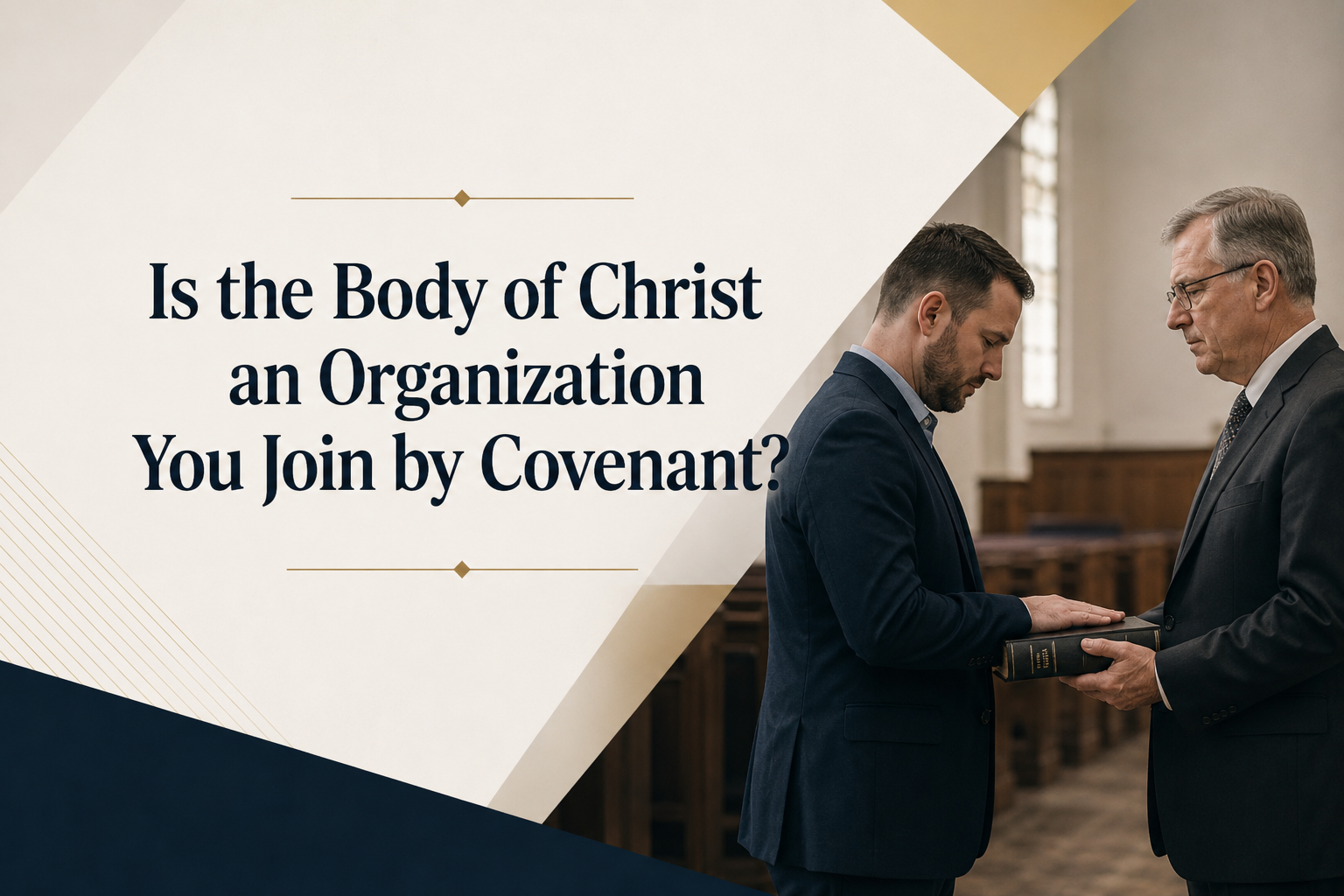
Examining Covenant Membership, the Body of Christ, and a Distinctive Restorationist Ecclesiology
Summary
Church membership matters. Christians were never intended to live in isolation from the gathered people of God, and the New Testament gives substantial attention to fellowship, pastoral leadership, accountability, discipline, doctrine, worship, service, and the responsibilities believers carry toward one another. A local congregation may establish a membership process, ask members to affirm its beliefs, and even use a covenant as a meaningful expression of commitment. None of those practices are necessarily inconsistent with Scripture. The more difficult question emerges when a church covenant is given a significance Scripture may never have assigned to it: when the covenant is no longer understood merely as the means by which someone formally joins a congregation or religious organization, but as the means by which a saved person becomes a member of the Body of Christ itself.
Within portions of the restorationist Holiness-Pentecostal tradition, particularly among several movements whose historical roots reach into the early Church of God movement in the Appalachian South, a distinctive ecclesiology developed around precisely this distinction. In this understanding, a person may be genuinely born again and therefore belong to the Kingdom of God while remaining outside the visible Body of Christ. Entrance into the Body occurs later when the believer recognizes the true Church and enters into covenant with it.[1] Not every organization descending from this history teaches the doctrine identically today, and it would be unfair to treat every Holiness-Pentecostal or Church of God body as though it held the same position. Nevertheless, the distinction has played an important role within this particular restorationist tradition and continues to shape how some Christians understand the Church, membership, spiritual authority, institutional loyalty, and even what it means to leave one religious organization for another.
The purpose of this article is not to ridicule that heritage or question the sincerity of those who continue to hold this interpretation. Many of the men and women who developed and preserved these teachings possessed a deep reverence for Scripture and a sincere desire to recover what they believed to be the order of the New Testament Church. The question is whether sincerity and historical continuity are sufficient to establish the doctrine itself. If Scripture teaches that a person enters the Body of Christ through a covenant taken after salvation, then that teaching should emerge from the biblical text. If, however, the doctrine requires several passages to be connected in ways their original contexts do not require, while a direct New Testament statement identifies another means by which believers enter the Body, then the doctrine must be reconsidered. The central text cannot be avoided: “For by one Spirit are we all baptized into one body” (1 Corinthians 12:13).
Understanding Where This Teaching Comes From
Readers unfamiliar with this religious tradition may find the distinction between the Kingdom of God and the Church of God unusual because most evangelical Christians use the language of the Body of Christ to refer broadly to those who belong to Christ through salvation. Within this particular restorationist tradition, however, the categories became more sharply separated. The Kingdom was associated with salvation and the new birth, while the Church was understood as a visible, organized, identifiable body possessing government, doctrine, discipline, and a covenant by which already-saved believers could formally enter it. This was not simply an argument that Christians should join a local church. It became an ecclesiological claim about the identity and boundaries of the Body of Christ itself.
The historical development of this position can be seen within the early Church of God movement connected with figures such as R. G. Spurling and A. J. Tomlinson. Harold D. Hunter, a Pentecostal historian who has written extensively on early Pentecostal movements and Church of God history, examined this development in his scholarly article “A.J. Tomlinson’s Emerging Ecclesiology,” published in Pneuma, the academic journal of the Society for Pentecostal Studies. Hunter shows that Tomlinson’s understanding of the Church developed over time through several influences and eventually included a strong emphasis upon an exclusive visible body, the distinction between the Kingdom and the Church, and the importance of a public covenant.[2] This historical context matters because doctrines can eventually become so familiar within a religious community that later generations experience them as though they simply appeared on the pages of Scripture in their completed form. History sometimes reveals a more complicated process.
The idea did not disappear when the original movement divided. Various descendants of that restorationist heritage retained different portions of the earlier ecclesiology. One example appears in The Bible Church, a book written by Wade H. Phillips and published in 2017 by Zion Assembly Church of God Publishing House in Cleveland, Tennessee. Zion Assembly is one of the several contemporary bodies whose history intersects with the wider Church of God restorationist tradition. Phillips’s book is a lengthy defense of the belief that the biblical Church must be visible, corporate, organized, universal, and distinct from what he calls the “invisible church” concept common within broader Protestant Christianity. Significantly, the book contains an entire chapter entitled “Church Covenant Principle,” demonstrating that covenant ecclesiology is not limited to the literature of one contemporary organization.[3]
An even more direct expression appears in a denominational study titled The Church of God Membership Covenant, written by Larry Walters, Sr., and published by The Church of God in Charleston, Tennessee. This is not an informal sermon transcript or the private opinion of an unknown member. The publication contains a statement explaining that the Church Literature Review Committee reviewed the work for consistency with doctrines upon which the General Assembly had ruled. Its foreword, written by then-General Overseer Robert J. Pruitt, presents the material as a study of the covenant through which a person becomes a member of The Church of God, identified in the publication with the Body of Christ.[4] For readers unfamiliar with these churches, this distinction is important. We are not attempting to reconstruct a doctrine from rumors about what former members remember hearing. The teaching can be examined in literature produced to explain and defend it.
What makes the Walters publication especially valuable for this discussion is its unusual candor about the biblical evidence. The book acknowledges that Scripture does not plainly state, in so many words, that there is a special covenant someone takes to become a member of the Body of Christ. It also acknowledges that the New Testament does not give the exact wording of such a covenant and does not explicitly tell us that the apostles and elders used a formal word covenant when receiving believers into the Church. Nevertheless, the publication argues that such a covenant is present by implication and must be presupposed from broader biblical principles concerning covenant, government, membership, and discipline.[5]
That admission brings us to the central interpretive problem.
When a Doctrine Must Be Presupposed
There is nothing inherently improper about theological inference. Christians affirm many theological conclusions by bringing multiple passages together and considering the whole counsel of Scripture. The word Trinity, for example, does not appear in Scripture, yet the doctrine expresses what Scripture repeatedly teaches concerning the Father, Son, and Holy Spirit. The problem is therefore not that the phrase “membership covenant” cannot be found in the New Testament. The real question is whether the doctrine being inferred accurately explains the biblical evidence or whether the inference introduces a mechanism Scripture never establishes.
This distinction becomes especially important because the claim being made is not small. We are not discussing whether a congregation may keep a membership roll or whether Christians may publicly promise to support a local church. We are asking how a human being becomes part of the Body of Jesus Christ. If a saved believer remains outside that Body until he or she takes another covenant, then something of enormous ecclesiological significance occurs after the new birth. A person may already have repented, believed the gospel, received forgiveness, been reconciled to God, become a child of God, received eternal life, and experienced the work of the Holy Spirit, yet still not belong to Christ’s Body. Such a distinction requires clear biblical support because it creates a category of Spirit-indwelt Christians who belong to Christ while remaining outside the Body of Christ.
The difficulty is that Scripture does not merely fail to record the proposed covenant. Scripture gives a direct statement explaining incorporation into the Body: “For by one Spirit are we all baptized into one body, whether we be Jews or Gentiles, whether we be bond or free; and have been all made to drink into one Spirit” (1 Corinthians 12:13).
Paul’s argument in 1 Corinthians 12 is not primarily about denominational membership. He is explaining unity and diversity within the Christian community. The Corinthians possess different gifts, functions, and responsibilities, but those differences do not create multiple bodies because the same Spirit works within them. Paul compares the Church to a human body and writes, “For as the body is one, and hath many members, and all the members of that one body, being many, are one body: so also is Christ” (1 Corinthians 12:12). He then explains why these diverse believers constitute one Body: “For by one Spirit are we all baptized into one body.”
The text does not say that the Spirit leads people toward an organization that subsequently places them into the Body through covenant. Paul does not divide Spirit baptism from Body membership. Nor does he identify two classes of Christians, one consisting of saved people in the Kingdom and another consisting of covenant members within the Body. His language is expansive: Jews and Gentiles, bond and free, all brought into one Body in relation to one Spirit.
The Walters covenant study recognizes that this text creates a problem and therefore devotes considerable attention to explaining it differently. The publication concedes that the Holy Ghost participates in the process but resists the conclusion that the Spirit’s work alone places a believer into the Body. Remarkably, the same publication reproduces several statements from a working document prepared within another Church of God tradition that took the opposite position: that the Spirit places believers into the Body, that membership in the Body is the Spirit’s responsibility, that a church covenant joins someone to a particular expression of the Body rather than creating membership in Christ’s universal Body, and that no organization can therefore claim to constitute the exclusive Body of Christ. The Walters study includes those statements specifically to argue against them.[6] The existence of this disagreement within related Church of God traditions is itself instructive. The question is not whether someone respects Church of God heritage. Christians within that same broad heritage have reached different conclusions because they have interpreted 1 Corinthians 12:13 differently.
The text must therefore decide the question.
One Body in Christ
First Corinthians 12 does not stand alone. Paul describes the Christian community similarly elsewhere: “So we, being many, are one body in Christ, and every one members one of another” (Romans 12:5). The location of this unity is important. Believers are one Body in Christ. Paul does not say that believers are one Body because they have discovered the correct earthly institution. Their corporate identity arises from their relationship with Christ.
Ephesians makes the connection even clearer. Paul tells Gentile believers that Christ has broken down the hostility separating Jew and Gentile so “that he might reconcile both unto God in one body by the cross” (Ephesians 2:16). The language is difficult to reconcile with the idea that reconciliation through Christ leaves someone outside the Body until a later ecclesiastical covenant occurs. Paul continues only a few verses later: “Now therefore ye are no more strangers and foreigners, but fellowcitizens with the saints, and of the household of God” (Ephesians 2:19). Those formerly alienated Gentiles have been brought near through the blood of Christ, reconciled in one Body, and made members of God’s household.
Later in the same letter Paul writes, “There is one body, and one Spirit, even as ye are called in one hope of your calling” (Ephesians 4:4). Once again, one Spirit and one Body appear together. The consistency across Paul’s writings is significant. The Body consists of believers united to Christ through His redemptive work and the ministry of the Spirit. This does not make local church membership meaningless. It places local church membership in its proper theological order. Christians join congregations because they already belong to Christ and therefore belong to one another. They do not become members of Christ’s Body because an organization completes something left unfinished at conversion.
Does Jeremiah 50:5 Establish a Membership Covenant?
One of the most important Old Testament passages used within covenant ecclesiology is Jeremiah 50:5: “They shall ask the way to Zion with their faces thitherward, saying, Come, and let us join ourselves to the LORD in a perpetual covenant that shall not be forgotten.” For someone already familiar with the language of Zion, joining, and a perpetual covenant, the verse may initially appear to provide strong support. This is precisely why context matters. A verse can contain the vocabulary of a later doctrine without actually teaching that doctrine.
Jeremiah identifies the people in the preceding verse: “In those days, and in that time, saith the LORD, the children of Israel shall come, they and the children of Judah together, going and weeping: they shall go, and seek the LORD their God” (Jeremiah 50:4). The setting concerns divine judgment upon Babylon and the restoration of Israel and Judah. These covenant people, having experienced judgment and displacement, return in repentance to seek God. When verse 5 says they will “join ourselves,” the verse explicitly identifies the one to whom they are joining themselves: “to the LORD.”
The passage does not say that New Testament believers will someday join a particular religious organization through a perpetual membership covenant. It does not distinguish Kingdom membership from Church membership. It does not describe a Church minister administering a covenant. It describes Israel and Judah returning to their covenant God.
There is also a larger problem with using Jeremiah 50 as the foundation for an additional Christian covenant. Jeremiah himself had already announced the great covenant that would define the future redemptive work of God: “Behold, the days come, saith the LORD, that I will make a new covenant with the house of Israel, and with the house of Judah” (Jeremiah 31:31). In that covenant God promises to write His law upon the heart, to be their God, and to make them His people. Jesus identifies His death with this covenant when He declares, “This cup is the new testament in my blood, which is shed for you” (Luke 22:20). Hebrews repeatedly identifies Jesus as the mediator of that New Covenant.
This is where the doctrine becomes far more serious than a disagreement over terminology. If a person is genuinely saved through faith in Christ but is said to remain only a member of an invisible Kingdom until he or she takes a second covenant to enter the visible Church, then the doctrine has introduced another covenantal threshold after the cross. The believer has received the gospel, been forgiven, reconciled to God, made a child of God, and brought into the New Covenant through the blood of Jesus Christ, yet is still told that something more is required to become a member of Christ’s Body. The question must therefore be asked plainly: What is this second covenant accomplishing that the covenant established by Jesus did not?
If the answer is that the second covenant makes a saved person a member of the Church or Body of Christ, then it appears to function as a better or more complete covenant than the one Jesus established. That is not a minor theological distinction. It risks diminishing the sufficiency of Christ’s finished work by suggesting that His covenant saves a person but does not fully place that person within His Body. The believer must then approach an organization, accept its terms, and make a further pledge before receiving an ecclesiastical status that Scripture presents as belonging to those who are united to Christ by the Spirit.
The New Testament gives no indication that Jesus established a preliminary covenant that saves people while reserving full membership in His Body for a later organizational covenant. Hebrews presents Christ as the mediator of a better covenant, established upon better promises (Hebrews 8:6). That better covenant is not a church membership agreement administered by a later institution. It is the New Covenant secured by the blood of Christ. Jesus did not die to create a partial salvation that an organization would later complete. He did not establish a covenant that merely places people in an invisible Kingdom while another covenant gives them access to the visible Body. The covenant of Christ is not provisional, incomplete, or waiting for institutional fulfillment.
This is why the teaching can become spiritually dangerous when it is tied to exclusive organizational claims. If an organization teaches that salvation places a person only in the Kingdom, while its own covenant places that person into the Body of Christ, then the organization has positioned itself as the necessary administrator of a status that belongs to Christ. It is no longer merely asking people to join a congregation, affirm a statement of faith, or accept the responsibilities of local church membership. It is presenting itself as the doorway through which saved people receive a fuller ecclesiastical identity.
That kind of claim should immediately raise serious concerns about high-control religion. A high-control organization often does not deny every central Christian doctrine. It may affirm the Bible, salvation, holiness, the deity of Christ, and the necessity of conversion. The danger may appear instead in the way it places itself between the believer and the fullness of Christian belonging. If the organization teaches that leaving it means leaving the Body of Christ, that questioning its authority means resisting God’s order, or that joining another church means remaining outside the true Church, then its membership covenant has become more than a voluntary expression of commitment. It has become a mechanism of spiritual control.
This does not mean that every person who holds a covenant ecclesiology is consciously promoting a cult or intentionally manipulating others. Nor does the presence of a membership covenant, by itself, prove that an organization is abusive or cultic. Churches may use covenants responsibly as expressions of mutual commitment and accountability. The concern arises when an organization’s covenant is treated as necessary for entrance into Christ’s Body, when its own identity is treated as the exclusive visible Church, and when departure is portrayed as departure from Christ Himself. Those are recognizable warning signs of a high-control religious system because they make institutional loyalty a condition of spiritual security.
This does not mean Jeremiah 50 has no relevance to Christian theology. It certainly contributes to the biblical themes of restoration, covenant faithfulness, Zion, repentance, and the gathering of God’s people. But an application is not the same thing as an institution. To move from “Israel and Judah will join themselves to the LORD in a perpetual covenant” to “a saved Christian must enter an ecclesiastical covenant to become a member of Christ’s Body” requires a theological bridge that Jeremiah never constructs. It also requires the creation of a second covenantal requirement that the New Testament never places between the believer and full membership in Christ.
The biblical question is therefore not merely whether a church may ask its members to make a promise. The deeper question is whether any organization has the authority to present its promise as the covenant that completes what Jesus began. Scripture gives no such authority. Christ’s covenant is the better covenant. His blood is sufficient. His Spirit places believers into His Body. No later organization can improve upon, complete, or administer a covenant better than the one established by the Son of God.
The Marriage Argument in Ephesians 5
Another important argument connects church membership to marriage. Paul writes, “For we are members of his body, of his flesh, and of his bones. For this cause shall a man leave his father and mother, and shall be joined unto his wife, and they two shall be one flesh. This is a great mystery: but I speak concerning Christ and the church” (Ephesians 5:30–32). Because marriage involves covenant and because Paul compares the relationship between Christ and the Church to marriage, some restorationist interpreters have reasoned that a believer must likewise enter the Body through a word covenant.
The connection initially sounds logical, but it asks the analogy to accomplish more than Paul asks of it. Ephesians 5 is addressing the Christian marriage relationship. Paul commands husbands to love their wives “even as Christ also loved the church, and gave himself for it” (Ephesians 5:25). Christ’s sacrificial love becomes the pattern for the husband. Paul then draws upon Genesis 2 and the mysterious union of husband and wife to illuminate the profound union between Christ and His Church.
Marriage is therefore an image explaining the relationship. It does not automatically establish the administrative process by which a believer enters that relationship. Scripture uses numerous images for the people of God. Christ is the Shepherd and believers are sheep. Christ is the cornerstone and believers are living stones. Christ is the vine and His people are branches. The Church is a household, temple, flock, bride, and Body. We do not take every feature of the earthly picture and convert it into a required ecclesiastical procedure. We ask what the inspired writer is using the metaphor to communicate.
Even more importantly, Paul begins the relevant portion with an existing reality: “For we are members of his body.” He is writing to Christians about what they already are. Nothing in the text records a covenant ceremony, instructs elders how to administer one, or identifies a verbal promise as the mechanism that produces Body membership. The covenant conclusion has to be brought into the passage before it can be taken back out.
Acts 2 and the Covenant We Cannot Find
Acts 2 is often appealed to because Luke describes people being “added” to the Christian community after they received Peter’s preaching. The argument usually proceeds in a seemingly reasonable way: if these converts were “added,” then they must have passed through some formal process by which they became members of an already-existing Church; and if they became members, then there must have been a covenant, whether Luke records the wording or not. From there, the unrecorded covenant is treated not as a possibility but as a necessary theological conclusion. The problem is that the text does not merely fail to mention the proposed covenant. The text gives us a much clearer explanation of what happened, who acted, and what kind of “addition” Luke intended to describe.
Peter’s sermon announces the fulfillment of God’s promises through the death, resurrection, and exaltation of Jesus Christ. His hearers are “pricked in their heart,” and they ask what they must do. Peter answers them with the language of repentance, baptism, forgiveness, and the gift of the Holy Ghost: “Repent, and be baptized every one of you in the name of Jesus Christ for the remission of sins, and ye shall receive the gift of the Holy Ghost” (Acts 2:38). Luke then writes, “Then they that gladly received his word were baptized: and the same day there were added unto them about three thousand souls” (Acts 2:41). The order is not incidental. They received the apostolic word, they were baptized, and they were added. Luke does not insert a covenant ceremony between conversion and baptism, nor does he identify a verbal pledge as the instrument by which these people entered the Body of Christ.
The Greek verb translated “were added” is προσετέθησαν (prosetethēsan), from προστίθημι (prostithēmi), meaning “to add,” “to place alongside,” or “to join to” something already present. The word describes numerical and communal addition, but the verb itself does not mean “to enter by covenant.” It does not contain the idea of a formal membership vow, nor does it specify the administrative mechanism by which the addition occurred. Luke is telling us that approximately three thousand people were added to the existing company of disciples. He is not giving us a hidden technical term for a covenant ceremony that the narrative never names.
This distinction matters because the covenant argument often treats the word “added” as though it carries a specialized ecclesiological definition. It does not. The meaning must be determined by the context, and the context explains the addition through repentance, faith, baptism, the reception of the apostolic word, and the work of God. Luke’s language is descriptive before it is administrative. He is describing the visible growth of the Christian community, not establishing a doctrine that salvation places a person in the Kingdom while a later covenant transfers that person into the Body of Christ.
The same point becomes even stronger at the end of the chapter: “And the Lord added to the church daily such as should be saved” (Acts 2:47). Here Luke changes the grammatical subject. In verse 41, the people are described as being added to the existing community. In verse 47, the Lord is the One who adds. The Greek text reads, ὁ δὲ κύριος προσετίθει (ho de kyrios prosetithei), “and the Lord was adding.” The imperfect tense presents an ongoing action. The Lord Himself continually adds those who are being saved to the Church.
That statement is devastating to the claim that a humanly administered covenant is the mechanism by which saved people become members of Christ’s Body. Luke does not say that the apostles added people through a covenant. He does not say that the elders added people through a covenant. He does not say that the Church added people through a covenant. He says that the Lord added. The Church certainly had visible practices—preaching, baptism, fellowship, teaching, prayer, the breaking of bread, and discipline—but the divine act of incorporating the saved into the Christian community is attributed to the Lord, not to an ecclesiastical pledge.
The phrase “such as should be saved” also deserves careful attention. The Greek participle is τοὺς σωζομένους (tous sōzomenous), literally “those being saved” or “those who were being saved.” Luke does not describe one group of people who had already entered the Kingdom and were now waiting for a second spiritual transition into the Body. He describes the Lord adding the saved to the Church. Salvation and addition to the Church are not presented as two unrelated spiritual memberships separated by an unrecorded covenant. The Lord’s saving work and His gathering of believers into the visible Christian community belong together in the narrative.
This does not mean that Acts 2 teaches a careless or invisible Christianity. Quite the opposite is true. The believers “continued stedfastly in the apostles’ doctrine and fellowship, and in breaking of bread, and in prayers” (Acts 2:42). They shared their possessions, gathered together, worshiped, received instruction, observed the Lord’s Supper, and lived under the authority of apostolic teaching. The Church was visible, organized, doctrinally defined, sacramentally marked, and morally accountable. But none of those realities requires the existence of a word covenant by which saved people become members of the Body of Christ. The passage gives us a committed Christian community without giving us the proposed covenant.
The covenant doctrine therefore faces a serious dilemma. If the covenant is necessary for Body membership, why does Luke omit it at the very moment when thousands are supposedly entering the Body? If the covenant is so essential that a person remains outside Christ’s Body without it, why does the inspired narrative emphasize repentance, baptism, the apostolic word, the Holy Ghost, and the Lord’s own act of addition while saying nothing about the covenant? And if the covenant is merely implied, why should an implication be elevated above the explicit statement that the Lord added the saved to the Church?
The answer cannot simply be that Luke assumed his readers already knew about the covenant. That explanation is possible only if the doctrine has already been established elsewhere, but the other New Testament passages do not establish it either. First Corinthians 12:13 explains entrance into the Body through the one Spirit. Romans 12:5 describes believers as one Body in Christ. Ephesians 2:16 says that Jew and Gentile are reconciled to God in one Body by the cross. The New Testament repeatedly explains the believer’s incorporation into Christ through Christ’s saving work and the Spirit’s ministry. It never explains that incorporation through a later ecclesiastical covenant.
The narrative of Acts 2 therefore does not provide a missing covenant. It provides a direct theological pattern: the gospel is preached, sinners repent and believe, believers are baptized, the Holy Spirit is given, the Christian community is formed, and the Lord adds the saved. To insert a covenant into that sequence is not to discover what Luke recorded. It is to supply a mechanism the text does not name because the doctrine requires one.
The Difference Between Joining a Church and Entering the Body
Much confusion can be removed by distinguishing two realities that should never have been made identical: joining a local congregation and being incorporated into the Body of Christ. Christians can formally join churches. Churches can define membership. Membership rolls can identify who has accepted responsibility within a congregation. Covenants can express mutual commitments between believers and a local body. Church discipline logically requires some understanding of who is responsible to whom. None of these practices is inherently unbiblical, and rejecting the covenant-body doctrine does not require rejecting organized Christianity, pastoral authority, or meaningful church membership.
The theological problem begins when a local or denominational membership process is treated as though it were the divine mechanism by which a believer becomes part of Christ Himself. A church covenant may appropriately say, “By making this commitment, you are joining this congregation, accepting its doctrine, submitting to its order, and assuming its responsibilities.” It becomes a different kind of claim when it effectively says, “By making this commitment, you are becoming a member of the Body of Christ.” The first statement concerns visible ecclesiastical order. The second concerns union with the crucified, risen, and exalted Lord.
The New Testament uses several words to describe the Church, but none of them gives an organization authority to redefine the means of union with Christ. Paul calls believers μέλη (melē), “members,” of Christ’s Body. In ordinary Greek usage, a melos is a bodily member or part, something organically connected to the body rather than merely listed on an institutional register. Paul’s metaphor is not that Christ has a body composed of people who have signed the correct document. His point is that believers are joined to Christ and to one another in a living spiritual union. The metaphor can certainly be applied to the responsibilities of local church life, but its foundation is union with Christ, not organizational enrollment.
This is why Paul can say, “For we are members of his body” (Ephesians 5:30), and why he can describe believers as “one body in Christ” (Romans 12:5). The preposition ἐν (en), “in,” identifies the sphere and source of this unity. Believers are one Body in Christ. They are not one Body because they have entered a particular administrative structure that later gives them access to Christ’s Body. Their membership is grounded in Christ Himself.
First Corinthians 12:13 makes the same point through the language of baptism: “For by one Spirit are we all baptized into one body.” The Greek preposition εἰς (eis) means “into,” indicating movement or incorporation into a new sphere or relationship. Paul does not say that the Spirit baptizes believers toward an organization and then waits for a covenant to complete the process. He says that by one Spirit believers are baptized into one Body. The Spirit is not merely an assistant directing people toward the true institution. The Spirit is the divine agent who incorporates believers into the Body.
This distinction protects both the universal and local dimensions of the Church. A believer may join a local congregation in order to worship, receive pastoral care, serve, submit to discipline, and participate in the visible life of the Christian community. That local congregation may rightly require a confession of faith, baptism, doctrinal agreement, and a commitment to Christian conduct. But the congregation is recognizing and discipling someone who belongs to Christ; it is not creating that person’s union with Christ through its own covenant.
The difference is not merely semantic. If a church covenant is treated as the doorway into the Body of Christ, then the organization acquires authority over a reality that belongs to the Spirit. It can begin to define who is truly “in” and who is truly “out” of Christ’s Body according to institutional boundaries. Christians outside the organization may be acknowledged as saved while still being treated as spiritually incomplete, ecclesiologically deficient, or separated from the Body itself. The organization’s membership process then becomes more than a means of congregational order. It becomes a boundary marker for the people of God.
That is precisely what the New Testament does not permit. The Church belongs to Christ because Christ purchased it with His own blood. The Spirit gives life to it. The Father adopts its members. Ministers serve it, but they do not create it. Local congregations manifest it, but they do not own it. A membership covenant may express a believer’s commitment to a congregation, but it cannot become a second means of grace or a second entrance into Christ.
When Ecclesiology Begins to Shape the Conscience
This discussion becomes especially important because ecclesiology eventually becomes culture. What a religious community believes about itself shapes how members understand obedience, loyalty, disagreement, and departure. If believers are repeatedly taught that salvation places them only in the Kingdom while a later covenant places them into the Body, and if the organization administering that covenant is simultaneously identified as the visible Church Christ established, then membership carries consequences far beyond participation in a congregation.
The doctrine creates a spiritual hierarchy of belonging. The saved person outside the organization may be acknowledged as a child of God, but that person is still portrayed as lacking the fuller ecclesiological status of a member of Christ’s Body. The organization’s members, by contrast, are taught to understand themselves as occupying the proper place within the visible Church. This distinction can make institutional membership appear not merely wise, beneficial, or obedient, but spiritually necessary. The organization becomes the place where salvation is recognized as complete in its ecclesial dimension.
That is why leaving can begin to feel like leaving the Body. Questioning the institution can begin to feel like questioning Christ. Rejecting an organizational interpretation may feel like rejecting revelation. Joining another congregation can feel spiritually different from an ordinary transfer of membership because the person may have been taught that other Christians, though genuinely saved, remain outside the visible Body. The emotional force of the doctrine does not come only from the word “covenant.” It comes from the theological identity attached to the organization that administers the covenant.
This does not mean every minister teaching covenant ecclesiology intends to manipulate anyone. That conclusion would be unfair and unnecessary. People may sincerely inherit a theological system, study its internal arguments, believe those arguments to be biblical, and teach them with good motives. Yet organizational consequences do not depend entirely upon the motives of individual leaders. A theological system can exert coercive pressure even when the people transmitting it believe they are protecting truth. If the institution is identified with the Body of Christ, then disagreement with the institution can be interpreted as disobedience to Christ, and departure from the institution can be interpreted as departure from the Church.
The issue is therefore not whether every leader is malicious. The issue is whether the doctrine places the conscience under a burden Scripture itself has not imposed. Jesus condemned religious leaders who “bind heavy burdens and grievous to be borne, and lay them on men’s shoulders” (Matthew 23:4). The problem with such burdens is not solved merely because the leaders carrying them believe they are acting for God. A requirement can be sincerely imposed and still exceed divine revelation.
The Greek concept of conscience, συνείδησις (syneidēsis), concerns a person’s moral awareness before God. Scripture teaches that the conscience must be instructed by truth, purified by Christ, and kept clear before the Lord. It does not teach that the conscience should be bound by every institutional interpretation that claims to represent the Church. When an organization tells believers that their standing within Christ’s Body depends upon remaining under that organization’s covenant, it is not merely asking for cooperation. It is making a claim upon the conscience.
That distinction has become increasingly important to me when thinking about church culture. An organization should not be evaluated only by asking whether its leaders intend harm. We should also ask what its theological assumptions teach people to fear. When institutional belonging becomes closely connected to a person’s understanding of whether he or she is actually inside the Body of Christ, the freedom to examine the institution’s claims can become deeply constrained. A theoretical choice may remain, but the emotional and spiritual cost of exercising that choice can be very high.
This is one reason sound ecclesiology matters. Christ must remain distinguishable from every organization that serves Him. The moment an organization’s identity becomes inseparable from Christ’s identity, institutional loyalty can be baptized as spiritual fidelity. The moment departure from an organization is treated as departure from the Body, the organization has moved beyond shepherding believers and has begun to define the boundaries of Christ’s people for Him.
The Questions the Doctrine Still Has to Answer
Those who defend this covenant doctrine may believe the problem is simply that outsiders have never properly understood the restorationist doctrine of the Church. But understanding the internal system does not remove the exegetical questions. In fact, understanding the system makes the questions more precise because the doctrine is not merely claiming that church membership is valuable. It is claiming that a saved person remains outside the Body of Christ until entering a particular covenant with a visible organization.
Where does the New Testament teach that someone may be born again and remain outside the Body of Christ? Where does it describe a class of Spirit-indwelt believers who belong to the Kingdom but not to the Body? Where does Jesus institute an additional covenant through which already-saved people become members of His Body? Where do the apostles administer that covenant, explain its wording, or warn believers that failure to enter it leaves them outside Christ’s Church?
Why does Paul say that “by one Spirit are we all baptized into one body” rather than describing the Spirit as merely leading Christians toward the organization through which Body membership is later obtained? The phrase “by one Spirit” identifies the divine agency behind the action, while “into one body” identifies the result. Paul’s grammar does not leave room for a second human mechanism that must complete what the Spirit has begun. If the covenant is necessary, then Paul’s statement is incomplete at precisely the point where he is explaining how the Body is formed. But Paul does not write as though his explanation is incomplete. He presents the Spirit’s work as the reason Jews and Gentiles, bond and free, become one Body.
Why are believers described as “one body in Christ” in Romans 12:5? The phrase does not say “one body in an organization” or “one body through a covenant.” It locates the unity of believers in Christ Himself. Why does Ephesians 2 say that Jews and Gentiles are reconciled to God “in one body by the cross”? The cross is the stated means of reconciliation, not a later membership covenant. Why does Ephesians 4:4 place “one body” and “one Spirit” together? The repeated association of the Spirit and the Body is not accidental. It is the New Testament’s consistent explanation of Christian incorporation.
Why should Jeremiah 50:5, which identifies Israel and Judah returning to the LORD, be interpreted as a New Testament membership procedure? The Hebrew verb translated “join” is נִלְוֶה (nilveh), from לָוָה (lavah), a verb associated with joining, attaching, or associating oneself with another. But the object of the verb is explicit: “let us join ourselves to the LORD.” The verse does not say, “Let us join ourselves to an organization that represents the LORD.” It describes the covenant people returning to Yahweh in the context of Israel’s restoration from judgment. To transform that prophetic statement into a church membership formula requires replacing the text’s stated object—the LORD—with an institution.
Why should the marriage metaphor of Ephesians 5 establish a covenant ceremony that Paul never describes? Paul uses marriage to explain sacrificial love, covenantal faithfulness, unity, and the mystery of Christ and the Church. He does not use the analogy to provide an administrative manual for receiving members into the Body. The metaphor illuminates the relationship; it does not establish every procedure by which the relationship is managed. If the marriage analogy proves that a word covenant is required for Body membership, then the interpreter must also explain why Paul never records the covenant’s wording, officiant, conditions, witnesses, or administration.
Why must Acts 2 contain an unrecorded word covenant when Luke never says that one occurred? The passage explicitly identifies the Lord as the One adding the saved. It records repentance, baptism, the apostolic word, the Holy Ghost, fellowship, doctrine, prayer, and the breaking of bread. The proposed covenant is absent not because Luke is vague about the events of Pentecost, but because the covenant is not part of the explanation Luke gives.
Most importantly, if a publication defending the doctrine acknowledges that the New Testament does not plainly state that the covenant exists, does not give its wording, and does not tell us that the apostles used one, how can that covenant become necessary for determining whether a believer belongs to Christ’s Body? A doctrine may be inferred when the inference is demanded by the totality of Scripture, but this doctrine is not demanded by the totality of Scripture. It is contradicted by the passages that directly identify the Spirit and the cross as the means by which believers are incorporated into one Body.
These are not hostile questions. They are hermeneutical questions. A doctrine with such profound implications for Christian identity should be able to answer them from the text rather than requiring the authority of the system to settle what the text itself has not established. The burden of proof rests especially heavily upon any doctrine that divides salvation from Body membership and then makes institutional covenant the bridge between them. The more a doctrine affects a believer’s conscience, fellowship, and freedom to leave, the clearer its biblical foundation must be.
Scripture Must Be Allowed to Correct Our Heritage
Restorationist Christians have historically emphasized the need to return to Scripture rather than simply perpetuate inherited religious traditions. There is something admirable in that instinct. Every generation of Christians should be willing to ask whether its practices remain faithful to the Word of God. But restorationism must also be willing to apply its own principle to itself. A tradition devoted to recovering biblical Christianity can eventually develop traditions of its own, and those traditions can become difficult to recognize precisely because they are defended with the language of restoration.
Paul instructed Timothy, “Study to shew thyself approved unto God, a workman that needeth not to be ashamed, rightly dividing the word of truth” (2 Timothy 2:15). The verb translated “study” is σπούδασον (spoudason), meaning to be diligent, earnest, or zealous. Paul is not commanding Timothy to repeat the conclusions of his religious environment. He is commanding him to labor carefully before God. The phrase “rightly dividing” translates ὀρθοτομοῦντα (orthotomounta), literally carrying the idea of cutting straight or handling something accurately. The image is one of precision. Scripture must not be bent to fit an inherited system, and passages must not be connected merely because they share religious vocabulary.
Rightly dividing Scripture cannot simply mean interpreting Scripture according to the conclusions our tradition has already reached. It requires the humility to allow the text to challenge the tradition. It requires us to distinguish between what a passage says, what it implies, what it may illustrate, and what a theological system needs it to say. Those categories are not interchangeable. A passage may illustrate covenant faithfulness without instituting a church membership covenant. A passage may describe people being added to a visible community without teaching that a human covenant places them into Christ’s Body. A passage may use marriage as a picture of Christ and the Church without establishing the administrative mechanism by which believers become members of that Church.
This is particularly important when verses from different covenants, books, authors, historical settings, and literary genres are brought together to support a major doctrine. Jeremiah 50 speaks about Israel and Judah returning to the LORD. Ephesians 5 uses marriage to explain Christ and the Church. Acts 2 describes the Pentecost community. First Corinthians 12 explicitly explains the relationship between the Spirit and the Body. These texts can certainly illuminate one another, but they should not be made to say more than their contexts permit. The interpreter must first honor the meaning of each passage before constructing a theological synthesis from them.
The Bereans received Paul’s preaching eagerly while “searching the scriptures daily, whether those things were so” (Acts 17:11). Luke calls them noble for doing so. Careful examination was not rebellion against apostolic authority. It was the appropriate response to a claim about divine truth. The Bereans did not assume that a respected teacher’s interpretation was correct merely because he spoke with conviction. They tested the message against the Scriptures.
The same principle remains necessary today. No restorationist claim is exempt from examination simply because it is old, familiar, or connected to a respected founder. Historical continuity may explain where a doctrine came from, but it cannot prove that the doctrine came from God. A teaching may be deeply embedded in a movement’s literature and still require correction by the biblical text. If the Church truly belongs to Christ, then the Church must be willing to hear Christ when Scripture exposes an error in its own self-understanding.
The Body Belongs to Christ
The New Testament gives the Church a remarkably high place without giving any religious organization the right to become confused with Christ Himself. The Church is His Bride, His flock, His household, His temple, and His Body. Ministers shepherd it, believers serve within it, local congregations embody it, and Christians should take their responsibilities to one another seriously. Yet its Head is not a General Assembly, bishop, overseer, denomination, council, founder, or membership covenant.
“And he is the head of the body, the church” (Colossians 1:18).
Paul’s statement is not merely devotional language. It is an ecclesiological boundary. The Greek word for “head,” κεφαλή (kephalē), identifies Christ as the source, authority, and governing Lord of the Church. The Church receives its life from Him, derives its identity from Him, and remains accountable to Him. No organization can place itself between Christ and His people as though it were the institution through which Christ’s Body becomes complete.
This is where the discussion ultimately returns. The question is not whether churches matter. They do. The question is whether a church may claim for its covenant what Scripture attributes to Christ and the Holy Spirit. The gospel does not leave us with half-connected Christians waiting for an institution to complete their relationship with Christ. Those who belong to Christ belong to His people. The Holy Spirit does not merely save individuals and then wait for an organization to make them members of the Body. Paul says that through the one Spirit believers are brought into the one Body.
Christians should therefore join churches. They should submit to godly pastoral care, receive correction, serve faithfully, participate in worship, support the mission of the congregation, pursue holiness, and live in accountable Christian community. A healthy doctrine of the universal Body should never become an excuse for isolation or a refusal to belong anywhere visibly. The New Testament knows nothing of a Christianity that refuses fellowship, rejects instruction, or treats local congregations as unnecessary. Believers are called to gather, serve, encourage, correct, bear burdens, and submit to one another in the fear of God.
But Christians should also understand what no membership covenant has the authority to do. It cannot make Christ their Savior because salvation belongs to Christ. It cannot make God their Father because adoption belongs to God. It cannot create the New Covenant because the New Covenant was established in the blood of Jesus. It cannot place the Holy Spirit within them because the Spirit is given by God. And it does not need to complete their entrance into the Body of the One to whom they already belong.
For those who have spent years believing otherwise, reconsidering this distinction may be difficult. The difficulty should be respected rather than mocked. When a particular understanding of the Church has shaped a person’s identity, family, friendships, ministry, and spiritual vocabulary, questioning that understanding may feel like questioning Christianity itself. But an organization is not Christ, and reconsidering an ecclesiological interpretation is not the same as abandoning faith. In fact, allowing Scripture to correct an inherited doctrine may be an act of faithfulness to Christ rather than a departure from Him.
Truth should be able to endure examination. If a covenant is truly the biblical doorway into the Body of Christ, Scripture will establish it. It will appear in the teaching of Jesus, the preaching of the apostles, the practice of the early Church, or the direct explanation of the inspired writers. But if the covenant cannot be found except through a chain of implications that begins with an organizational conclusion and then returns to the text looking for support, the doctrine should not be imposed upon the conscience as though it were a plain command of God.
If Scripture instead says, “For by one Spirit are we all baptized into one body,” then the Church must have enough humility to allow that statement to carry its natural weight. The Spirit’s work is not a preliminary step awaiting institutional completion. It is God’s own act of incorporation. The cross reconciles sinners to God in one Body. Christ is the Head of that Body. The Lord adds the saved to His Church.
The Body belongs to Christ.
Christ is its Head.
And those who belong to Him are not waiting for an organization to make them His.
Endnotes
[1] Throughout this article, Scripture quotations are taken from the King James Version. The restorationist distinction described here can be seen in contemporary literature from The Church of God, headquartered in Charleston, Tennessee. Its public teaching distinguishes the Kingdom of God, entered through the new birth, from the visible Church, entered through covenant. See The Church of God, “The Kingdom of God and The Church of God,” accessed August 31, 2026. The wording and emphasis should not be generalized to every Church of God or Holiness-Pentecostal organization because related bodies have developed differently.
[2] Harold D. Hunter, “A.J. Tomlinson’s Emerging Ecclesiology,” Pneuma 32 (2010): 369–389. Hunter’s study is particularly valuable because it examines Tomlinson historically rather than assuming that his mature ecclesiology existed in completed form from the beginning. Hunter discusses the early distinction between Kingdom and Church, the influence of visible-Church restorationism, Tomlinson’s evolving understanding of the public covenant, and the development of what Hunter describes as an exclusive-body ecclesiology. A copy of the article is contained in the author’s Church of God historical research collection.
[3] Wade H. Phillips, The Bible Church: Versus the “Invisible Church” Myth, Denominationalism, Independent Churches and Ministries, Roman Catholicism, and the World Council of Churches (Cleveland, TN: Zion Assembly Church of God Publishing House, 2017). Phillips writes from within Zion Assembly Church of God, a restorationist body distinct from The Church of God headquartered in Charleston. The book argues for a visible, corporate, universal Church and includes a dedicated chapter titled “Church Covenant Principle,” showing that covenant ecclesiology exists within more than one branch of this restorationist heritage.
[4] Larry Walters, Sr., The Church of God Membership Covenant (Charleston, TN: The Church of God, n.d.). The publication identifies Walters as the author and contains a Church Publishing Committee statement explaining that the Church Literature Review Committee reviewed the work for doctrinal consistency in areas previously addressed by the General Assembly. The foreword is attributed to Robert J. Pruitt, then General Overseer, and presents the study as an explanation of the covenant associated with becoming a member of The Church of God, understood in the publication as the Body of Christ.
[5] Walters, Membership Covenant. The publication explicitly states that the Bible does not plainly say there is a special covenant someone takes to become a member of the Body of Christ, that the exact wording of such a covenant is not found in Scripture, and that the New Testament does not state in so many words that the apostles and elders used a formal word covenant for membership. It then argues that the covenant must nevertheless be presupposed from broader biblical teachings concerning covenant, government, discipline, and membership.
[6] Walters, Membership Covenant, discussion of 1 Corinthians 12:13. The work reproduces statements from a working document considered within another church organization which argued that the Spirit places believers into the Body, that Body membership is the Spirit’s responsibility, that a membership covenant joins someone to a particular expression of the Body rather than creating Body membership, and that the Spirit’s universal work prevents any one organization from claiming exclusive identity as the Body of Christ. Walters includes these statements in order to challenge them and defend the older covenant-body interpretation.
[7] For the early development of the Church of God movement and the later significance attached to the public covenant, see Hunter, “A.J. Tomlinson’s Emerging Ecclesiology.” Hunter observes that Tomlinson’s later accounts emphasized the public covenant more strongly and situates the development within the broader restorationist and Holiness environment from which the early movement emerged.
[8] The Church of God, 107th Annual General Assembly Minutes (2012). Assembly minutes preserved in the author’s historical collection provide primary-source material for understanding how the contemporary body describes its government, ecclesiology, biblical authority, and institutional identity.
[9] The broader Church of God restorationist family should not be treated as doctrinally uniform. The author’s historical collection includes Assembly Minutes from the Church of God of Prophecy, The Church of God, and Zion Assembly Church of God, as well as later historical and polity studies. These sources document both continuity and substantial development within organizations sharing portions of the same early history. See, for example, History and Polity of the Church of God of Prophecy.
[10] The distinction between official teaching and the lived effect of organizational assumptions is discussed more fully in Nathan J. Bonilla, “Culture Is More Than What an Organization Believes,” August 11, 2026. The article argues that religious culture must be evaluated not only through statements of faith and official documents but also through the patterns of belonging, disagreement, authority, fear, and approval those beliefs produce in practice.
[11] For the principle that claims of divine illumination remain accountable to responsible biblical interpretation, see Nathan J. Bonilla, “Testing Every Claim of Divine Revelation,” July 1, 2026. The article distinguishes revelation, inspiration, and illumination and argues that neither spiritual experience nor institutional claims of divine guidance remove the responsibility to interpret Scripture within its literary, historical, and theological context.
[12] For a broader discussion of the difference between legitimate church authority and the binding of Christian conscience, see Nathan J. Bonilla, “When a Church Demands What Christ Never Required,” July 17, 2026. The article affirms pastoral authority, church membership, doctrinal conviction, organized government, and holiness while distinguishing these from institutional requirements that exceed what Scripture establishes.

Leave a Reply